

Vietnamese astronomy enthusiasts will have the opportunity to observe the Orionids, which will reach their peak at midnight on October 21st and into the early morning of October 22nd.
The Orionids meteor shower occurs annually from October 2nd to November 7th. Although the density is no longer as high as in the past, the Orionids are very bright, providing a spectacular light show in the night sky. At its peak, there are approximately 10-20 streaks of light appearing in the sky per hour, and they can be observed in both the Northern and Southern hemispheres.
In early and mid-October, if you have a clear sky and a bit of luck, you might see a few meteors each night. However, according to Mr. Dang Vu Tuan Son, President of the Vietnam Astronomical and Space Association (VACA), the peak of this phenomenon occurs on the night of October 21st.
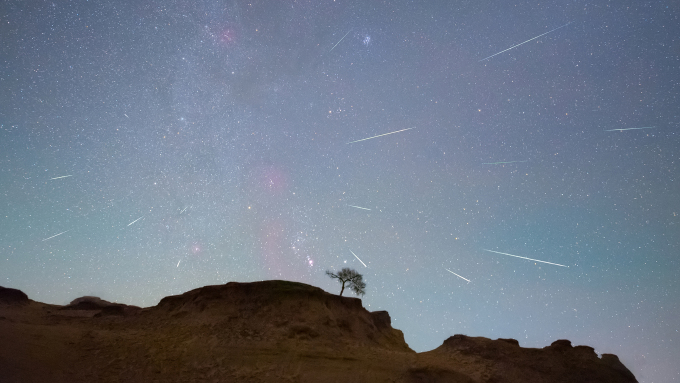
The Orionids meteor shower was seen from Daqing city, Heilongjiang province, China, on October 22, 2020. Photo: CNN
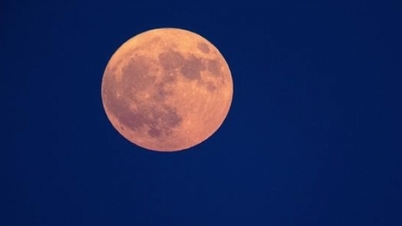
Mr. Son said that this year, observation will be relatively favorable if there are no weather fluctuations because the Moon will set early and the sky after midnight will not be blinded by moonlight. The first half-moon of the month may obscure some evening meteors, but it will not have too much of an impact.
In Vietnam, the ideal time to observe this phenomenon is after midnight on October 21st, or early morning of October 22nd, when the phenomenon reaches its peak and the Orion constellation (the central area of the phenomenon) has risen high enough. If the sky is clear enough (no clouds and minimal light pollution), this constellation is easily recognizable by the three stars aligned to form Orion's belt and the two very bright stars Betelgeuse and Rigel.
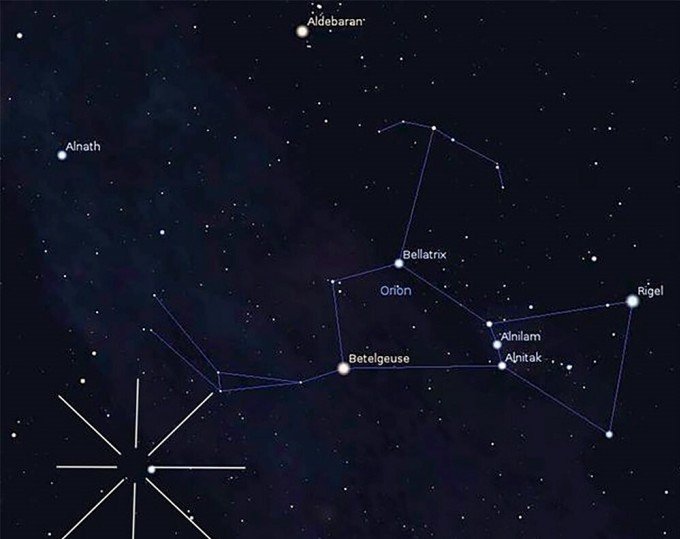
How to identify and observe the location of the Orion constellation in the sky. Photo: VACA
With meteor showers, observers don't need any special equipment. You just need a clear sky, a safe viewing location, and a little patience. After 20-30 minutes of gazing at the sky, your eyes will adjust to the darkness and it will be easier to spot the meteors.
The Orionids meteor shower is named after the constellation Orion, which is where most of the streaks of light are concentrated. In fact, they are a consequence of the famous Halley's Comet (1P/halley), named after the astronomer Edmund Halley.
Halley's Comet was last observed from Earth in 1986 and is expected to return in 2061. This short-period comet completes an orbit in 76 years, described as "occurring about once in a lifetime." The debris it leaves behind during its visits forms a stream of meteoroids that stretches through space. When our planet passes through this region of orbit, these debris fragments enter Earth's atmosphere and burn up due to atmospheric pressure, creating numerous visible meteors. This phenomenon was first recorded in the 19th century, when it was one of the largest annual meteor showers.
Nhu Quynh
Source link



![[Image] Close-up view of the interchange connecting the two expressways and Long Thanh Airport.](https://vphoto.vietnam.vn/thumb/1200x675/vietnam/resource/IMAGE/2026/05/25/1779703378210_ndo_br_z7863716673926-224453a31600126cce10622af6290afd-4549-jpg.webp)
![[Image] Hanoi's urban life under the challenge of a "scorching hot" environment](https://vphoto.vietnam.vn/thumb/1200x675/vietnam/resource/IMAGE/2026/05/25/1779706979265_nang-nong-t5-2026-minh-duy-7-4636-jpg.webp)




























































































Comment (0)