

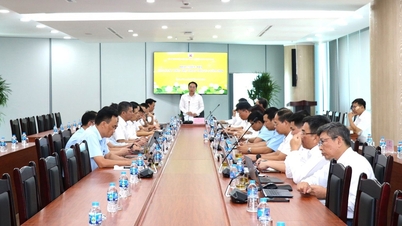
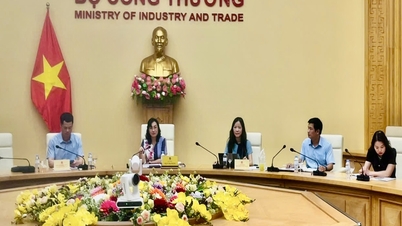
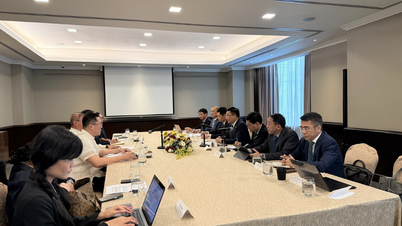
The event, co-organized by the University of Economics and Industrial Engineering ( Ministry of Industry and Trade ) and the National Economics University, was held in both in-person and online formats. The conference attracted over 900 delegates from ministries, departments, localities, research institutes, universities, managers, and businesses.
Nearly 100 scientists, researchers, and managers from various fields across 23 agencies and businesses nationwide participated in writing papers for the conference, creating a forum for scientists, managers, and businesses to identify the advantages, difficulties, and challenges of digital transformation in order to develop the digital economy .
Dr. Tran Hoang Long, Rector of the University of Economics and Industrial Engineering, stated: Digital transformation plays a crucial role in the formation and development of the digital economy and digital society, opening up many opportunities and spaces for innovation in all sectors of the economy and social life. Digital transformation is creating strong connections, forming an important foundation for the development of new business models, advanced services, and customer experiences.
In the age of technology, digital transformation is not just a trend but also a necessary strategy to optimize resources, enhance productivity, and create added value. Through the combination of technologies such as artificial intelligence (AI), big data, blockchain, and IoT (Internet of Things), countries, agencies, and businesses are proactively adapting and maximizing the opportunities offered by digital transformation to shape the future. Educational institutions play a crucial role in shaping the future workforce for the digital economy and digital society. Education serves both as a means of imparting knowledge and as a foundation for developing digital skills, creative thinking, and the ability to adapt to the rapid changes in technology.
At the conference, delegates and guests focused on key issues in the field of digital transformation – the latest trends in digital transformation, identifying the challenges and exploring the opportunities that arise.
Other issues discussed included: the foundational conditions for developing the digital economy; plans and strategies for effective digital transformation implementation; digital transformation: opportunities and challenges for organizations and businesses; developing human resources to meet the requirements of the digital economy; and other related issues.
At the official presentation session, the Organizing Committee selected five papers focusing on key issues of digital transformation, closely related to areas such as state management, education, and banking.
During the six months of preparation and organization, the Conference Organizing Committee received 90 papers from 87 authors from 23 organizations, agencies, research institutes, and universities nationwide. The Conference Secretariat compiled 46 valuable papers and published the Conference Proceedings.
The workshop dedicated time to discussion, with both in-person and online questions from attendees, focusing on practical aspects of digital transformation. These questions were addressed to the presiding panel and the four main speakers. Discussion topics centered on issues such as the digital university model; cybersecurity; trends and strategic models to be developed for digital transformation; digital workforce training; and retraining of university staff to adapt to the rapid changes of the current digital era.
Through the conference, many core aspects of digital transformation were clarified by scientists, and valuable scientific contributions were made, providing a basis for scientists, managers, and experts to continue researching, developing, and implementing digital policies, regulations, and solutions in practice, contributing to accelerating the socio-economic development of the country.
Source link





![[Photo] General Secretary and President To Lam presides over a meeting on preparations for the review of one year of operation of the three-tiered government system.](https://vphoto.vietnam.vn/thumb/1200x675/vietnam/resource/IMAGE/2026/06/02/1780391821195_a1-bnd-4595-9717-jpg.webp)







































































Comment (0)