

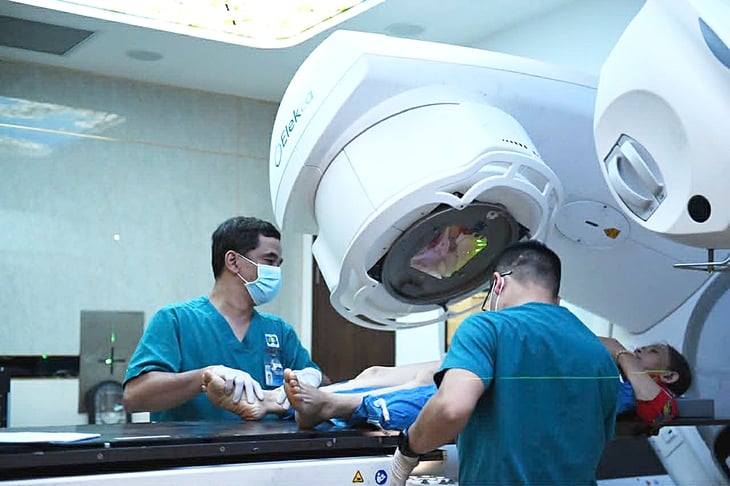
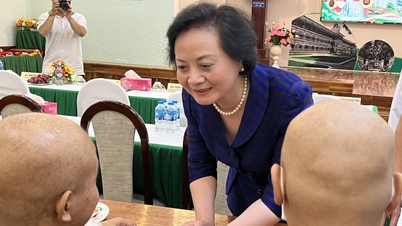
Radiation therapy technicians treating cancer patients at the Oncology Hospital, Branch 2 (Ho Chi Minh City) - Photo: TU TRUNG
Unlike many other diseases, cancer has its own "language" and there is no single "cure" for cancer, but there are treatments that can offer a chance of recovery for patients with certain types of cancer.
Understanding these differences can sometimes lead to significant changes in treatment.
Understanding cancer correctly
If "vegetables" is a general term encompassing many different types of vegetables and fruits such as carrots, celery, kale, etc., then cancer is similar. Cancer is a broad term for over 200 different diseases, ranging from colon, bladder, brain, eye, kidney, liver, lung, breast, and ovarian cancer to skin cancer.
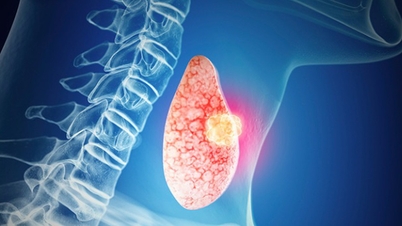
When cancer develops, abnormal cells appear, proliferate, invade, and destroy healthy tissues in the body. Some types progress slowly, while others spread rapidly. Each type starts in a different organ, with its own distinct levels, stages, and manifestations.
Because each type of cancer is a different story, there cannot be a single "cure" for all. In some cases, after treatment, the disease seems to disappear and the patient is considered cured. But the reality is not that simple.
"Cured," "recovered," and "recovered"
In medicine in general, "cured" is usually used to refer to a condition where the illness has completely disappeared and will never return. For example, if appendicitis is treated by removing the appendix, you can consider yourself cured.
But with cancer, the concept is more complex.
Doctors can use statistics from various patient groups to estimate the risk of recurrence. However, no one can guarantee that cancer will not return. This is for two reasons: Medicine does not yet fully understand all aspects of the disease. There may still be cancerous cells remaining somewhere in the body. And over time, these could develop into new tumors.
Therefore, instead of saying "cured," professionals often use the word "treated." If, after treatment, the cancer does not recur for the rest of the patient's life, the patient is considered "cured."
Another common term is "remission," meaning that the cancer symptoms have disappeared.
Treatment: a long journey, not a miracle.
Currently, there is no single "cure" for all types of cancer. However, many treatments can help patients recover or prolong their lives. Some people live healthy lives for many years after treatment and die from other causes. Others, despite treatment, do not survive but are given extra time—perhaps a few years, or even decades.
Common treatment methods currently available include: surgery, chemotherapy, radiation therapy, stem cell transplantation, immunotherapy, hormone therapy, targeted therapy, clinical trials, and palliative care.
Treatment plans are always individualized, based on the type of cancer, stage of the disease, overall health status, and the patient's wishes.
Cancer research has been ongoing for over 200 years. While there are no complete answers, medicine has made significant progress. In the last five years, treatment options have become much more diverse. Today, doctors can detect many types of cancer at a much earlier stage. If one method is ineffective, there are still other alternatives.
What about natural or alternative methods?
To date, no natural or alternative methods have been proven to cure cancer. However, some safe therapies such as acupuncture, massage, meditation, and yoga may help alleviate side effects such as fatigue, nausea, and pain.
These methods are called adjunctive therapies, meaning they are performed alongside primary treatment. And before trying any supplemental method, you should discuss it with your doctor to ensure safety.
Cancer is not a one-day story. It's a journey filled with challenges, choices, and hopes nurtured little by little. While there's no "miracle cure," medicine is moving forward, slowly but steadily. And in that journey, understanding and choosing correctly is always the most important thing.
Some warning signs to watch out for.
* A method is being advertised as being able to cure many different types of cancer.
* Relying solely on personal stories instead of scientific data.
* Phrases like "100% natural" and "miracle cure".
* Claimed to be more effective than chemotherapy.
Source: https://tuoitre.vn/co-phuong-method-of-curing-cancer-20260303230913711.htm


![[Image] Close-up view of the interchange connecting the two expressways and Long Thanh Airport.](https://vphoto.vietnam.vn/thumb/1200x675/vietnam/resource/IMAGE/2026/05/25/1779703378210_ndo_br_z7863716673926-224453a31600126cce10622af6290afd-4549-jpg.webp)
![[Image] Hanoi's urban life under the challenge of a "scorching hot" environment](https://vphoto.vietnam.vn/thumb/1200x675/vietnam/resource/IMAGE/2026/05/25/1779706979265_nang-nong-t5-2026-minh-duy-7-4636-jpg.webp)



































































Comment (0)