

In recent years, the trend of focusing on nutrition, especially protein content, has spread in the US and many other countries, making common products like coffee, potato chips, pasta, and protein bars more popular than ever.
To keep up with this trend, major food corporations have consistently incorporated whey—a complete, easily soluble, and rapidly absorbed protein—into their product lines, from Mars' Eggo waffles to Starbucks' creamy milk foam.
However, this rapid boom quickly led to an oversupply of whey protein, unable to keep up with market demand.
Whey is essentially a byproduct of cheese production, meaning that factories cannot independently produce it and must depend entirely on the raw milk that is processed into cheese.
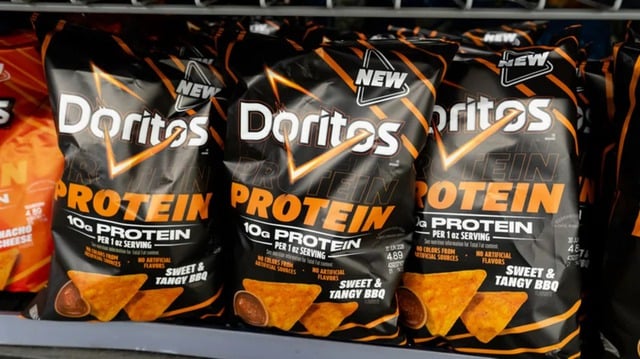
Doritos protein-rich products are now available in many places. Photo: PJ McDonnell/Shutterstock
As of June 2026, many major whey suppliers worldwide were experiencing year-long stock shortages, while the price of high-protein whey concentrates had increased by an average of over 40% in just the past few months.
Many businesses have even had to accept importing raw materials at prices 50% higher, yet they remain concerned about the continued supply shortage.
The negative consequences of this crisis are beginning to become apparent in many businesses around the world. For example, HelloAmino in Canada, after receiving notification that their supplier had run out of whey, was forced to switch to another source, resulting in their pancakes being dry and hard like sawdust.
In the UK, the Majic Protein brand also had to buy up all the remaining whey from its partners to barely stay afloat for another two months.
Even the American supplement brand Vitalura Labs had to decide to temporarily suspend sales of its whey isolate product line – an item that accounts for half of the company's sales – due to the price of this ingredient skyrocketing by more than 300% since 2023.
Faced with this dilemma, many businesses are considering switching to using protein extracts from milk or plant-based proteins from beans and peas. However, they themselves must admit that these options cannot perfectly replace the texture and distinctive flavor of whey.
Industry experts predict consumers will soon feel the impact as this wave of price increases reaches retail shelves.
Although the prices of products labeled "whey protein" on their packaging remain relatively stable compared to last year, an upward trend is evident and it typically takes 12 to 18 months to directly impact consumers' wallets.
In contrast to the sluggish sales of whey-based products, sales of dried meat snacks have seen strong growth thanks to the advantage of having an extremely stable supply.
From a nutritionist's perspective, the vast majority of people in modern cities today are not at all deficient in protein. In fact, the amount of protein they consume each day often far exceeds the minimum required amount.
Therefore, the trend of maximizing protein intake on social media platforms may benefit certain groups, but it is not an essential need for the vast majority of people.
As a result, once whey protein becomes too expensive and difficult to find, it is entirely inevitable that consumers will return to traditional, naturally protein-rich food sources such as meat, fish, eggs, milk, or nuts.
The protein supplement craze has once again exposed the limitations of the global supply chain, as consumer trends change too rapidly.
However, the question of whether food manufacturers can adapt in time, or whether consumers will ultimately pay a higher price for protein bars or "muscle-building" lattes, remains open.
Source: https://suckhoedoisong.vn/con-sot-protein-bat-dau-nguoi-lanh-169260602134312933.htm

![[Photo] General Secretary and President To Lam presides over a meeting on preparations for the review of one year of operation of the three-tiered government system.](https://vphoto.vietnam.vn/thumb/1200x675/vietnam/resource/IMAGE/2026/06/02/1780391821195_a1-bnd-4595-9717-jpg.webp)
































































































Comment (0)