


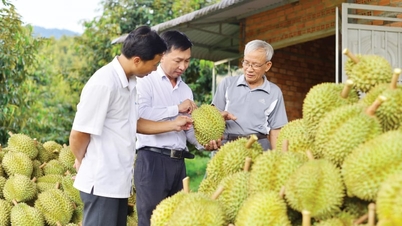
Mr. Chau Hong Khanh (second from the right) grows cantaloupe using high-tech methods. Photo: DANG LINH
In the high-tech shrimp farming area of Duong Hung Aquatic Seed Company Limited in Tan Thanh commune, interconnected nursery tanks are covered with green tarpaulins, and the oxygen system runs continuously day and night. Workers constantly check the salinity and water temperature using electronic equipment before transferring the shrimp to the next farming stage.
The two-stage shrimp nursery model applied by the company aims to help shrimp larvae adapt to the local water environment, minimize thermal shock, and reduce losses during erratic weather. Looking at the tiny shrimp swimming densely on the water surface, Ms. Phan Hong Nhien, representative of Duong Hung Aquatic Seed Company Limited, said that this process helps improve the survival rate of the larvae, especially in conditions where hot weather and unseasonal rains are becoming increasingly common.
However, behind this systematic approach lies immense cost pressure. From pond lining systems, aeration machines, water treatment, to environmental monitoring software, all require significant investment. “To implement high technology, you need to invest comprehensively, but the initial costs are too high. Many in-depth digital transformation solutions are still difficult for small businesses to access,” Ms. Nhien said. What worries businesses even more is the inconsistent quality of breeding stock on the market. According to Ms. Nhien, many farmers buy poor-quality breeding stock, leading to significant losses and affecting the entire farming area. “We hope that the relevant authorities will tighten the management of breeding stock quality, ensuring that the breeding stock meets standards to reduce risks for farmers,” Ms. Nhien suggested.
In Tra Pho hamlet, Giang Thanh border commune, Mr. Dao Thanh Tan's cold-storage duck farm stands out amidst the fields. Tens of thousands of Grimaud ducks move simultaneously under a misting system, automatic feeders, and continuously running cooling fans. Having been involved in the business for over 5 years, Mr. Tan chose a contract farming model in partnership with CP Vietnam Livestock Corporation. The company provides the ducklings, feed, technical expertise, and guarantees the purchase of the output. Each batch, he raises approximately 15,000 ducks, which reach a weight of over 3.2 kg/each after 42 days and are ready for sale. He rotates through 4-5 batches per year, earning hundreds of millions of dong in profit.
Mr. Tan said: “Since linking with businesses, the output has become more stable, and the livestock farming process is more systematic, but scaling up has created new challenges. The most difficult thing now is clean water for livestock farming. The water in this area is saline, so we have to treat it ourselves to convert it from saline to freshwater, which significantly increases costs.” According to Mr. Tan, without a stable water source, farmers find it difficult to confidently expand high-tech farming models on a large scale.
In My Quy hamlet, Vinh Thanh Trung commune, Mr. Tran Tan Thanh is pursuing a high-tech pangasius farming model that meets ASC standards. On an area of approximately 5 hectares, the ponds are equipped with environmental monitoring systems, recirculating water treatment, and automated feed control. Thanks to partnerships with businesses from input to output, his family earns billions of dong in profit each year.
Achieving that success was a challenging journey. Mr. Thanh said that the investment cost in technology was very high, while the issue of fish fry remained the biggest concern. “To get good quality fry, I have to go to Dong Thap to buy them, and the long transportation time results in significant losses, considerably increasing costs. I hope the province will soon build a high-tech catfish fry production center to ensure a reliable source of quality fry. If the supply of fry is unstable, catfish farmers in An Giang will face great difficulties,” Mr. Thanh said.
In An Giang province, the reality shows that high-tech agriculture is still developing in a fragmented manner, mainly relying on the self-reliance of pioneering businesses and farmers. Meanwhile, fundamental issues such as raw material sources, clean water, high-quality seed centers, and synchronized digital transformation have not yet been thoroughly addressed. Having just invested over 500 million VND in building a greenhouse for growing cantaloupe in Son Kien commune, Mr. Chau Hong Khanh stated: “What farmers need is a sufficiently strong ecosystem, appropriate loans, synchronized infrastructure, quality seeds, supportive businesses, and a stable market.”
Source: https://baoangiang.com.vn/cong-nghe-cao-nhung-dau-ra-con-kho-a485374.html

![[Image] Close-up view of the interchange connecting the two expressways and Long Thanh Airport.](https://vphoto.vietnam.vn/thumb/1200x675/vietnam/resource/IMAGE/2026/05/25/1779703378210_ndo_br_z7863716673926-224453a31600126cce10622af6290afd-4549-jpg.webp)
![[Image] Hanoi's urban life under the challenge of a "scorching hot" environment](https://vphoto.vietnam.vn/thumb/1200x675/vietnam/resource/IMAGE/2026/05/25/1779706979265_nang-nong-t5-2026-minh-duy-7-4636-jpg.webp)


























































Comment (0)