

 |
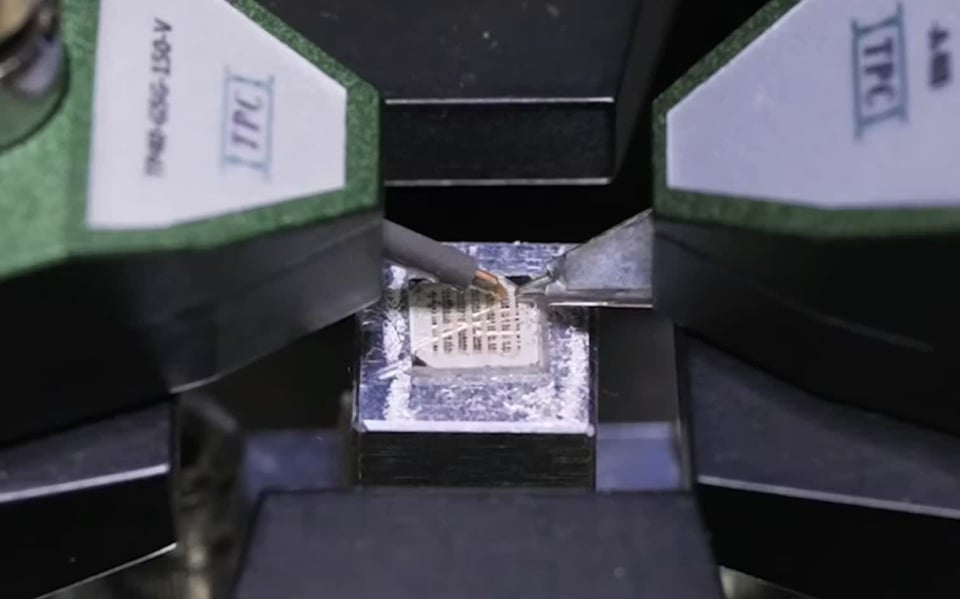
This new technology uses quantum mechanical properties to convert electrical signal information into tiny magnetic fields for recording. Photo: Tomoaki Nakatsuji/University of Tokyo . |
According to new research published in the scientific journal Science , the era of ultra-fast and ultra-battery-efficient computers is approaching. This advancement is thanks to a type of "non-volatile quantum switch" invented by scientists at the University of Tokyo (Japan).
The new component has the potential to boost the processing speed of the microchip by up to 1,000 times. Notably, the system generates absolutely no heat during operation.
According to the research team's explanation, with traditional silicon chips, current must flow continuously through the circuits to process data (bits 0 and 1). This creates significant friction and causes the device to overheat quickly.
This is a current technological limitation that prevents engineers from increasing chip speed further, as the machine would overheat and burn out the circuits. The new component has completely solved this problem. Instead of using electrical current, the device utilizes the magnetic properties (called spin) of electrons to store information.
 |
In the future, massive data centers like Google's will consume only 1% of the resources they do today. Photo: Alastair Wiper. |
This component consists of two main layers of material: tantalum and manganese. When an electric current flows through the tantalum layer, the system immediately stores information in the manganese layer in the form of tiny magnetic fields. These magnetic fields are the data that is stored without the need for continuous power supply. Thanks to this clever principle, the new invention saves up to 100 times more energy than current chip designs.
"Simply put, a massive Google data center currently consumes enough electricity to power 80,000 households; in the future, it will only need the electricity of 800 homes. Similarly, a MacBook Pro could operate for three months on a single charge," a representative of the research team told Nikkei.
In the lab, the new component achieved a record processing speed of just 40 picoseconds (less than one billionth of a second), 1,000 times faster than conventional silicon chips. The device is also incredibly durable, running stably after more than 100 billion tests. Remarkably, scientists discovered a crucial finding: the smaller the component becomes, the faster and smoother the machine runs.
If implemented in practice, this technology would completely change the face of the electronics industry. Large data files that currently take an hour to process would be resolved in just one second.
However, the road from the laboratory to mass commercial production is still very long. Representatives of the research team stated that manufacturing a single component is very different from maintaining consistent industrial production on a large scale.
The first prototype chips using this technology are expected to appear in 2030. Consumers will have to wait a few more years after this date to own commercial devices.
Source: https://znews.vn/cong-nghe-giup-laptop-chay-3-thang-khong-can-sac-post1653053.html




![[Image] Close-up view of the interchange connecting the two expressways and Long Thanh Airport.](https://vphoto.vietnam.vn/thumb/1200x675/vietnam/resource/IMAGE/2026/05/25/1779703378210_ndo_br_z7863716673926-224453a31600126cce10622af6290afd-4549-jpg.webp)






















































































Comment (0)