

SGGP
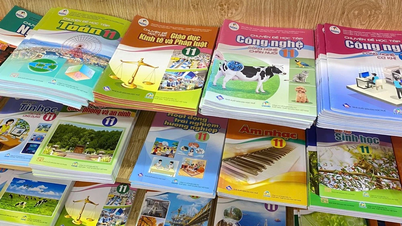
The South Korean Ministry of Education announced it will launch AI-based digital textbooks in elementary and middle schools starting in 2025, aiming to diversify students' learning programs.
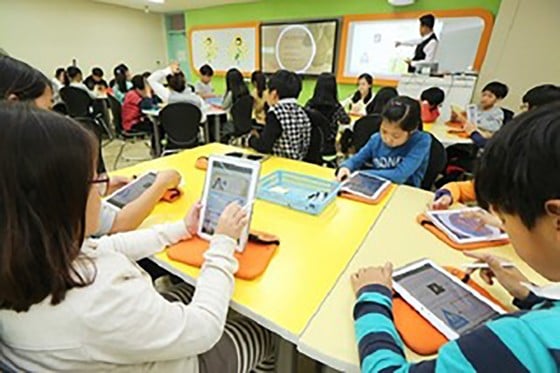 |
| Students use tablets in an elementary school classroom in Seoul, South Korea. |
This information comes as the South Korean Ministry of Education identifies AI-powered digital textbooks as part of the government 's educational innovation program through the metaverse and interactive AI technologies. The use of digital textbooks is also expected to facilitate customized learning for each student at different educational levels.
Accordingly, elementary school students in grades 3 and 4, and grade 10 students will be among the first to benefit from digitally customized textbooks for Math, English, and Computer Science starting in 2025.
Next, by 2026, digital textbooks will be provided to 5th and 6th graders in elementary schools and 8th graders in junior high schools. Four other subjects—Korean language, Social Studies, Science and Technology, and Home Economics —will also undergo digital transition. By 2027, 9th graders will receive digital textbooks. Digital textbooks will be implemented for all subjects from 2028, except for activity-based subjects such as Music, Art, Physical Education, and Ethics. 1st and 2nd graders in elementary schools will not yet be able to use digital textbooks as they are considered too young to be exposed to such electronic devices.
According to the South Korean Ministry of Education, AI-powered digital textbooks can suggest basic learning tasks, such as understanding fundamental concepts for "slow learners," and more in-depth learning tasks like discussions and essay writing suggestions for "fast learners." The agency also emphasized that digital and paper textbooks will be used in parallel until all students, parents, and teachers can proficiently use AI-powered digital textbooks and achieve the desired educational outcomes.
As part of the education reform plan, 300 schools across South Korea are expected to pilot an AI-based curriculum this year. This pilot program will be implemented nationwide, with 16 out of 17 local education departments registering to participate. These institutions will receive support from the Ministry of Education in terms of budget, consultancy, and teachers to implement the program starting in the second half of this year.
Pioneering digital schools will play a role in building innovative classroom models, freely applying AI-powered educational software developed by both the private and public sectors. Previously, the Korean Ministry of Education planned to select seven pilot education departments in 2023, then expand to all 17 provincial and municipal education departments nationwide in 2024. However, since most local education departments registered for the pilot program, the ministry decided to support these departments in implementing the program starting this year.
Source
























































































Comment (0)