Multi-value products derived from salt to improve the lives of salt farmers.
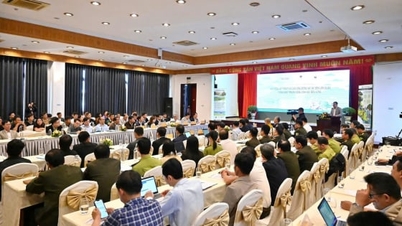
On the afternoon of March 7th, the Ministry of Agriculture and Environment, in coordination with the People's Committee of Bac Lieu province, held a conference to review the implementation of Decree No. 40/2017/ND-CP on the management of salt production and business.
According to Deputy Minister of Agriculture and Environment Vo Van Hung, the early and increasingly severe effects of climate change and extreme weather have strongly impacted salt production, due to the low mechanization rate in the fields and the lack of storage facilities. Salt production is a labor-intensive industry with low income, thus creating competition for labor between the salt industry and other sectors.
According to Deputy Minister Vo Van Hung, due to low income from salt production, some salt farmers have abandoned their fields and are seeking other jobs with higher incomes. Furthermore, the average income of salt farmers is currently only about 40 million VND per year, which is only 70% of the national average income.
The Ministry of Agriculture and Environment will focus on increasing the quantity and quality of salt, diversifying products, and boosting domestic salt production, processing, and consumption. Photo: Trong Linh.
Deputy Minister of Agriculture and Environment Vo Van Hung highly appreciated Bac Lieu province's efforts in preserving and promoting the value of salt over the past time. He also affirmed that in the coming time, the Ministry of Agriculture and Environment will focus on improving production volume and quality, diversifying products, and boosting domestic salt production, processing, and consumption.
Invest in the development of salt production in areas with favorable natural conditions, focusing on large-scale production. Establish industrial salt production zones with modern technology, linking production with processing, recovery of by-products from salt production, and other economic sectors such as rural tourism and healthcare and beauty services.
Developing the salt industry involves synchronously encompassing production, processing, preservation, and consumption. This includes linking the restructuring of salt production with technological innovation. Investing in upgrading salt field infrastructure will improve productivity, quality, and efficiency per unit area. The goal is to ensure livelihoods, increase income for salt farmers, and ultimately help them prosper through salt production.
More policy mechanisms are needed to support investment in the development of the salt industry.
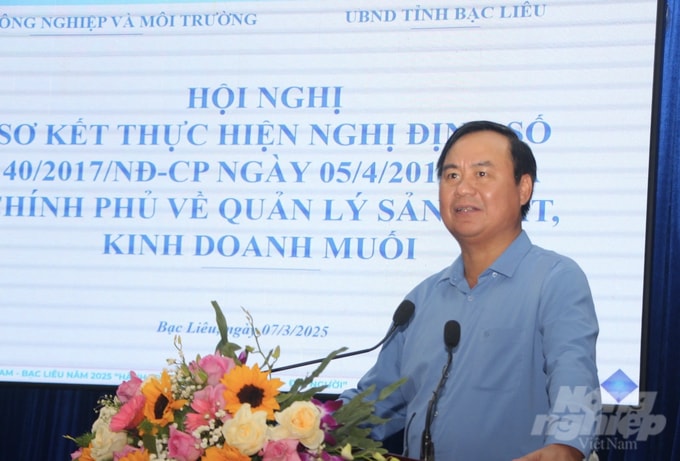
Chairman of the Bac Lieu Provincial People's Committee, Pham Van Thieu, noted that the salt-making industry has been and is facing many challenges. Climate change affects salt productivity and quality, and market competition factors make salt prices very volatile and frequently low. Income from salt production is lower than other professions, affecting efforts to preserve and conserve Bac Lieu's traditional salt-making industry.
Therefore, it requires attention and investment from all levels and sectors to support the salt industry towards product diversification, not only for consumption but also for beauty products, medicinal products, and salt for industrial production.
According to a report by the Ministry of Agriculture and Environment, following the Government's issuance of Decree No. 40/2017/ND-CP on the management of salt production and trading, the Ministry has proactively coordinated with other ministries, sectors, and localities to implement various solutions to effectively perform its state management functions regarding salt production, processing, and trading. Simultaneously, it has developed and promulgated mechanisms, policies, regulations on expenditure levels, and allocated annual funding from local budgets to support investment in salt production development.
Chairman of the People's Committee of Bac Lieu province, Pham Van Thieu, speaks at the conference. Photo: Trong Linh.
The average salt production during the period 2017-2024 reached nearly 1 million tons per year. The average number of salt production workers during the period 2017-2020 was 41,247, decreasing to approximately 19,000 by 2024.
Regarding production methods, the country currently has 19 provinces and cities, including 40 districts and 116 communes, engaged in salt production. Of these, 5 provinces are in the North, 7 in the Central region, and 7 in the South.
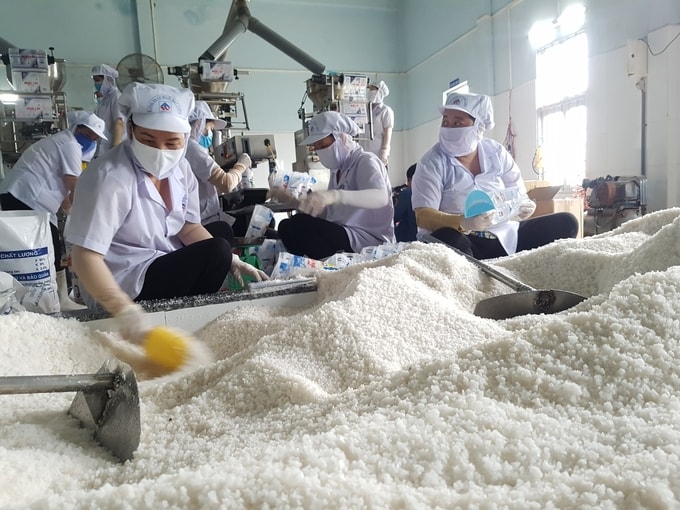
Currently, there are 73 salt processing facilities nationwide, belonging to all economic sectors, involved in the production of refined salt, iodized salt, and clean salt for export. Of these, 13 salt processing facilities have invested in applying scientific and technological advancements, with a capacity of 15,000 - 22,000 tons/year, and one facility has invested in two complete production lines imported from Spain with a capacity of 200,000 tons/year.
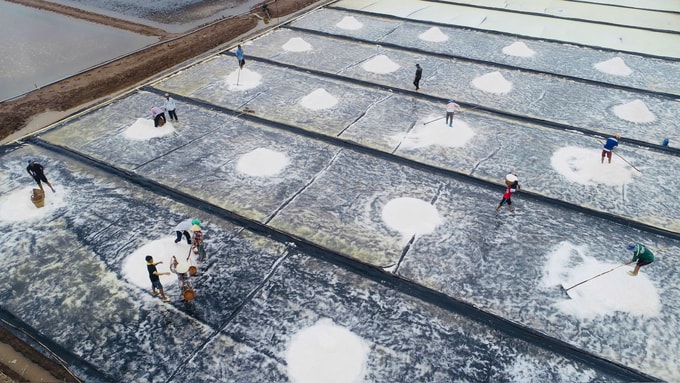
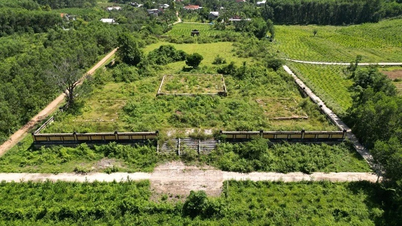
Salt fields in Dong Hai district, Bac Lieu province. Photo: Trong Linh.
Among these, the most diverse salt products are those used in food and beverages. Salt products from some localities have been exported to Europe, the US, Japan, South Korea, etc., and have established distribution channels in major supermarkets such as BigC, Copmak, Vinmart, and the Bach Hoa Xanh retail system.
In Bac Lieu province alone, with a production area of nearly 1,400 hectares, the output is nearly 80,000 tons per year. Among the province's 160 OCOP products, many are directly related to salt.





![[Photo] General Secretary and President To Lam presides over a meeting on preparations for the review of one year of operation of the three-tiered government system.](https://vphoto.vietnam.vn/thumb/1200x675/vietnam/resource/IMAGE/2026/06/02/1780391821195_a1-bnd-4595-9717-jpg.webp)







































































Comment (0)