

By the end of 1974, the war situation had shifted in Vietnam's favor, allowing for the offensive and uprising that lasted for two years, 1975-1976. In March 1975, the Liberation Army achieved successive major victories on the battlefields of the Central Highlands and Central Vietnam.
Following the directives of the Politburo , the Central Military Commission, and the General Staff, the Tri Thien Military Region, the 2nd Corps, and the 5th Military Region launched the Da Nang campaign (from March 26 to March 29, 1975), attacking and destroying all enemy forces in Quang Da, preventing them from consolidating their forces and establishing a new strategic position.
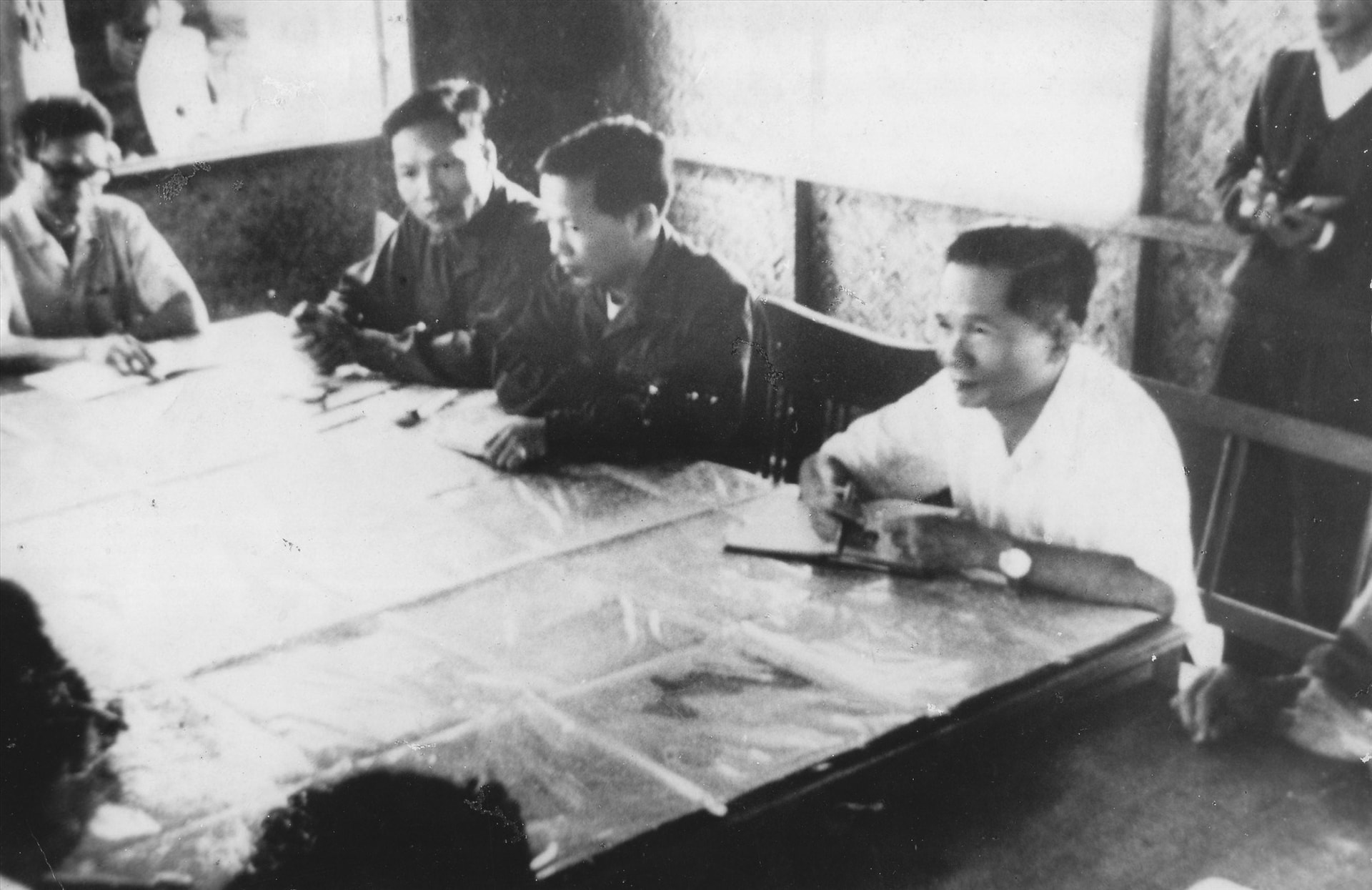
Following the directives of Military Region 5, Quang Da established a forward command post comprising comrades: Phan Hoan - Commander, Tran Than - Secretary of the Special Zone Party Committee as Political Commissar, and Le Cong Thanh as Deputy Political Commissar; to unify the command of local armed forces and coordinate with the main forces of the Quang Da - Da Nang liberation army.
On March 26, 1975, the 2nd Division, along with the 572nd Artillery Regiment, the 573rd Anti-Aircraft Regiment, and the 574th Armored Regiment, moved their formations to Thang Binh and Que Son, ready to advance towards Da Nang.
At exactly 5:30 a.m. on March 28, 1975, the artillery campaign began to control Da Nang, the headquarters of the puppet 1st Army Corps, and the Son Tra peninsula.
Artillery from the 2nd Division and provincial firepower heavily bombarded Hon Bang, Tra Kieu, Nam Phuoc, and Cau Lau. By 9:00 AM that same day, the 38th Regiment had routed the enemy forces positioned north of the Ba Ren bridge; the 96th Regiment of the province captured the Duy Xuyen district capital and the town of Nam Phuoc. By 12:00 PM on March 28, 1975, Duy Xuyen district was completely free of enemy forces.
To block our pursuit, on the afternoon of March 28, 1975, the enemy bombed and destroyed the Ba Ren and Cau Lau bridges. With the bridges destroyed, our tanks and artillery were blocked south of the Cau Lau bridge. However, thanks to good preparations made beforehand, hundreds of boats of various sizes belonging to the people on both banks of the river came out to welcome our troops across.
At Dai Loc, the Marine Brigade and the 3rd Division of the puppet army, along with local troops, continued to confront the 304th Division, but the mentality of defeat was rapidly developing within the enemy ranks in the face of our relentless attacks.

In Dien Ban, on March 28, 1975, enemy troops at the Trum Giao intersection, both ends of the Cam Ly bridge, Truong Giang outpost, and Bo Bo stronghold fled. Armed forces and revolutionary bases in various locations managed to persuade 2,000 to surrender.
On the night of March 28, 1975, Regiment 38 crossed the Thu Bon River to capture Vinh Dien town. Regiment 97, from the Dien Ban area, crossed Highway 1 to Dien Ngoc - Hoa Hai (Hoa Vang).
The Quang Da forward command post moved from Hon Tau mountain to Dien Hoa to command and direct the attack and uprising to liberate Da Nang.
On the night of March 28, 1975, the Quang Da Provincial Party Committee received an urgent report: Ngo Quang Truong had abandoned his post and fled. Da Nang was in chaos; the puppet regime was powerless to maintain order or control the situation.
On March 29, 1975, the 96th and 97th Regiments of Quang Da province, in coordination with the 2nd, 304th, and 325th Divisions, launched a simultaneous attack on Da Nang from various directions, the last stronghold of the 1st Corps - Military Region 1 of the puppet regime.
At exactly 11:30 AM, we took control, planting the flag of the National Liberation Front of South Vietnam on the roof of the city hall. By 12 noon, our troops had captured Da Nang airport - the headquarters of the puppet 1st Army Corps - and three hours later, we took control of the Son Tra peninsula.
Da Nang was completely liberated.
Source: https://baodanang.vn/da-nang-trong-hao-khi-thang-ba-3329850.html
![[Photo] The courage of new recruits of Brigade 144 on the training ground.](https://vphoto.vietnam.vn/thumb/1200x675/vietnam/resource/IMAGE/2026/05/27/1779881651341_anh-man-hinh-2026-05-27-luc-18-32-52.png)

![[Photo] General Secretary and President To Lam and his wife begin their official visit to Thailand.](https://vphoto.vietnam.vn/thumb/1200x675/vietnam/resource/IMAGE/2026/05/27/1779881249412_anh-man-hinh-2026-05-27-luc-18-10-51.png)















![[Video] Weather forecast for tonight and tomorrow, May 28, 2026: Northern Vietnam to see a drop in temperature, Central Vietnam to continue experiencing intense heat.](https://vphoto.vietnam.vn/thumb/402x226/vietnam/resource/IMAGE/2026/05/27/1779887047052_thumb-toi-2705-png.webp)











































![[Photo] The courage of new recruits of Brigade 144 on the training ground.](https://vphoto.vietnam.vn/thumb/402x226/vietnam/resource/IMAGE/2026/05/27/1779881651341_anh-man-hinh-2026-05-27-luc-18-32-52.png)































Comment (0)