

Ho Chi Minh City – Ms. Binh, 34 years old, experienced facial burning and itching, followed by the appearance of red bruises on both cheeks after receiving a turmeric face mask at a spa.
Ms. Binh said she has a history of allergic reactions, including cracked skin and facial redness, when applying fresh turmeric to her face to reduce inflammation and dark spots from acne. As a child, doctors diagnosed her skin as allergic to turmeric, but she could eat and drink turmeric.
This time, the spa staff applied a turmeric face mask to her without prior notice. When her face felt hot, itchy, and tingly, she asked the staff and only then discovered what had happened. After washing her face, the symptoms subsided. Two to three days later, the itching stopped, but there were many red bruises on both cheeks and chin.
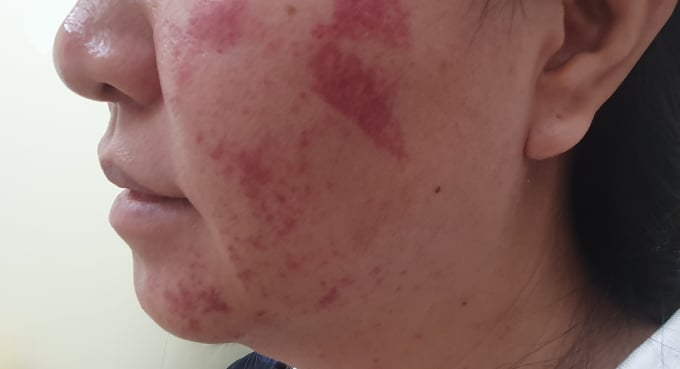
The red bruises on Ms. Binh's cheek are due to subcutaneous bleeding. Photo: Anh Thu.
On January 8th, Dr. Dang Thi Ngoc Bich, a dermatologist and cosmetic skin specialist at Tam Anh General Hospital in Ho Chi Minh City, diagnosed the patient with allergic contact dermatitis caused by turmeric components in a facial mask, resulting in subcutaneous bleeding.
Cosmetic allergies occur when the body's immune system overreacts to allergens in cosmetic products. This reaction releases various chemical mediators such as histamine and serotonin, causing allergic symptoms ranging from mild to severe.
According to Dr. Bich, turmeric is rich in curcumin – a powerful antioxidant with anti-inflammatory and antibacterial properties. Turmeric also helps brighten and even out skin tone, increase moisture, reduce dark spots and acne scars, and tighten pores. Turmeric is generally harmless and has long been a popular spice in cuisine , traditional medicine, and is extracted for use in some cosmetics. However, people with sensitive skin like Ms. Binh may experience allergic reactions to turmeric. This is similar to some people being allergic to common foods like eggs or peanuts.
The doctor prescribed a topical medication for Ms. Binh containing anti-allergic and anti-bruising ingredients. After 5 days of applying a thin layer of the medication and washing it off after 15 minutes, her skin allergy subsided.
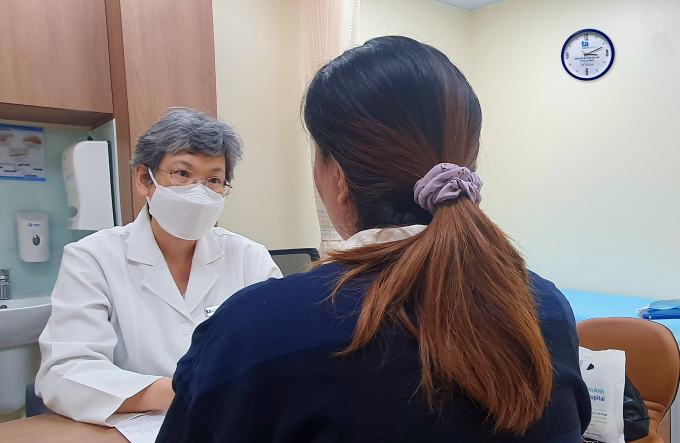
Doctor Bich examines Ms. Binh. Photo: Anh Thu
The most common sign of an allergic reaction is a localized tingling or burning sensation, occurring within minutes to hours after applying cosmetics. The skin may become red and swollen in thinner areas such as the eyelids, cheeks, and lips, or spread across the entire face. Patches of redness may appear in the areas where cosmetics were applied, accompanied by blisters and itching.
Severe allergic reactions may manifest as blisters or vesicles. After a few days, the reddened skin may darken, develop brown spots, hyperpigmentation; acne may appear; the skin may become dry and flaky... If the allergy persists for a long time, it can develop into contact eczema (contact dermatitis) with well-defined erythematous patches accompanied by blisters, sores, and itching.
Allergic reactions can appear immediately after direct contact of the skin with an allergen such as face masks, lotions, soaps, shampoos, perfumes, makeup, lipsticks, etc. Depending on each person's constitution and level of sensitivity, allergic symptoms may manifest later with varying degrees of severity.
Most cases of allergic contact dermatitis resolve on their own within a few days or weeks once contact with the allergen is stopped. However, Dr. Bich noted that in rare cases, more severe symptoms can occur, such as difficulty breathing or anaphylactic shock.
To reduce the risk of allergic reactions to new cosmetics, Dr. Bich recommends that users test for a reaction on a small area of skin before using them for the first time. When receiving skin care at spas or medical facilities, users should inform staff from the outset about any substances they are allergic to and ask detailed questions about the products used in the treatment.
When unusual skin reactions occur, patients should quickly clean off any remaining cosmetics. In mild cases of allergy, simply washing the skin and discontinuing the use of the suspected allergen will gradually reduce and eliminate symptoms. In cases of severe skin irritation causing itching, burning, and swelling, temporary relief can be achieved by applying a cold compress, and a dermatologist should be consulted for appropriate treatment.
Patients should not self-treat with allergy medication at home. Self-medication is one of the causes of worsening allergies and increases the risk of irreversible skin damage.
Patients should also avoid rubbing or scratching the irritated skin area and refrain from sun exposure, as the skin is in a vulnerable state.
Anh Thu
Source link

![[Photo] Solemn bathing ceremony and Buddha procession in Hue](https://vphoto.vietnam.vn/thumb/1200x675/vietnam/resource/IMAGE/2026/05/31/1780228263543_1-jpg.webp)
![[Photo] Admire the coral "masterpiece" amidst the million-year-old heritage of Dak Lak province.](https://vphoto.vietnam.vn/thumb/1200x675/vietnam/resource/IMAGE/2026/05/31/1780221235105_anh-man-hinh-2026-05-31-luc-16-53-27.png)

![[Photo] The General Secretary, President and his wife begin their state visit to the Philippines.](https://vphoto.vietnam.vn/thumb/1200x675/vietnam/resource/IMAGE/2026/05/31/1780230559452_anh-man-hinh-2026-05-31-luc-19-28-11.png)
![[Image] Hanoi Police officially crowned champions of V-League 2025/2026](https://vphoto.vietnam.vn/thumb/1200x675/vietnam/resource/IMAGE/2026/05/31/1780244769054_ndo_br_039d561b692be875b13a-jpg.webp)





















![[Video] Sunset at Lap An Lagoon – Where the sun sets over the fishing nets](https://vphoto.vietnam.vn/thumb/340x192/vietnam/resource/IMAGE/2026/05/31/1780192137701_beach-landscape-sea-water-nature-grass-745871-pxhere-com.jpeg)








































![[Photo] Admire the coral "masterpiece" amidst the million-year-old heritage of Dak Lak province.](https://vphoto.vietnam.vn/thumb/402x226/vietnam/resource/IMAGE/2026/05/31/1780221235105_anh-man-hinh-2026-05-31-luc-16-53-27.png)







































Comment (0)