

On weekday evenings at Ky Ninh Secondary School, as the sound of the waves in the distance gradually subsides, dozens of Zalo groups for parents, teachers, and students light up.
No longer simply places to announce meeting schedules or remind students of grades, these study groups have become "second classrooms"—where parents sit next to their children, closely monitoring their handwriting, while students gradually develop a sense of self-learning.
A simple yet effective model of community mobilization is creating positive changes in the school environment of this coastal region.
When parents no longer leave everything to the school.
The idea of "Parents studying with their children" originated from the concerns of teacher Vo Nguyen Ha – the school's Vice Principal. Initially, the model was piloted in grade 6 with the aim of forming good study habits for students at the beginning of the school year.
"Through observation, we've noticed that many parents love their children very much but lack the means to support them. Some children's academic performance suffers because their parents come home late from work, leaving them to rely on phones or social media. Therefore, I believe we need to create a bridge to connect parents with their children's learning process," shared teacher Vo Nguyen Ha.
Surprisingly, after only a short period of implementation, the rate of students submitting assignments in full increased significantly, and the learning atmosphere in the classrooms became more vibrant. Many parents who previously didn't know how to monitor their children's studies have now started proactively communicating with teachers every evening.
In implementing Directive No. 45-CT/TU of the Standing Committee of the Ha Tinh Provincial Party Committee on reforming and improving the effectiveness of the "Skilled Mass Mobilization" emulation movement and the Resolution of the Hai Ninh Ward Party Congress for the 2025-2030 term, recognizing the practical effectiveness of the model, the school decided to expand it to all 9th grade students – a group of students who are entering the stressful period of preparing for the entrance exams to the next level.
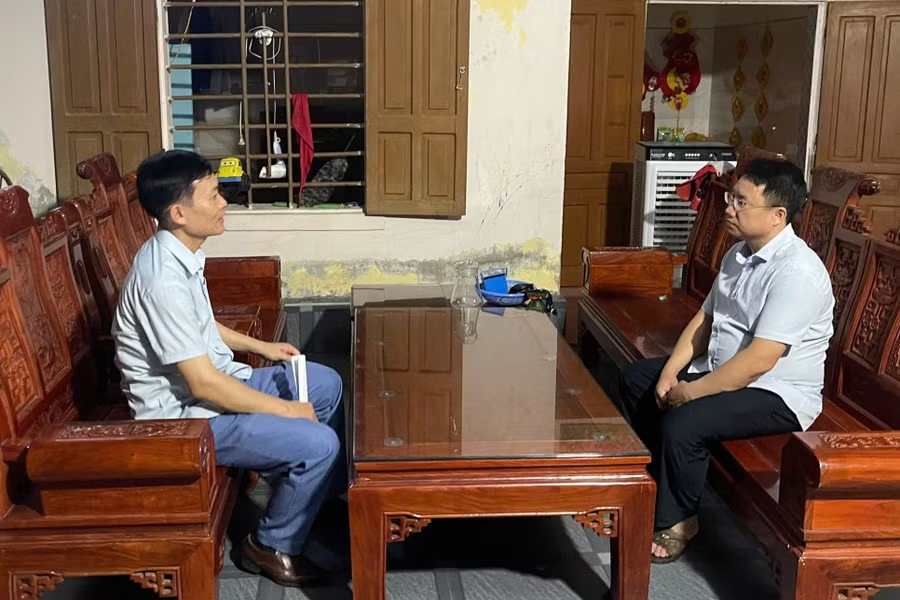
According to the implementation plan, each class will form online study groups for each subject, such as "Math 9A - Parents Learn with Their Children," "Literature 9A - Parents Learn with Their Children," etc., with the participation of the school's management board, homeroom teachers, subject teachers, and parents. Teachers will assign homework between 7:00 PM and 7:30 PM, and parents will monitor their children's work, taking photos and sending them to the group before 10:00 PM.
It sounds simple, but in coastal areas where many parents still make a living by fishing, small-scale trading, or working as laborers, maintaining that routine every evening is quite an effort.
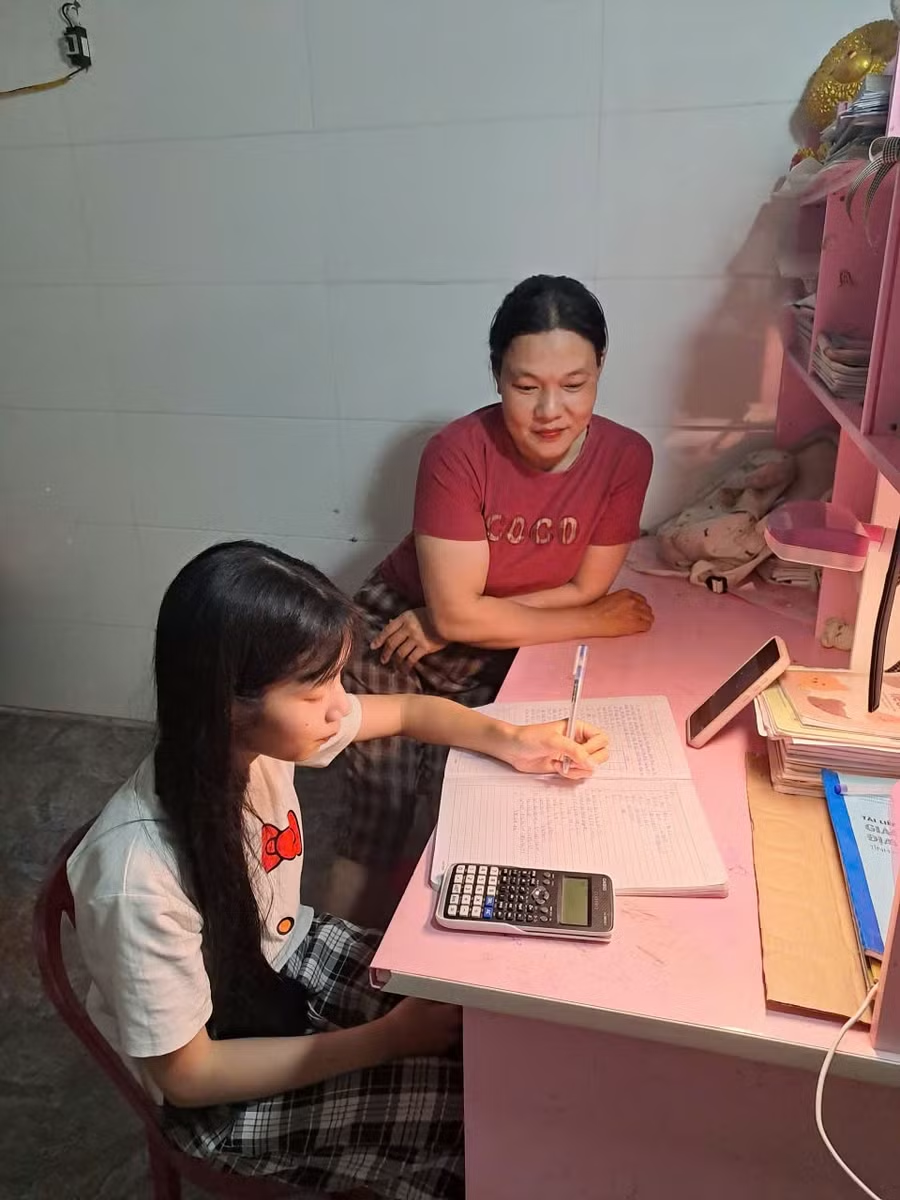
Late at night, in a small house in Hai Ninh ward, Ms. Ha Thi My still sits next to her son, Le Ha Minh Quan, a 9th-grade student. On the study desk, the phone is neatly placed, ready to take pictures of assignments to send to the class group.
Ms. My shared: "Before, when I came home from work, I thought I would leave everything about my child's studies to the teachers. But since participating in this model, I've come to understand how my child studies and where their weaknesses lie. Sometimes, when my child is lazy, they become more self-motivated when they see me sitting next to them."
Minh Quân said: “At first, I felt a little pressured because I had to submit my assignments on time every night. But then I got used to it. My mother reminded me, so I didn't dare procrastinate anymore.”
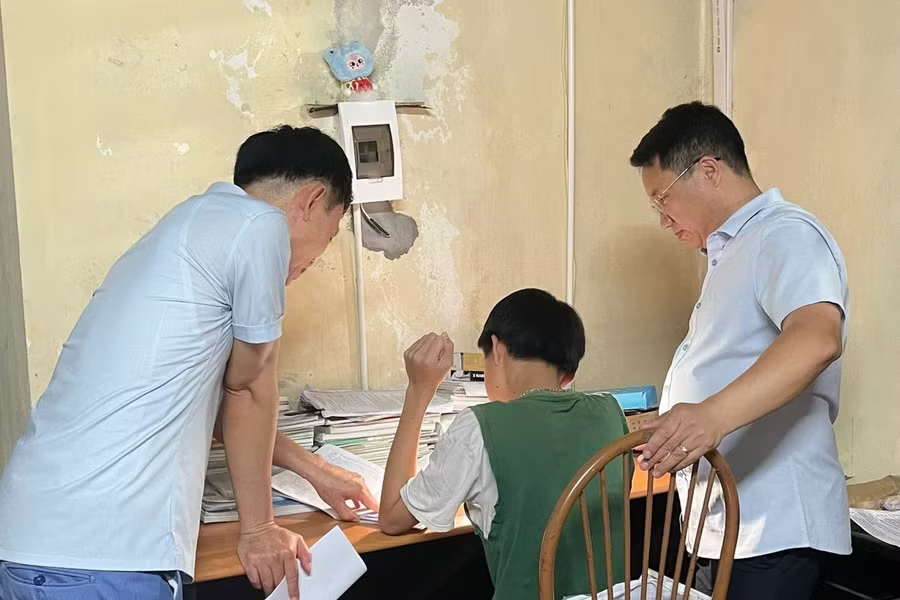
Minh Quân is not alone; many students at Kỳ Ninh Secondary School are gradually changing their study habits thanks to the support of their families. Evenings previously spent on phones or online games are now being replaced with more serious self-study time.
According to Ms. Tran Thi Hai Hoa, the homeroom teacher of class 9A, the most valuable thing is not about assigning homework or taking pictures of assignments, but about the change in awareness from the parents.
"There are parents who previously barely communicated with teachers throughout the semester. Now, they ask about their children's studies every night. Many students with average academic performance have shown clear improvement because their parents have started paying attention in the right way," Ms. Hoa said.
Effective mass mobilization starts with everyday things.
In its implementation plan, Ky Ninh Secondary School clearly defines its goal as not creating academic pressure but rather building a "learning family," strengthening cooperation between the school and parents, and enhancing students' self-learning awareness.
Notably, the model leverages familiar technology platforms like Zalo for implementation. No complex software or modern classrooms are needed; simply through online chat groups, the connection between families and schools becomes much closer.
According to Principal Tran Minh Dao, the model's greatest success lies in consensus.
"Effective community engagement in schools isn't something overly complicated. The important thing is to make parents understand that they are also a part of the educational process. When parents are involved and teachers share the responsibility, students will change," Mr. Dao said.
According to the teacher, the school doesn't require parents to teach their children specialized knowledge, but rather to dedicate time to caring for, reminding, and creating a positive learning environment.
To ensure the model doesn't become merely a formality, the school administration regularly monitors the activities of each class group, checks the percentage of students submitting assignments, and provides timely support to classes facing difficulties. For parents who are not tech-savvy, teachers provide thorough step-by-step guidance; families with special circumstances also receive individual attention.
In this age of technological dominance, bringing parents closer to their children through evening study sessions may seem like a small thing, but it carries immense significance.
Some parents jokingly say, "When our child enters 9th grade, we parents also... have to relearn 9th grade." But behind that humorous remark lies a positive shift in the family's responsibility towards education.
Commenting on the "Parents Learn Together with Their Children" model at Ky Ninh Secondary School, Mr. Tran Ba Toan - Chairman of the Hai Ninh Ward People's Committee - said that this is not an entirely new approach, but it has yielded clear results because it stems from the dedication, responsibility, and concern of the school's staff in improving the quality of education and strengthening the family's involvement with students.
“The model has a simple and practical approach, thus gaining high consensus from parents and society. Through its implementation in the past school year, the school's educational quality has improved significantly, with a noticeable increase in the percentage of students achieving good and excellent grades. Specifically for the 2025-2026 school year, Ky Ninh Secondary School had 3 students winning provincial-level awards, an increase of 2 compared to the previous school year; there were 5 outstanding students and 77 excellent students at the school level,” Mr. Toan said.
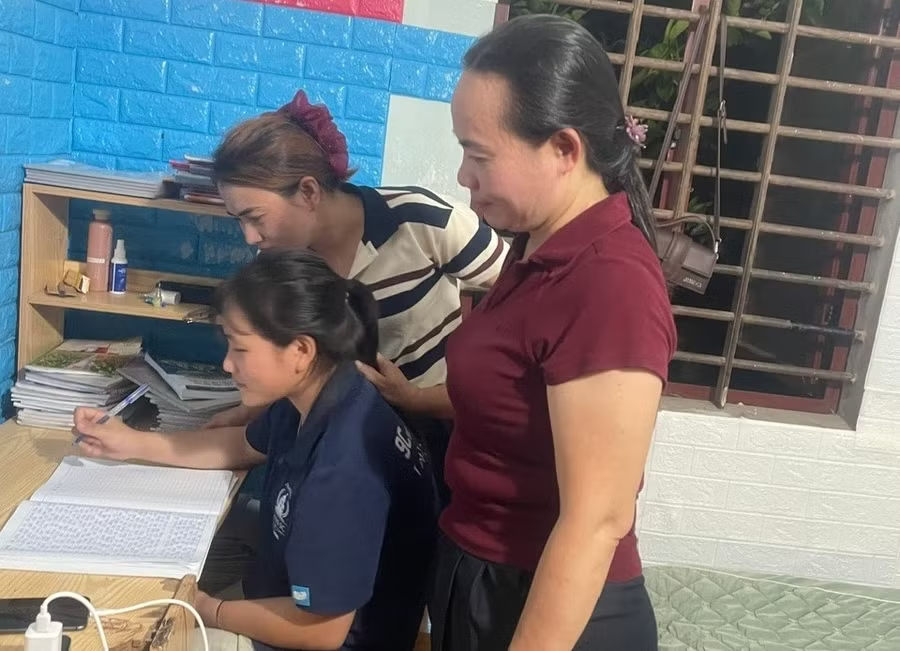
In coastal areas where many parents are busy earning a living year-round, sitting down with their children to study every evening is sometimes more difficult than solving math problems or writing essays. But it is from these simple things that the "Parents Studying with Their Children" model is rekindling study habits, strengthening family bonds, and instilling faith in education.
Without flashy achievements or elaborate slogans, the skillful approach to community mobilization at Ky Ninh Secondary School began with the study lights burning each evening in every coastal home.
And perhaps that is the most beautiful aspect of education: when schools and families work together to support their students.
Mr. Tran Ba Toan, Chairman of the Hai Ninh Ward People's Committee, said that the locality is continuing to research and promote the expansion of the model throughout the area; initially, it has created a ripple effect at Ky Hai Primary and Secondary School, Ky Ha Secondary School, and some other schools.
Source: https://giaoducthoidai.vn/dan-van-kheo-tu-viec-bo-me-hoc-cung-con-moi-toi-post779058.html
![[Image] Hanoi's urban life under the challenge of a "scorching hot" environment](https://vphoto.vietnam.vn/thumb/1200x675/vietnam/resource/IMAGE/2026/05/25/1779706979265_nang-nong-t5-2026-minh-duy-7-4636-jpg.webp)


![[Image] Close-up view of the interchange connecting the two expressways and Long Thanh Airport.](https://vphoto.vietnam.vn/thumb/1200x675/vietnam/resource/IMAGE/2026/05/25/1779703378210_ndo_br_z7863716673926-224453a31600126cce10622af6290afd-4549-jpg.webp)



























































































Comment (0)