

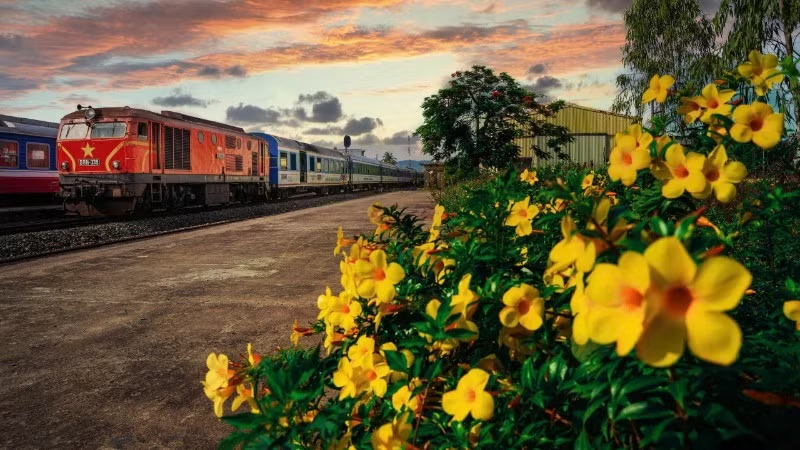
In contemporary literary life, it is not uncommon for people to bring their professional experiences into poetry. However, the case of poet Dang Hieu Dan is a unique example of someone with a poetic soul using their experience to reflect on life, including their profession.
Many generations of students and colleagues still affectionately call him by the familiar name: Teacher Dan. This simple way of addressing him perfectly suits the appearance and personality of a gentle, calm teacher who always creates a relaxed atmosphere in communication.
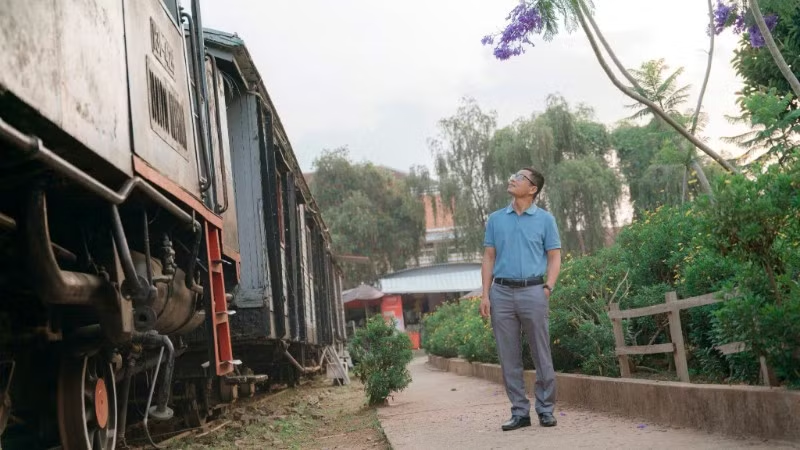
He often appears with a gentle smile, a calm voice, and the simple demeanor of someone who has been dedicated to teaching for many years. Perhaps it is this quiet quality that makes his poetry tend towards soft emotions, moments of quiet reflection, and simple beauty. Many say that seeing Mr. Dan at the train station always gives the feeling that he carries with him a private world full of tranquility and enduring depth, like the rhythmic movement of trains over the years.

As a lecturer and Master of Mechanical Engineering, currently working and managing at the Da Nang Railway College branch, he lives amidst locomotives, tracks, signals, and journeys that stretch across the country... Even so, the scope of his poetry is not confined to his profession. From the trains, his poetry opens up to his homeland, memories, love, history, the many lives of people, and the cultural beauty of Vietnam. His profession here doesn't limit his emotions but becomes a lens through which the poet can look deeper into life and people.
In Dang Hieu Dan's poetry, poems about trains have transcended the subject matter, becoming an "aesthetic of railway tracks," where the trains appear both as symbols of movement and as embodiments of memory, history, and the cultural journey of the nation. This also accumulates values that allow his poetry to go beyond mere descriptive landscapes, becoming works rich in humanistic and philosophical depth.
The image of the ship has appeared in many works throughout history, symbolizing the aspiration for exploration , adventure, construction... and also the feelings of separation and reunion. In Dang Hieu Dan's poetry, the ship often carries a familiar yet deeply cultural nuance because he writes from the life experiences of someone who loves and lives within their profession.
Right from the opening lines of "The Train to My Homeland," the poetic space is constructed with the rhythm of the trans-Vietnam train: "The train whistles peacefully on a calm morning / The wheels roll smoothly along the country" simultaneously evokes sound, rhythm, and space. Unlike many writers who often exploit the train as a symbol of speed, Dang Hieu Dan chooses a slow pace.
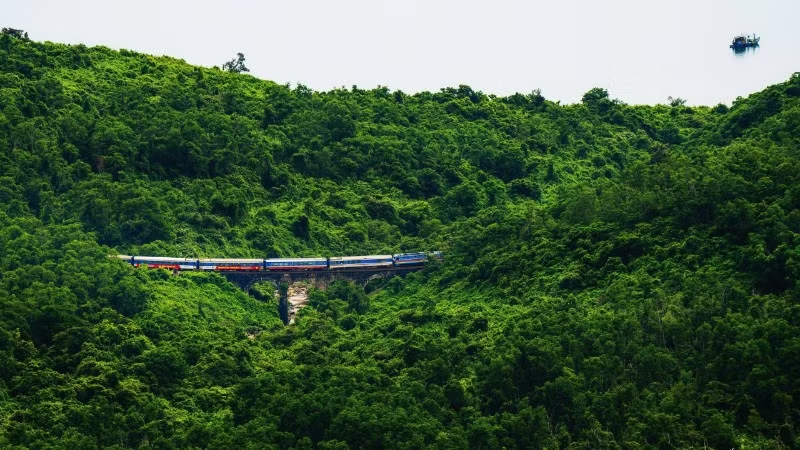
This very slowness opens up the possibility of contemplation. Through the train window, the country appears as a continuous cultural tapestry: "Hue shrouded in mist, the Perfume River flowing dreamily / Truong Tien Bridge, whoever passes by, evokes nostalgic verses." With just a few brushstrokes, the poet has recreated the spirit of the region. Using the same technique, when the train passes Hai Van Pass, his poetry opens up another realm of association: "Here is Hai Van Pass, clouds and wind linger in wonder / Lang Co is smooth and gentle, the arched bridge opens its doors."
One of the striking features in Dang Hieu Dan's poetry is the intertwining of geographical space and the space of memory. The journey of the train is essentially the inner journey of the lyrical subject. Each train station, each place becomes an anchor point for emotions.
In the poem "Afternoon Coffee at the Train Station," the Long Bien area is depicted with a nostalgic feel: "Long Bien captivates my heart / With the blooming of the Ngau fragrance season." The Hanoi space is evoked through the "Ngau fragrance season," a small detail that is rich in its ability to awaken visual and olfactory memories. This is a writing style that leans more towards feeling than realism. In the following section, the rhythm of the poem slows down in the movement of time: "The train slowly leaves the station / My sun, a fiery light / Bidding farewell to another day / Waves break at the foot of the bridge." Despite its lonely and private tone, the poem is not at all melancholic.
Dang Hieu Dan's poetry often reflects a sense of "returning home." Regardless of the subject matter or the destination of his "poetic ship," the ultimate point of reference remains his homeland in central Vietnam. The poem "The Train Returning to My Trach, My Beloved Homeland" is a prime example: "The train takes you back to my homeland / The legendary clear blue river / The folk songs linger on / Throughout my innocent life, I carry them with me." Thus, the train becomes a means of connecting generations and memories of love and family, creating a distinct local cultural space.
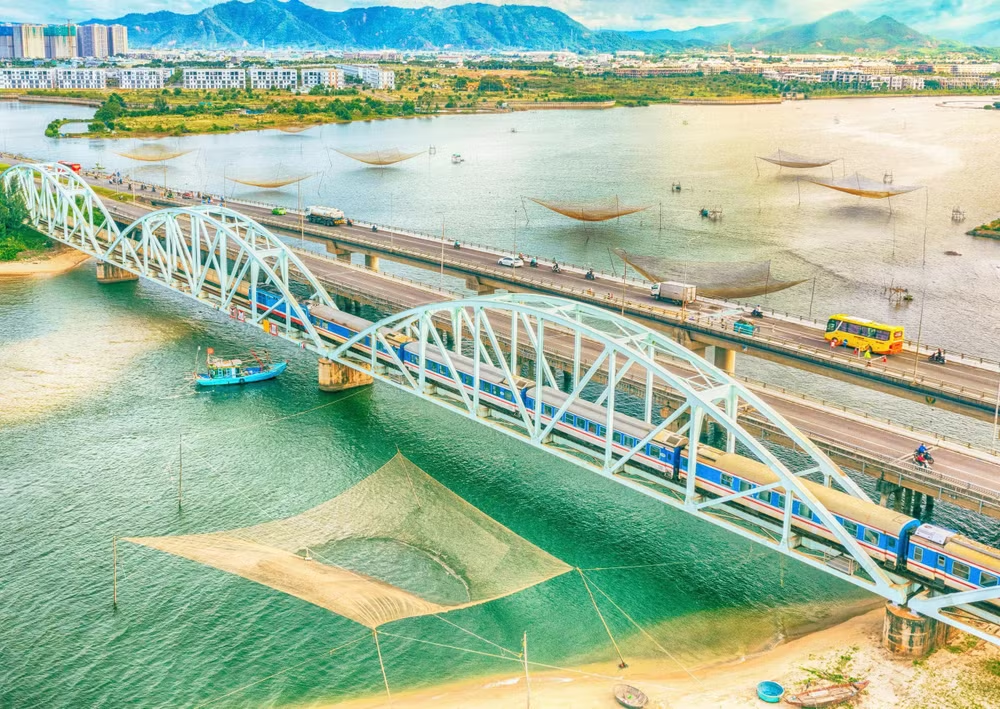
Besides its lyrical quality, Dang Hieu Dan's poetry also possesses a distinct historical consciousness. This is evident in poems such as "Beside the Arch Bridge - The Gate of Time": "Connecting the country's vast land for two centuries / The majestic Arch Bridge marks the passage of time." The bridge becomes a witness to the country's transformations: "Though divided North and South many times / The Reunification trains are still connected." The railway appears as a symbol of national unity and the aspiration for reunion after the war. This historical depth gives Dang Hieu Dan's poetry a subtle epic quality.
Interestingly, despite exploring historical elements, his poetry avoids rigid discourse. Dang Hieu Dan consistently maintains a soft emotional quality. This seems to stem from his perspective of viewing history through a cultural lens, rather than through illustrative thinking.
Besides poetry, Dang Hieu Dan also has a passion for photography, and this element likely influences the visual structure in his poems. Many lines of poetry are highly visual, resembling frames from film or painting. In the poem "Spring Comes to Hai Van Small Station," the imagery is organized using blocks of color and light: "A plum blossom branch budding, waiting for the morning"; "A station, a fading golden corner of the sky." The golden hue of the plum blossoms, the color of the mountain mist, and the morning light blend into a visually rich composition.
Or in the poem "Legend of the Night Train," the cinematic quality is even more evident: "The wheels shudder against time / Grinding against the rails, the loops of the past." This is a highly symbolic image, the physical movement of the train transformed into the movement of time. "The loops of the past" make the rails seem like a pathway into historical memory. The verse has both sound and philosophical depth. Also in this poem, Dang Hieu Dan shows the ability to combine legend and reality: "The train drifts in the night, the night of the vast forest / LangBiang, the legendary LangBiang," taking the train through both cultural space and time.
Dang Hieu Dan's literary path doesn't focus on the quantity of works or awards, but rather on how he preserves the beauty of life and professions through poetry. In the context of modern life, work is sometimes viewed from an economic perspective, constantly changing and evolving... But his poetry reminds readers that behind the trains lies a whole cultural life and the memories of many generations. Small stations, bridges, train whistles, rail rhythms, the golden apricot blossoms of Hai Van or the winding road of Lang Co… through his poetry, these have become "cultural coordinates".
Perhaps it was his teaching profession that helped Dang Hieu Dan's poetry maintain its calmness and sincerity. He doesn't pursue extreme innovation or show off linguistic techniques. His poetry leans towards natural emotions, rich in musicality and evocative. It's a poetic realm free from noise, with a lingering, far-reaching resonance.

Dang Hieu Dan's creative journey, the train, the journeys... are themes of artistic destiny. The trains traveling through the sun-drenched central region, over the Hai Van Pass, past Long Bien station, or back to his hometown of My Trach… ultimately converge into a larger journey: the exploration and deeper appreciation of the beauty of Vietnam, its land, and its people. Amidst the rhythmic rolling of the train wheels along the length of the country, this teacher with a poetic soul quietly writes, photographs, and preserves for posterity the beautiful moments of the railway tracks and memories.
Beyond the inspiration of railways, Dang Hieu Dan's poetry is diverse in subject matter, and regardless of the subject, his poems consistently maintain a gentle emotional tone, a slow, lingering rhythm, and a tender appreciation for the simple beauty of life. Because of this, his poetry always evokes empathy, and behind each verse lies the portrait of a quiet, persistent teacher who cherishes the beauty of life, much like the silent trains that travel through the years, extending journeys of love and preservation.
Source: https://nhandan.vn/dang-hieu-dan-nha-tho-lang-tham-บน-chuyen-tau-thi-ca-post962534.html























![[Image] Hanoi's urban life under the challenge of a "scorching hot" environment](https://vphoto.vietnam.vn/thumb/1200x675/vietnam/resource/IMAGE/2026/05/25/1779706979265_nang-nong-t5-2026-minh-duy-7-4636-jpg.webp)























































Comment (0)