

How long do I need to register for temporary residence before I can register for permanent residence under the new law?
From July 1, 2021 - the date the 2020 Residence Law came into effect - the requirements regarding the duration of temporary residence have been abolished.
Citizens nationwide can register for permanent residency as soon as they meet the legal accommodation requirements stipulated in Article 20 of the Residence Law, regardless of the duration of their temporary residence.
Previously, before the Residence Law of 2020 came into effect, in order to register for permanent residence (also known as immigration) in Ho Chi Minh City, Da Nang, Hai Phong, Can Tho, etc., citizens had to have continuously resided at their legal place of residence for at least one year (if immigrating to a district or town within the city), or at least two years (if immigrating to the inner city).
Specifically for Hanoi , people from other provinces who wish to register their household in the inner city must have resided continuously in the inner city for at least 3 years; those registering in the suburbs must have resided temporarily for at least 1 year (according to the Law on the Capital City).
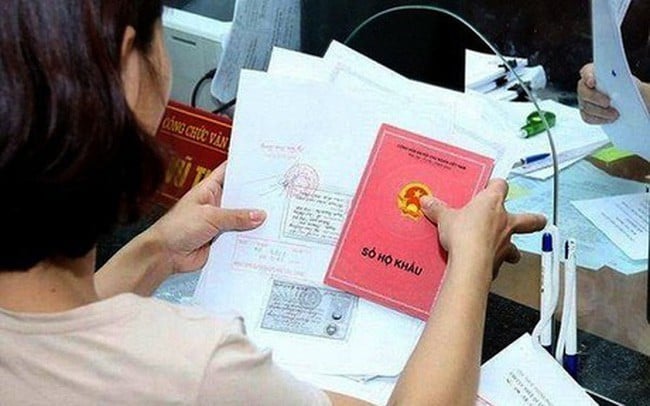 |
| The issued household registration book is valid and serves as proof of residence until December 31, 2022. |
Is the household registration book still in use today?
Clause 3, Article 38 of the 2020 Residence Law stipulates: "From the date this Law comes into effect, household registration books and temporary residence books that have already been issued shall continue to be used and shall have the same value as documents confirming residence as prescribed by this Law until December 31, 2022."
Accordingly, the household registration book that has already been issued will still be used and remains valid as a document confirming residence until December 31, 2022.
However, if the information in the Household Registration Book differs from the information in the Residence Database, the information in the Residence Database will be used. And when carrying out residence registration procedures that result in changes to the information in the Household Registration Book, the residence registration agency will revoke the issued Household Registration Book, adjust and update the information in the Residence Database, and will not issue a new or reissued Household Registration Book.
Along with the rapid development of digital technology and the policy of building an "e-government" and moving towards a digital economy, the Government issued Resolution No. 112/NQ-CP on simplifying administrative procedures and citizen documents related to population management within the scope of the state management functions of the Ministry of Public Security . This resolution stipulates that "the form of population management using 'Household Registration Books' will be abolished and replaced with a management system using personal identification numbers."
Information about citizens is collected and updated in the National Population Database in accordance with the provisions of Article 9 of the 2014 Law on Citizen Identification, as amended in 2020.
Thus, the information on citizens' permanent residence will be updated in the National Population Database.
Therefore, the household registration book will no longer be used as a document confirming a citizen's place of residence; instead, it will be determined through the individual's identification number in the National Population Database.
What are the requirements for registering a household in Vietnam?
The conditions for registering permanent residence are stipulated in Article 20 of the Residence Law 2020 as follows:
- Citizens are entitled to register their permanent residence at a legally owned dwelling.
- Citizens may register their permanent residence at a legally owned dwelling when the head of the household and the owner agree in the following cases:
Wife lives with husband; husband lives with wife; child lives with father and mother; father and mother live with child;
Elderly people living with their siblings, nephews, or nieces; people with severe or particularly severe disabilities, those unable to work, and those suffering from mental illness or other diseases that impair their cognitive abilities or behavioral control may live with their paternal or maternal grandparents, siblings, uncles, aunts, nephews, nieces, or guardians;
Minors who, with the consent of their parents or guardians, or who are orphaned, may live with their great-grandparents (paternal or maternal), grandparents, siblings, uncles, aunts, or guardians.
- Citizens may register their permanent residence at a legally rented, borrowed, or shared accommodation if they meet the following conditions:
- To register for permanent residency at the rented, borrowed, or temporarily occupied location with the consent of the property owner;
- Ensure that the minimum housing area requirements stipulated by the Provincial People's Council are met, but not less than 8 square meters of floor space per person.
- Citizens may register their permanent residence at religious establishments with auxiliary buildings that serve as housing if they fall into one of the following categories:
Religious workers are ordained, elected, appointed, nominated, or transferred to work in religious establishments;
Representative of the religious institution;
A person who has been granted permission by the representative/management board of the religious establishment to register as a permanent resident in order to directly manage and organize religious activities at the religious establishment;
Children, people with severe disabilities, people with serious disabilities, and homeless people may register for permanent residency with the consent of the representative/management board of the religious institution, the head, or their representative.
- Individuals receiving care, support, and assistance may register for permanent residency at the social assistance facility with the consent of the head of that facility, or may register for permanent residency in the household receiving care and support with the consent of the head of the household and the legal owner of the residence.
- Individuals living or working as itinerant workers on a vehicle may register their permanent residence at that vehicle if they meet the following conditions:
- Being the vehicle owner or having the vehicle owner's consent to register as a permanent resident;
- The vehicle is registered and inspected in accordance with the law.
- In cases where the vehicle is not required to be registered or inspected, confirmation from the People's Committee of the commune where the vehicle is regularly parked is required, stating that the vehicle is used for residential purposes.
- Confirmation from the People's Committee at the commune level is required that the vehicle is registered and regularly parked within the area, in cases where the vehicle is not required to be registered or the vehicle's registration location does not coincide with its regular parking location.
- The registration of permanent residence for minors requires the consent of their parents or guardians, except in cases where the minor's place of residence is determined by the Court.
Source

![[Photo] The General Secretary, President and his wife begin their state visit to the Philippines.](https://vphoto.vietnam.vn/thumb/1200x675/vietnam/resource/IMAGE/2026/05/31/1780230559452_anh-man-hinh-2026-05-31-luc-19-28-11.png)
![[Photo] Admire the coral "masterpiece" amidst the million-year-old heritage of Dak Lak province.](https://vphoto.vietnam.vn/thumb/1200x675/vietnam/resource/IMAGE/2026/05/31/1780221235105_anh-man-hinh-2026-05-31-luc-16-53-27.png)

![[Photo] Solemn bathing ceremony and Buddha procession in Hue](https://vphoto.vietnam.vn/thumb/1200x675/vietnam/resource/IMAGE/2026/05/31/1780228263543_1-jpg.webp)





















![[Video] Sunset at Lap An Lagoon – Where the sun sets over the fishing nets](https://vphoto.vietnam.vn/thumb/340x192/vietnam/resource/IMAGE/2026/05/31/1780192137701_beach-landscape-sea-water-nature-grass-745871-pxhere-com.jpeg)




































![[Photo] Admire the coral "masterpiece" amidst the million-year-old heritage of Dak Lak province.](https://vphoto.vietnam.vn/thumb/402x226/vietnam/resource/IMAGE/2026/05/31/1780221235105_anh-man-hinh-2026-05-31-luc-16-53-27.png)
































Comment (0)