


In practice, accurate evaluations create momentum for development, while inaccurate evaluations reduce the effectiveness and efficiency of the entire political system. At the same time, the results of cadre evaluations play a crucial role in promoting change within the cadre workforce, thereby making a significant contribution to improving the quality and effectiveness of assigned tasks.
Focus on leadership
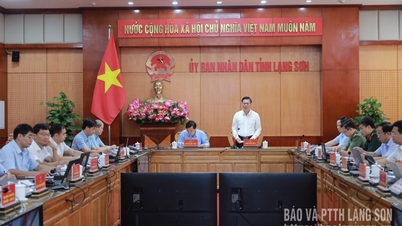
Recognizing this, over the years, leadership and guidance on cadre evaluation in the province have been implemented synchronously and rigorously from the provincial level to the grassroots. Mr. Luong Truong Dat, Provincial Party Committee member and Deputy Head of the Standing Committee of the Provincial Party Organization Department, stated: Based on the Central Committee's regulations and guidelines on annual performance review, evaluation, and ranking, the Provincial Party Organization Department advises the Provincial Party Standing Committee on leadership and guidance in implementation, specifically by issuing guidelines and regulations on annual performance review, evaluation, and ranking for collectives and individuals within the political system. Year after year, cadre evaluation and ranking have been carried out seriously, rigorously, and objectively by Party committees, agencies, and units; the cadre evaluation process has become increasingly rigorous, transparent, objective, and democratic. Evaluations are conducted regularly and continuously, with comprehensive and multi-dimensional content, linked to the output of each specific job position.
Accordingly, the Provincial Party Committee has issued numerous regulations and guidelines, gradually standardizing the work of evaluating cadres, such as: Guidance No. 10 dated November 28, 2019, of the Standing Committee of the Provincial Party Committee on the annual review, evaluation, and classification of the quality of Party organizations, Party members, and collective and individual leaders and managers at all levels; Guidance No. 06 dated November 30, 2023, on the annual review, evaluation, and classification of the quality of collectives and individuals in the political system; and Regulation No. 93 dated December 1, 2025, on the review, evaluation, and classification of the quality of collectives and individuals in the political system of Lang Son province. These regulations specifically establish criteria for evaluating, scoring, and classifying the quality of collectives and individual leaders and managers at all levels.
“The Party Committee of the ward always focuses on leading and directing efforts to improve the quality of cadres and civil servants; implementing clear task assignments linked to individual responsibility; and strengthening inspection, supervision, monitoring, and evaluation of work performance, sense of responsibility, quality of advice, and effectiveness of coordination for each position.” Comrade Phung Quang Hoi, Member of the Standing Committee of the Provincial Party Committee, Secretary of the Party Committee of Dong Kinh Ward |
Based on this, Party committees, agencies, and units have played a leading and guiding role in the work of evaluating cadres, considering it a regular and important task linked to Party building and the political system. Many Party committees have issued plans, concretizing documents from higher levels, clearly assigning responsibilities to each collective and individual in the implementation, ensuring that the evaluation of cadres is carried out seriously, systematically, and in accordance with regulations.
Ms. Nghiem Thi Bach Tuyet, Permanent Deputy Secretary of the Party Committee of Dong Dang commune, said: Following the directives and guidelines from higher levels, the commune's Party Committee has developed a specific plan for reviewing and evaluating cadres, ensuring adherence to the correct procedures and criteria. The evaluation is conducted based on work output and results, while also comparing individuals and groups with similar positions, functions, and responsibilities. This ensures that individual evaluations are closely linked to collective performance and the results of the political tasks performed by agencies and units, guaranteeing objectivity and comprehensiveness.
During the implementation process, the heads of Party committees, agencies, and units demonstrated a high sense of responsibility, directly supervising the review and evaluation of cadres; at the same time, they promoted democracy, encouraged frank and objective discussions, and avoided favoritism, avoidance, and superficial evaluations. The evaluation was closely linked to the results of political tasks, professional work, sense of responsibility, spirit of serving the people, and the moral character and lifestyle of the cadres.
In addition, agencies and units have focused on innovating evaluation methods towards a multi-dimensional and comprehensive approach; combining self-assessment, collective leadership evaluation with feedback from officials, civil servants, and employees, as well as feedback from citizens and businesses. Some units have proactively developed evaluation criteria based on job positions and specific products, thereby enhancing quantification and reducing general, subjective assessments.
Use work efficiency as the benchmark.
Currently, there are over 28,000 officials, civil servants, and public employees in the province. Generally, the province's workforce basically ensures the required number, structure, and quality, demonstrating a sense of responsibility, receiving thorough training, participating in state management training, and acquiring the skills and expertise required for their positions. They possess the capacity to advise and organize the implementation of tasks, essentially meeting the demands of the current period. In the past five years, the average percentage of officials, civil servants, and public employees across the province who have performed their duties well or better has exceeded 95%.
One of the key innovations in the province's cadre evaluation process in recent times is the clear identification of work efficiency as the primary measure. Instead of general, subjective evaluations, the assessment is now concretized through the results of task performance, progress, product quality, and the level of completion of assigned targets.
In Dong Kinh ward, evaluations have been based on the quantity and quality of work performed, assessing progress and effectiveness in fulfilling assigned targets and tasks, and quantifying these by concrete results. According to Comrade Phung Quang Hoi, Member of the Provincial Party Standing Committee and Secretary of the Dong Kinh Ward Party Committee, adhering closely to directives and guidance from higher levels, the ward Party Committee has consistently focused on leading and directing efforts to improve the quality of its staff and civil servants; clearly assigning tasks and linking them to individual responsibility; and strengthening inspection, supervision, monitoring, and evaluation of work performance, sense of responsibility, quality of advice, and effective coordination at each position.
Not only in Dong Kinh ward, but many localities, agencies, and units throughout the province have proactively concretized the evaluation of officials using criteria linked to the results of task performance. This has gradually overcome the situation of vague and superficial evaluations, while simultaneously creating motivation for officials to strive and improve the quality and efficiency of their work.
Mr. Duong Cong Nui, a specialist at the Party Committee's Inspection Committee of Hung Vu commune, shared: "The specific assessment of the quality and output of each civil servant's work has motivated us in fulfilling our assigned tasks. We proactively improve our professional skills and expertise to perform our duties well, and uphold the spirit of criticism and self-criticism in reviewing and evaluating cadres and civil servants. From there, we develop specific directions to overcome limitations and strive to successfully complete all assigned tasks."
It can be affirmed that the evaluation and classification of cadres by Party committees, agencies, and units at all levels have been carried out seriously, strictly, objectively, and according to the correct procedures as guided by higher authorities, with many positive changes and results that are fundamentally accurate; the cadre evaluation process is becoming increasingly rigorous, transparent, objective, and democratic. Along with this, the team of cadres, civil servants, and public employees in the province are increasingly improving their self-awareness in self-criticism and criticism; frankly acknowledging their strengths and weaknesses. Through evaluation, each cadre has a basis to develop a plan for self-improvement and overcoming shortcomings.
In the coming period, Party committees, governments, agencies, and units will continue to innovate the work of evaluating cadres in a comprehensive and continuous manner, using work efficiency and people's satisfaction as the main criteria; thereby contributing to building a team of cadres with sufficient qualities, capabilities, and prestige to meet the requirements of the tasks in the new period.
Source: https://baolangson.vn/bai-30-4-doi-moi-danh-gia-can-bo-5088302.html




















































































Comment (0)