

Ethics, a value that journalism cannot lose.
In the 1990s, most newspapers around the world shared a similar work environment, which persisted for decades. It consisted of beige desktop computers that each reporter worked with for hours. Also present in the center of the newsroom was usually a large desk with a landline telephone or a computer connected to the internet – which few people actually used.
Those old images surely still linger in the minds of journalists from the era when journalism flourished. And those images remind us of the fundamental values of journalism: that journalism is not technology. Talent, ambition, a spirit of learning, and professional ethics in general are what create the true value of journalism, and are what make society honor journalism, both globally and in Vietnam.
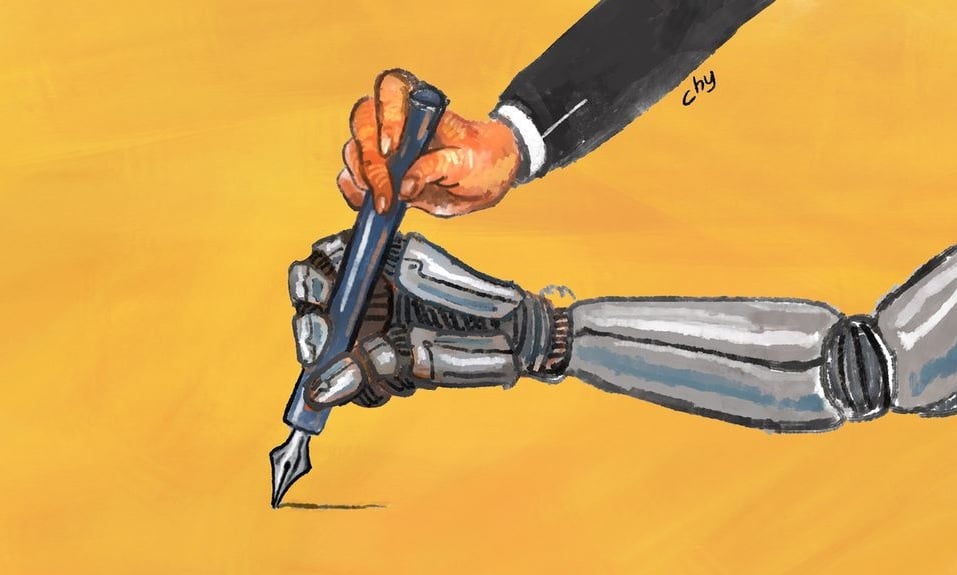
Ethical and human factors will play a decisive role in helping journalism survive in the AI era. Photo: GI
But just nearly a decade later, in the 2000s—a period long enough for a journalism student to enter university and begin writing their first real articles—journalistic life changed completely. At that time, the search engine “Google” entered the common vocabulary as a verb, before officially being included in the Oxford Dictionary in June 2006.
Very quickly afterward, hundreds of thousands of journalists worldwide, as well as radio and television editors, quietly and rapidly—almost unconsciously—took Google and the internet in general for granted in their work, even considering Googling or searching for information online as a "work process."
Then, just about a decade later, with the explosion of digital journalism and the social media era, journalism quickly changed once again. After print newspapers gradually disappeared along with roadside newsstands, many newspapers and online news sites flocked to social media or focused on Google's SEO campaigns to disseminate news. The initial results were promising, with many newspapers, even newly established ones, achieving resounding success through clicks.
Essentially, the journalistic model has fundamentally changed, from directly selling products to offering them for free, as much as possible, in exchange for advertising revenue. This is a rather unconscious trend – and one that still persists – because everything happens so quickly, and almost no journalist has enough time to stop and reflect. Everyone is forced to jump into this race, and try to run as fast as possible.
That seems to be the biggest "mistake" in the history of journalism, entrusting our profession, pride, and future to tech giants, none of whom may have ever worked in journalism or even have a basic understanding of it! All they care about is getting as many clicks as possible, thereby generating as much advertising revenue as possible!
For a time, many websites and online newspapers succeeded in that endeavor. They offered news for free on social media and followed search engine guidelines to get readers to click. But that era, known as "free digital media," is fading away, as quickly as it began.
Many online news sites that were once icons of the free digital age, such as Buzzfeed News or Vice recently, have closed down or been sold. The reason is simple: like many other newspapers, they have been "assimilated" with social media, producing news articles "on demand" from technology, and therefore are easily "ousted" when they no longer have value or uniqueness.
Avoid the pitfalls of the AI era.
Looking back on this long journey, those old lessons show that the main danger to journalism lies in journalistic ethics, not technology or any third party. That danger is expected to continue in the same direction, but will be far more frightening in the upcoming AI era.

A fake photograph of former President Donald Trump being arrested, created by AI. Photo: Reuters
As we know, with AI, exemplified by ChatGPT, even an individual can create hundreds of articles in just a few minutes, even though these are merely hybrid products of existing information. If journalism is assimilated by AI in this way, becoming overly dependent on it to publish news articles while neglecting its core values and ethics, then in the not-too-distant future, journalism will lose even its remaining values.
It's important to know that AI, through big language models and increasingly sophisticated algorithms, can not only create an article in seconds but also perform almost every other task in journalism, from generating images and videos to automated publishing, and even automated coordination and interaction with readers.
If the press doesn't just view AI as a tool to serve its work, but instead relies on it to produce news articles and publish content in a haphazard, uncreative, and low-quality manner, then one day readers will no longer see any difference between journalism and texts created by artificial intelligence, which are not only of poor quality but also full of misinformation.
In recent times, there have been numerous examples of AI products, whether intentionally or unintentionally, causing a serious wave of misinformation. Countless pieces of fake news and images have spread on social media, from fake photos of US President Joe Biden declaring war on World War III, to fake images of President Vladimir Putin and former President Donald Trump being arrested, to video technology that fakes the faces of famous TV presenters to spread misinformation for malicious purposes.
If journalism fails to maintain its integrity and continues to be swept along by the AI wave simply to reap some benefits from tech giants, the future of journalism will be over.
Fortunately, that's just a nightmare. The reality is that journalism has found new avenues for growth. Most of the world's leading newspapers and news agencies have moved beyond the era of free digital content and social media, which was once solely for generating views in exchange for meager advertising revenue left behind by tech giants. Many major publications have regained their footing by offering paid services or through reader contributions – contributions from those willing to pay for quality articles.
It is reasonable to believe that journalism in general will avoid the pitfalls that the AI era is setting ahead, although it must be noted that these pitfalls are very dangerous and require vigilance and, especially, unity to overcome!
Bui Huy
Source


![[Photo] Prime Minister Pham Minh Chinh attends the Conference on the Implementation of Tasks for 2026 of the Industry and Trade Sector](/_next/image?url=https%3A%2F%2Fvphoto.vietnam.vn%2Fthumb%2F1200x675%2Fvietnam%2Fresource%2FIMAGE%2F2025%2F12%2F19%2F1766159500458_ndo_br_shared31-jpg.webp&w=3840&q=75)



































































































Comment (0)