

The rare earth elements, a group of 17 metals, are relatively abundant in the Earth's crust, but their extraction is extremely difficult.
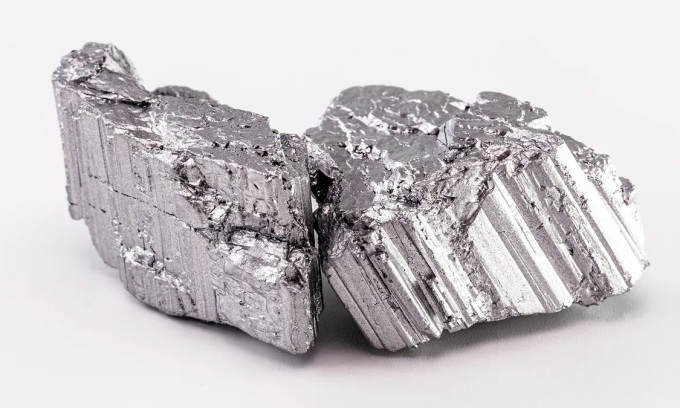
Neodymium, one of the extremely difficult rare earth elements to mine. Photo: RHJ/Getty
Rare earth elements possess many useful properties, making them highly sought after in the energy and technology industries. This group comprises 17 metals, including 15 metals at the end of the periodic table, along with yttrium and scandium.
The most valuable of these elements are neodymium, praseodymium, terbium, and dysprosium, which act as ultra-powerful miniature magnets, a crucial component of electronic devices such as smartphones, electric vehicle batteries, and wind turbines. However, the limited supply of rare earth elements is a major concern for companies and governments when producing these modern necessities.
Rare earth elements aren't actually that rare. According to research by the U.S. Geological Survey (USGS) on the crystalline abundance of different elements (the average availability across the Earth's crust), most rare earth elements are present in roughly the same quantities as common metals like copper and zinc. "They're certainly not as rare as metals like silver, gold, or platinum," said Aaron Noble, a professor at Virginia Polytechnic University.
However, extracting them from natural sources is extremely difficult. "The problem is they're not concentrated in one place. There are about 300 milligrams of rare earth elements in every kilogram of shale across the United States," said Paul Ziemkiewicz, director of the West Virginia Water Research Institute.
Typically, metals concentrate in the Earth's crust due to various geological processes, such as lava flows, hydrothermal activity, and mountain formation. However, the unusual chemical properties of rare earth elements mean they are not usually concentrated together under these specific conditions. Traces of rare earths are scattered across the planet, making their extraction less efficient.
Occasionally, acidic underground environments can slightly increase the levels of rare earth elements in certain locations. However, finding these locations is only the first challenge.
In nature, metals exist as mixtures called ores, containing metal molecules bonded to other non-metals (anti-ions) by strong ionic bonds. To obtain pure metal, these bonds must be broken and the non-metal must be removed. The difficulty of this task depends on the metal and the non-metal with which it is bonded.
"Copper ore typically appears in the form of sulfides (chemical compounds containing sulfur and other elements). You heat the ore until the sulfides escape as gas, and the pure copper settles at the bottom of the reactor. That's a fairly easy extraction process. Some others, such as iron oxides, require additives to release the metal. But separating rare earth elements is much more complex," Ziemkiewicz explains.
Rare earth metals have three positive charges and form extremely strong ionic bonds with phosphate antiions, each of which has three negative charges. Therefore, the extraction process must overcome the extremely strong bond between the positive metal and the negative phosphate.
"Rare earth ores are very chemically stable minerals, requiring a great deal of energy and chemical power to break them down. Typically, that process requires extremely low pH levels, harsh conditions, and extremely high temperatures because the bonds within the ore are incredibly strong," Noble said.
The difficulty in extracting pure elements has given them the name "rare earth." Some experts are researching new methods to recycle and extract these valuable metals from industrial waste and old electronics to ease pressure on current supplies. They are also trying to recreate the unique magnetic and electronic properties of rare earths in new compounds, hoping these new compounds will become more accessible alternatives. However, there are currently no effective alternatives to rare earths, despite increasing demand.
Thu Thao (According to Live Science )
Source link







































































































Comment (0)