

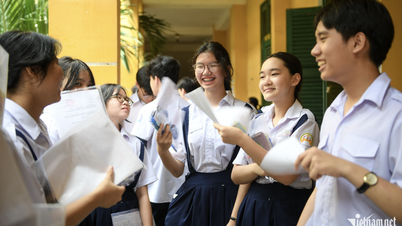
The 2025-2026 school year concluded with many noteworthy developments in the province's education sector. These included not only impressive figures regarding academic performance, character development, and student achievements, but also a prominent mark of innovation that spread from the management level down to each individual school.
 |
In her overall assessment of the achievements, Ms. La Thi Thuy, Director of the Department of Education and Training, stated that the implementation of indicators serving the people and businesses has consistently maintained a high level; the quality of education continues to achieve good results, increasing compared to the previous academic year. The percentage of teachers meeting standards currently stands at 97.18%, with those exceeding standards reaching 23.3%; the percentage of solid classrooms is 92.8%, higher than the national average.
Notably, the education sector promptly advised on the issuance of documents to concretize Resolution No. 71-NQ/TW, dated August 22, 2025, of the Politburo on breakthroughs in education and training development, and at the same time organized thorough dissemination and implementation throughout the sector.
Based on practical experience, Nguyen Binh Khiem Specialized High School (Phuoc Hau Ward) is a shining example of high-quality education. In the 2025-2026 school year, the school maintained a stable student enrollment, with 100% of students achieving good conduct grades; 95.01% of students achieved good academic results, and 4.99% achieved fair results. The school had 549 outstanding students and 365 excellent students; it won 11 national-level student excellence awards, 45 Olympic 30/4 medals, and 21 national-level IOE awards.
According to Mr. Nguyen Hong Bao, Principal of Nguyen Binh Khiem Specialized High School, these results were achieved thanks to the timely attention and guidance of leaders at all levels, the direction and management of the Party Committee and the school's management board, the enthusiasm and dedication of the teachers; and especially the students' efforts in studying and actively participating in movements.
While in specialized schools, innovation is demonstrated through high-quality education, thematic workshops, digital transformation, and the application of AI in teaching, in schools in disadvantaged areas, innovation is reflected in the perseverance to overcome limitations in resources.
At Luu Van Mot Secondary School in Quoi Thien commune, the 2025-2026 school year is considered a special journey, linked to the theme "Discipline - Creativity - Breakthrough - Development". Despite being a secondary school in an "island commune" facing many difficulties, the school has achieved many positive results: The percentage of students with good academic performance reached 46.67%, far exceeding the planned target; there are no longer any students with unsatisfactory grades; and the student retention rate reached 99.43%. Regarding conduct, 98.67% of students are rated good, with no students rated as satisfactory or unsatisfactory.
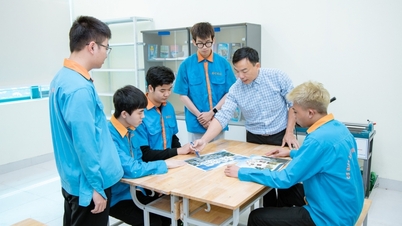
The school's most notable achievements are digital transformation and STEM/STEAM education. The school has digitized 100% of its professional records, completed 100% of digital student report cards from grades 6 to 9, applied AI tools such as ChatGPT, Canva AI, and NotebookLM to over 80 digitized lessons; and implemented 13 practical STEM/STEAM models.
Principal Vo Le Minh Trieu shared: "Today's students no longer learn by rote or abstract theories; they have learned to create things themselves and think for themselves to master technology."
At Tan My A Primary School (Tra Con commune), the context presents many challenges. The school is located in a particularly disadvantaged commune, where over 40% of the population are Khmer people, living in difficult circumstances, and over 30% of students come from poor or near-poor households.
However, according to Mr. Trinh Hong Vinh, the school principal, there are still important foundations for improving the quality of education: a synchronized and timely issuance of guiding documents; the attention of the local authorities; spacious and solid facilities; the school achieving national standards level 2 and educational quality accreditation level 3.
In particular, 100% of the school's staff, teachers, and employees meet the required training standards; the school's leadership team is assessed as having scientific and innovative management capabilities, being bold and proactive, and demonstrating a high sense of responsibility. This proves that, even in disadvantaged areas with potentially limited socio -economic conditions, with a dedicated team, good management, and the support of the local community, the school can still create a stable, modern, and safe learning environment for students.
Drawing from the school's practical experience, Mr. Trieu emphasized: "Infrastructure may still be lacking, but educational thinking must not be outdated. Difficulties are not a reason to stop, but a motivation to break through." This statement can be seen as a typical message reflecting the innovative mark of the province's education system in the past school year: Innovation begins first and foremost with awareness, with the responsibility of the leaders and the efforts of the teaching staff.
Alongside positive results, the provincial education sector also frankly acknowledges many difficulties. According to the Department of Education and Training, the entire province still lacks approximately 3,100 teachers, while the primary school level alone has a surplus of 413 teachers; and 2.82% of teachers have not yet met the qualification standards according to the 2019 Education Law. Infrastructure still includes 35 temporary classrooms and nearly 1,400 semi-permanent classrooms; the need for investment in infrastructure repair exceeds 11 trillion VND, while the projected public investment capital is only about 1,313 trillion VND.
The scattered nature of the school network also presents a major challenge. There are 494 preschools but 418 school locations; primary schools have 568 with 449 school locations. Furthermore, the rate of students attending school for two sessions per day is low, the quality of foreign language teaching is uneven, and some ethnic minority students from disadvantaged backgrounds are not yet eligible for support, thus increasing the risk of dropping out.
Overall, the provincial education sector in the 2025-2026 school year was marked by many positive changes: the quality of education was maintained, digital transformation was accelerated, many schools proactively innovated, and a spirit of creativity spread among teachers and students. The results show that innovation is becoming an important driving force, contributing to building a local education system that is increasingly modern, equitable, and humane.
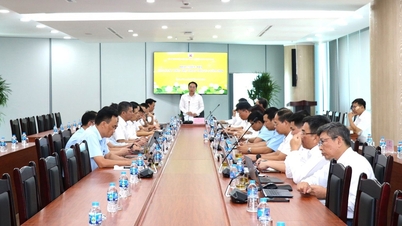
During a working session between the Standing Committee of the Provincial Party Committee and the provincial education sector at the end of May, Comrade Tran Van Lau, Member of the Central Committee of the Party and Secretary of the Provincial Party Committee, requested the education sector to continue effectively implementing Resolution No. 71 of the Politburo and Action Program No. 06 of the Provincial Party Committee; linking educational development with the human resource needs for digital transformation, innovation, and international integration. At the same time, he urged the sector to promote innovation in teaching methods towards developing students' qualities, competencies, life skills, digital skills, and foreign language proficiency; and to strengthen STEM education and the application of technology in teaching. In addition, the sector needs to review and reorganize the school network, prioritize investment in infrastructure, ensure equal learning opportunities for students, especially in disadvantaged areas; and focus on moral education, life skills, and preventing and combating school violence.
Text and photos: CAO HUYEN
Source: https://baovinhlong.com.vn/xa-hoi/giao-duc-dao-tao/202606/dau-an-noi-bat-cua-nganh-giao-duc-tinh-0384b3d/





![[Photo] General Secretary and President To Lam presides over a meeting on preparations for the review of one year of operation of the three-tiered government system.](https://vphoto.vietnam.vn/thumb/1200x675/vietnam/resource/IMAGE/2026/06/02/1780391821195_a1-bnd-4595-9717-jpg.webp)














![[Image] Affirming the aspirations and new standards of the Vietnamese real estate market in the new era.](https://vphoto.vietnam.vn/thumb/1200x675/vietnam/resource/IMAGE/2026/06/03/1780441948766_giai-thuong-bat-dong-san-2026-minh-duy-6-7364-jpg.webp)

















































Comment (0)