

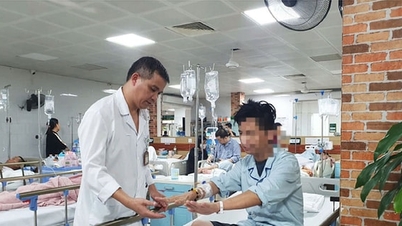
In mild cases of water intoxication, you may experience nausea or a headache. In severe cases, water intoxication can cause seizures, coma, and even death. While water intoxication is rare for most people, understanding the warning signs and limits is important.
How the body handles excess water
The kidneys are incredibly efficient filters. When working at full capacity, they can produce urine at a rate of about 10 to 15 milliliters per minute, equivalent to about 600 to 900 milliliters per hour. As long as you drink less than that, your kidneys can keep up and eliminate the excess fluid.
The problem begins when you take in water faster than your kidneys can eliminate it. The excess water remains in the blood and dilutes the concentration of sodium and other electrolytes. Sodium plays a crucial role in nerve signaling, muscle contraction, and regulating fluid balance inside and outside cells.
When sodium levels in the blood drop, water flows into cells through osmosis, causing them to swell. Most cells in the body can tolerate a degree of swelling, but your brain is inside a rigid skull, leaving no room for expansion.
Symptoms of water intoxication
Symptoms typically increase in a predictable pattern. Initially, you may notice nausea, headache, and a feeling of fullness or discomfort. As sodium levels continue to drop, neurological symptoms become more severe: muscle spasms, slurred speech, confusion, and fatigue. In severe cases, cerebral edema can cause seizures, loss of consciousness, and even death.
A systematic review published in BMJ Open found that, in clinical cases of hyponatremia due to water intake, the median blood sodium level at admission was 118 millimoles per liter. Normal sodium levels are 135 to 145.
Any level below 125 is classified as severe hyponatremia. Of the reported cases, 78% of patients recovered, but 13% died. Nearly half of those deaths were directly due to complications of low sodium, primarily cerebral edema and pulmonary edema.
How much is too much to drink?
Most healthy adults need about 11.5 to 15.5 cups (2.7 to 3.7 liters) of total fluids per day, including water from food and other beverages. Doubling or tripling that amount, especially in a short period of time, is where the risk of intoxication increases sharply.
A practical rule to remember: If you drink so much that your urine is completely clear and you're constantly having to go to the bathroom, chances are you're drinking too much.
Groups at high risk of water intoxication
Marathon runners, ultramarathon runners, and long-distance cyclists sometimes drink more than they sweat, especially when following the outdated advice of "drink as much as possible" during training.
The problem is exacerbated by the fact that high-intensity physical activity stimulates a hormone that causes your kidneys to retain water instead of eliminating it. Therefore, athletes are simultaneously absorbing too much and excreting too little.
Prior to 1981, athletes were actually advised to avoid drinking water during exercise, which caused its own problems with dehydration. Then, the trend completely reversed, and cases of exercise-related hyponatremia became more common as recommendations for water intake increased.
Currently, the general understanding is that athletes should drink when they feel thirsty rather than forcing themselves to drink water according to a schedule.
People with certain mental disorders are also at higher risk. One condition called psychogenic polydipsia involves compulsive water-seeking and excessive drinking, often seen in people with schizophrenia or other psychotic disorders. These patients may develop chronic complications beyond sodium depletion, including bladder problems, kidney damage, and even heart failure due to persistent fluid overload.
Smaller body size is also a factor. People with lower body weight have a smaller total blood volume, so the same amount of excess water will dilute their sodium more noticeably. This is why children are particularly vulnerable.
Source: https://giaoducthoidai.vn/dau-hieu-canh-bao-ngo-doc-khi-uong-qua-nhieu-nuoc-post779742.html




























![[Photo] Reception to welcome General Secretary and President To Lam and his wife on their State visit to the Philippines](https://vphoto.vietnam.vn/thumb/1200x675/vietnam/resource/IMAGE/2026/06/01/1780295488620_vna-potal-chieu-dai-chao-mung-tong-bi-thu-chu-tich-nuoc-to-lam-va-phu-nhan-tham-cap-nha-nuoc-toi-philippines-8798060-7855-jpg.webp)





























































Comment (0)