

 |
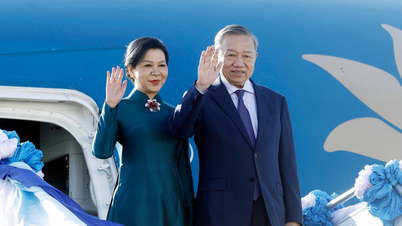
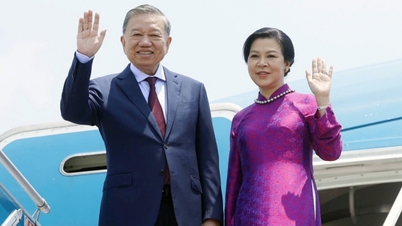
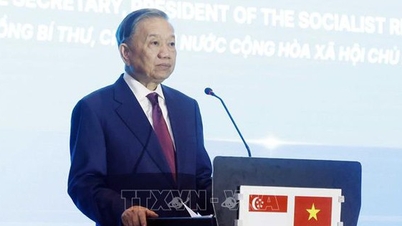
| General Secretary and President To Lam and his wife will pay a state visit to the Philippines from May 31 to June 1. (Source: VNA) |
Ambassador, could you please explain the significance and key priorities of General Secretary and President To Lam's current state visit to the Philippines?
The State visit to the Republic of the Philippines by Comrade To Lam, General Secretary of the Central Committee of the Communist Party of Vietnam and President of the Socialist Republic of Vietnam, takes place in the context of the two countries looking forward to celebrating the 50th anniversary of the establishment of diplomatic relations (July 12, 1976 - July 12, 2026). This is an important historical milestone, marking the first time in half a century that the Head of the Vietnamese Party and State has made an official visit to the Philippines.
 |
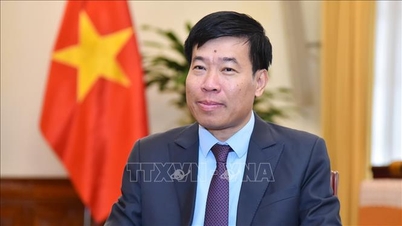
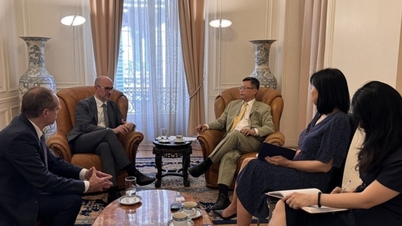
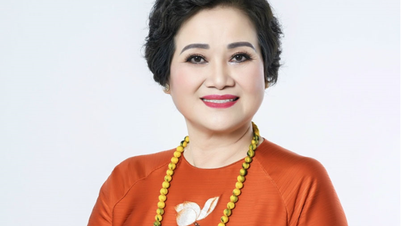
| Vietnamese Ambassador to the Philippines Lai Thai Binh. (Source: Vietnamese Embassy in the Philippines) |
Against the backdrop of a continuously complex regional and international situation, this visit strongly affirms Vietnam's independent, self-reliant, diversified, and multilateral foreign policy, as emphasized at the 14th National Congress of the Communist Party of Vietnam. Through this visit, the Party and State of Vietnam demonstrate their high regard for the Philippines – a close neighbor bordering the East Sea – and reaffirm their determination to elevate bilateral relations to a new level, making them more stable, sustainable, and substantive.
For both countries, the visit provides an important opportunity to enhance political trust, strengthen core pillars of cooperation, and promote coordinated efforts to address regional and global issues.
For the region, as the Philippines assumes the ASEAN chairmanship in 2026 with the theme "Together We Steer Our Shared Future," Vietnam's practical support and partnership will contribute to strengthening ASEAN's unity and central role, promoting a peaceful, stable, prosperous, and resilient Southeast Asia, and contributing to peace, cooperation, and overall development in the region and the world.
 |
| Ambassador Lai Thai Binh poses for a commemorative photo with Philippine President Ferdinand R. Marcos Jr. and First Lady Liza Araneta at the Philippine Presidential Palace. (Source: Vietnamese Embassy in the Philippines) |
Looking back at five decades of bilateral relations and the development of the Strategic Partnership, could the Ambassador highlight the most outstanding aspects of cooperation between the two countries?
The Vietnam-Philippines Strategic Partnership is developing positively, comprehensively, and substantively across many key areas.
In terms of politics and diplomacy, both sides maintain regular and flexible high-level contact channels through delegation exchanges, correspondence, telephone calls, and meetings on the sidelines of multilateral forums, thereby strengthening political trust and promoting concrete cooperation. The recent participation of the Vietnamese delegation, led by Prime Minister Le Minh Hung, in the 48th ASEAN Summit in Cebu created new momentum, demonstrating Vietnam's strong support for the Philippines in its role as ASEAN Chair in 2026.
Regarding security and defense, the two countries effectively maintain dialogue and exchange mechanisms from the ministerial level to the armed forces. To date, they have held 7 Deputy Minister-level Defense Policy Dialogue sessions (the most recent in November 2025 in Vietnam), 10 Naval Consultations, 3 Air Force Consultations, and 2 Conferences between the Vietnam Coast Guard and the Philippine Coast Guard.
Traditional cooperation in training, search and rescue, and experience exchange continues to develop, while expanding into new areas such as defense industry, logistics, and military medicine. In August 2024, during a visit by Minister of Defense Phan Van Giang, the two sides signed two Memoranda of Intent on humanitarian assistance - disaster relief at sea and military medical cooperation. The two countries also cooperate closely in combating transnational crime, human security, extradition, and enhancing law enforcement capacity, while increasingly focusing on non-traditional security challenges.
In terms of economics, trade, and investment, bilateral trade turnover has grown impressively at an average rate of over 10% per year during the 2015-2025 period, from US$2.92 billion to US$7.8 billion. Vietnam is currently the 11th largest trading partner of the Philippines. The structure of goods is increasingly diversified with nearly 40 key export product groups from Vietnam. Investment cooperation from Vietnam to the Philippines has increased sharply in recent years. In 2025 alone, it is expected to reach over US$92 million, accounting for nearly 70% of the total cumulative capital (US$133 million). Projects focus on green transformation, electric taxis, and high technology, opening up new impetus for infrastructure and sustainable development in the Philippines.
In terms of tourism, the number of Filipino visitors to Vietnam has increased more than fourfold in less than 10 years, from 110,967 (2016) to 482,173 (2025). In just the first four months of 2026, the number reached approximately 236,000 (a 73.4% increase), placing the Philippines among Vietnam's top 10 largest source markets for tourists for the first time. The expansion of direct flights by five airlines (Vietnam Airlines, Philippine Airlines, Vietjet Air, Cebu Pacific, and AirAsia) has significantly contributed to this achievement.
Regarding labor, although still modest in scale, labor cooperation has great potential due to the increasing needs of both sides. The Philippines has the advantage of a workforce with good English skills and professional training, while Vietnamese workers stand out with their ability to learn quickly and handle high pressure. Both sides are promoting cooperation in areas such as lecturers, technology experts, management, care services, and skilled workers…
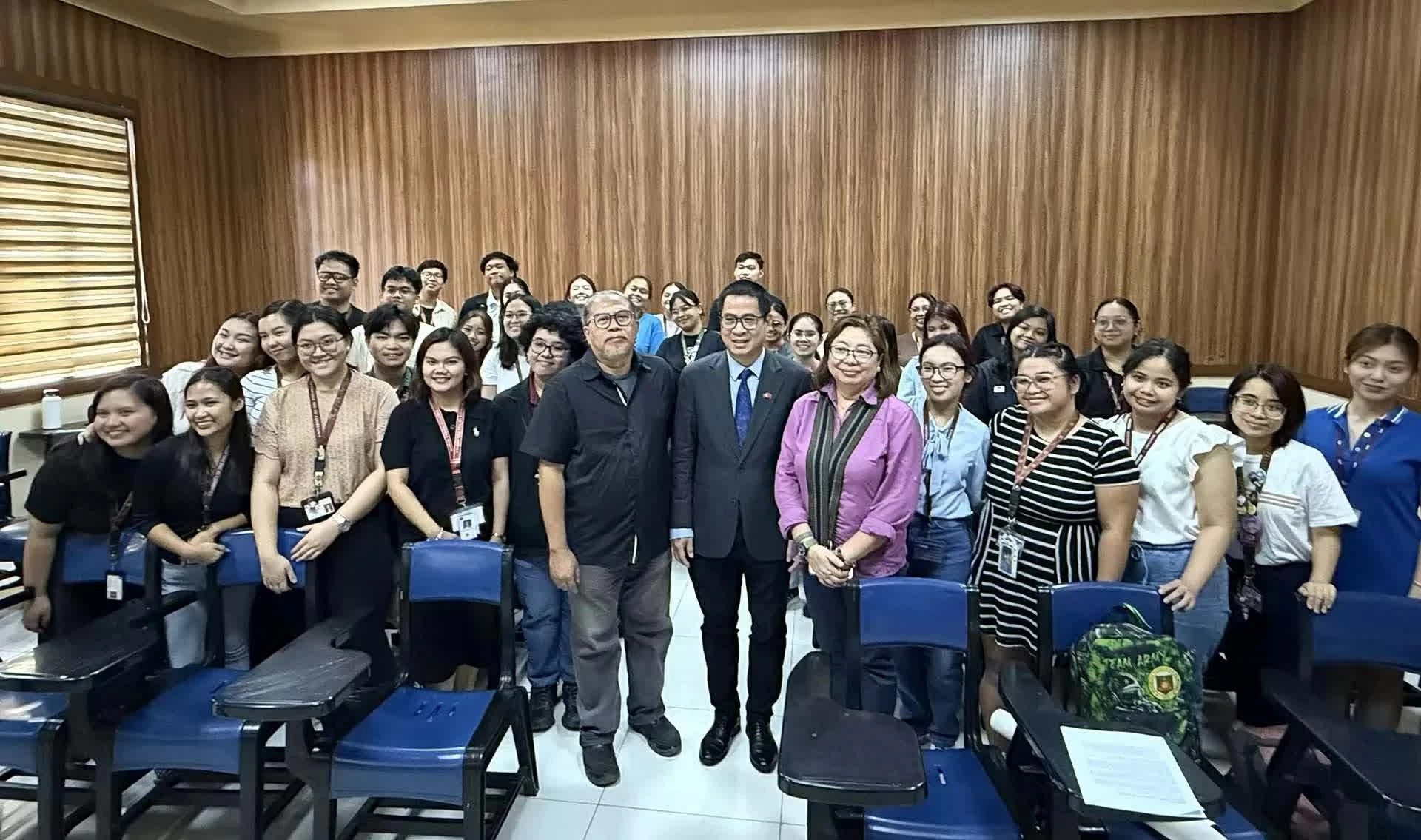 |
| Ambassador Lai Thai Binh and delegates attended a special discussion with students, focusing on the life and legacy of President Ho Chi Minh and the national hero of the Philippines, at the University of the Philippines on April 29, 2025. (Source: Vietnamese Embassy in the Philippines) |
Given the current regional and international economic context, as well as the development needs and goals of each country, could the Ambassador please outline the key areas that both sides should promote in the coming period?
Despite significant progress, Vietnam-Philippines relations have not yet reached their full potential, given the combined population of over 220 million people, their crucial geostrategic location, and highly complementary economies. With an increasingly solid foundation of political trust, bilateral relations have ample room for robust growth in both breadth and depth.
Trade and Investment: The target of achieving $10 billion in trade turnover is entirely feasible if both sides continue to simplify procedures, strongly promote trade, and connect businesses. Improving logistics and maritime connectivity will contribute to reducing costs and increasing the efficiency of goods exchange.
Agriculture and food security: Moving beyond traditional trade relations, the two countries need to move towards long-term cooperation mechanisms, stabilizing supply chains, and expanding cooperation in smart agriculture, aquaculture, and climate change adaptation – all of which are promising major trends.
Maritime economy: With the advantage of being two coastal nations, both sides have great potential for cooperation in sustainable exploitation, maritime transport, and offshore renewable energy.
Education, training, and the digital economy: The Philippines has strengths in English-speaking human resources and the BPO industry, while Vietnam has a dynamic technology ecosystem. Both sides can enhance cooperation in training digital human resources, artificial intelligence, cybersecurity, fintech, and connecting universities and vocational training institutions.
Green transformation: The Philippines' need for transportation modernization and energy transition opens up significant opportunities for Vietnamese businesses, particularly in the electric vehicle sector, as evidenced by the rapid expansion of GSM (Vingroup) in this market.
The Vietnam-Philippines relationship not only brings practical benefits to both nations but also serves as an important pillar contributing to strengthening ASEAN solidarity and maintaining ASEAN's central role in the region and the world. In the context of a geopolitical landscape still fraught with complex factors, the close cooperation between the two countries is a vivid testament to the spirit of strategic autonomy, for the sake of peace, stability, and shared prosperity.
Thank you very much, Ambassador!
Source: https://baoquocte.vn/dau-moc-lich-su-trong-quan-he-viet-nam-philippines-399241.html
![[Photo] Ba Lang An Lighthouse - the "eye of the sea" amidst the "rock museum" of Quang Ngai province.](https://vphoto.vietnam.vn/thumb/1200x675/vietnam/resource/IMAGE/2026/05/29/1780038698840_anh-man-hinh-2026-05-29-luc-14-10-42.png)


![[Image] Pleasant weather helps students enter the 10th grade entrance exam with confidence.](https://vphoto.vietnam.vn/thumb/1200x675/vietnam/resource/IMAGE/2026/05/29/1780034401612_ngay-1-thi-lop-10-minh-duy-8-5009-jpg.webp)























































Comment (0)