

 |
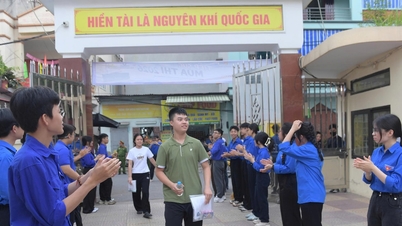
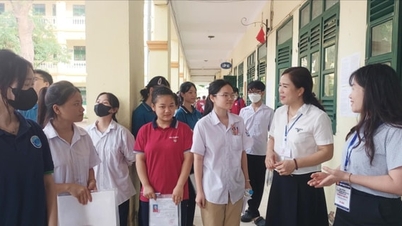
| Candidates register for the 2026 10th grade entrance exam on the morning of May 29th. (Photo: Pham Thao) |
Hanoi is entering the 10th grade enrollment season with increasing pressure as the number of students rises sharply while public schools can only meet about 60% of the demand.
Behind the high admission rates lie the anxieties of students and parents, the competition for top-tier schools, and concerns about their educational paths after lower secondary school. But more than just an exam, this is also a time for society to re-examine how we place our expectations on our students.
When exams are more than just about scores.
This year, Hanoi has approximately 147,000 ninth-grade students, an increase of nearly 20,000 compared to the previous school year, while the enrollment quota for public high schools is only about 60%. This means that tens of thousands of students will not be able to get into public schools, despite many of them having worked very hard throughout their years of schooling.
The pressure, therefore, doesn't just come from exams or tests. What stresses many students the most is the feeling of competition and the fear of being left behind. For many families, the 10th grade entrance exam seems to become the first decisive "race" for their children's future.
Many students share that they have almost no time to rest in the final months of high school. Their schedules are packed from morning to night, and they continue with extra classes on weekends to reinforce their knowledge. Some put pressure on themselves for fear of disappointing their parents, while others worry about the competition ratios for their desired schools.
Meanwhile, parents are equally anxious. Choosing which school to attend, how to register their preferences, and whether their child's abilities are competitive enough... have become constant concerns in many families. Some parents are willing to invest heavily in extra tutoring with the hope that their child will secure a "safe spot" in a public school.
However, it's worth noting that this pressure largely doesn't stem from the exam itself, but rather from the imbalances in the current education system. The disparity in quality, facilities, and reputation among schools causes students to flock to a few top-tier institutions. This leads to high competition rates, creating the mindset that only prestigious schools guarantee a good future.
In reality, it's perfectly understandable to want your child to study in a good environment. But when too many expectations are placed on a few schools, an invisible pressure weighs heavily on students. Some students, as young as 15, already feel like failures simply because they didn't get into their desired school.
This is also why many education experts believe that the 10th grade exam should be viewed with a calmer mindset. An exam can assess academic ability at a given time, but it cannot be the sole measure of a person's value or capabilities.
In fact, many students achieve success through different paths. Some are suited to vocational training environments, where they gain early exposure to practical skills and clear career guidance. Others thrive better in private schools or more flexible educational models. Each student has unique abilities and needs a suitable environment to develop.
Therefore, the important thing is not to get into a "top school" at all costs, but to find a path that suits one's abilities, interests, and circumstances. When students learn in a suitable environment, they will have a better chance of sustainable development instead of just chasing after academic pressure.
 |
| In recent years, the 10th grade entrance exam in Hanoi and Ho Chi Minh City has been considered quite stressful. (Illustrative photo: Pham Thao) |
Reduce pressure from substantive changes.
Looking at the reality of 10th grade admissions over the years, the pressure will be very difficult to reduce if we only tell students "not to worry." What is needed more are substantive solutions from the education sector and society as a whole.
One proposal that has garnered significant attention from experts is allowing students to adjust their preferences after the competition ratios are announced. This is seen as a flexible solution to give students more opportunities to consider options that align with their actual abilities.
Currently, many students register their preferences without complete information or are influenced by herd mentality. After the competition ratios are announced, many realize their initial choices were too difficult, but they no longer have the opportunity to adjust them. If there were a more flexible mechanism, students would be more proactive and experience less psychological pressure during the admissions process.
In addition, career guidance and streaming after lower secondary school are also being strengthened. Career counseling activities, introductions to vocational training models, private schools, and other educational paths are gradually helping parents and students gain a more multifaceted perspective. This is a necessary change because for many years, many people still assumed that only attending public high school and then going to university was the right path. This notion inadvertently put a lot of pressure on many students, even though their abilities or interests were suited to other paths.
In the context of a rapidly changing labor market, society increasingly needs people with professional skills, practical thinking, and adaptability. Therefore, choosing vocational training or pursuing another educational path is no longer an inferior option, but simply a different path that is more suitable for each student.
However, in the long run, the most fundamental solution remains comprehensive investment in education. As the student population increases rapidly due to urbanization, expanding schools, adding teachers, and improving the quality of schools is something that cannot be delayed.
If the quality gap between schools narrows, the tendency to flock to a few top schools will also decrease. Then, the 10th grade entrance exam will be less stressful, and students will have more opportunities to choose a suitable environment. Most importantly, it is necessary to ensure that all students after 9th grade have the opportunity to continue their education.
Whether attending public high school, private high school, or vocational education, all students deserve respect and equal opportunities for development.
A progressive society should not allow students to grow up feeling that a single exam can determine their entire future. After all, education is not just about selection, but also about opening opportunities for each individual. The 10th grade exam will undoubtedly remain a significant milestone for many students in Hanoi.
But besides preparing with knowledge, perhaps what students need most is the support and understanding from their families, schools, and society.
Because, after all, the most valuable thing about being a student isn't getting into a particular school, but rather growing up with self-confidence, having their individual abilities respected, and believing that they always have many opportunities ahead.
Source: https://baoquocte.vn/de-ky-thi-lop-10-tro-nen-nhe-nhang-hon-399201.html
![[Photo] Admire the coral "masterpiece" amidst the million-year-old heritage of Dak Lak province.](https://vphoto.vietnam.vn/thumb/1200x675/vietnam/resource/IMAGE/2026/05/30/1780107638639_y25-jpg.webp)


































































































Comment (0)