First and foremost, the most important principle to remember is that if you suspect a heart attack or stroke, you must call emergency services immediately. You shouldn't wait for clearer symptoms, nor should you wait for the patient to improve before deciding what to do next, according to the health website Healthline (USA).
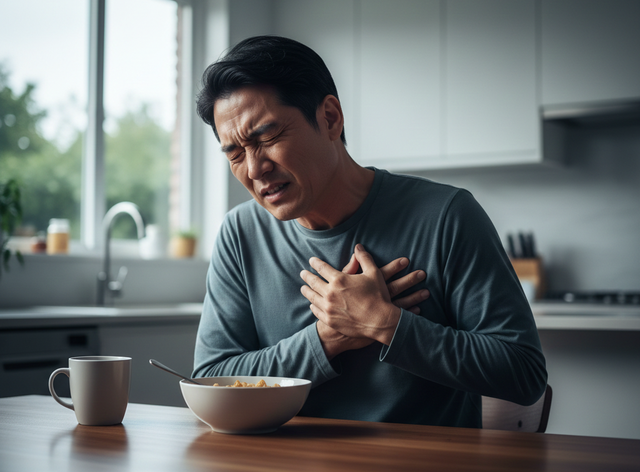
Chest pain is a typical symptom of a heart attack.
PHOTO: AI
The reason is that with heart attacks and strokes, every minute of delay increases the risk of death or severe disability. When calling emergency services, if possible, clearly describe when symptoms started, whether they occurred suddenly or worsened gradually, and the patient's current condition, such as whether they are conscious, able to speak, or breathing normally. This information is crucial for medical personnel.
With a heart attack, symptoms are usually concentrated mainly in the chest area. The most typical sign is pain or tightness in the center of the chest, feeling like pressure, squeezing, or suffocation. This pain may radiate to the left arm, shoulder, neck, jaw, back, or upper abdomen. Many cases are accompanied by shortness of breath, cold sweats, nausea, dizziness, or unusual fatigue.
One common misconception is that not everyone who has a heart attack experiences severe chest pain. Some people may only feel mild but persistent chest tightness, unexplained shortness of breath, or sudden fatigue accompanied by nausea.
Meanwhile, strokes often present with sudden neurological disorders. Common signs include facial drooping, uneven smile, weakness or numbness in one arm or leg making it difficult to grasp objects or causing unsteadiness while walking. In addition, patients may experience slurred speech, difficulty speaking, inability to speak, or difficulty understanding others. Strokes can also cause sudden blurred vision, loss of vision in one eye, double vision, severe dizziness, loss of balance, or very severe headaches.
Therefore, in an emergency, a simple question to quickly determine the cause is: Is the most prominent symptom located in the chest or the nervous system? If the patient experiences primarily chest pain or tightness, with pain radiating to the arms, jaw, and back, accompanied by shortness of breath, cold sweats, or nausea, it is highly likely a heart attack.
Conversely, if the main symptoms are facial drooping, weakness on one side of the body, difficulty speaking, gait disturbances, or vision problems, then a stroke should be strongly suspected.
However, if you're unsure, treat it as an emergency, get the patient to the emergency room, and call emergency services. A mistake is always safer than a missed diagnosis, according to Healthline .
Source: https://thanhnien.vn/dau-tim-va-dot-quy-cach-phan-biet-nhanh-trong-tinh-huong-khan-cap-185251222143432534.htm























![[Video] Sunset at Lap An Lagoon – Where the sun sets over the fishing nets](https://vphoto.vietnam.vn/thumb/340x192/vietnam/resource/IMAGE/2026/05/31/1780192137701_beach-landscape-sea-water-nature-grass-745871-pxhere-com.jpeg)






![[Photo] The General Secretary, President and his wife lay flowers at the Ho Chi Minh Monument in Manila.](https://vphoto.vietnam.vn/thumb/1200x675/vietnam/resource/IMAGE/2026/05/31/1780219759477_anh-man-hinh-2026-05-31-luc-16-29-07.png)





































































Comment (0)