

 |
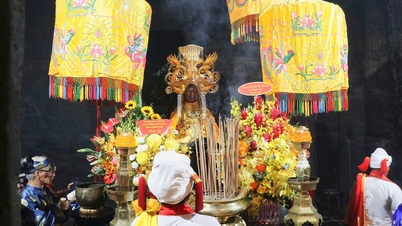
| Locals and tourists come to worship at the ancient temple. |
Legend of the Golden Mountain
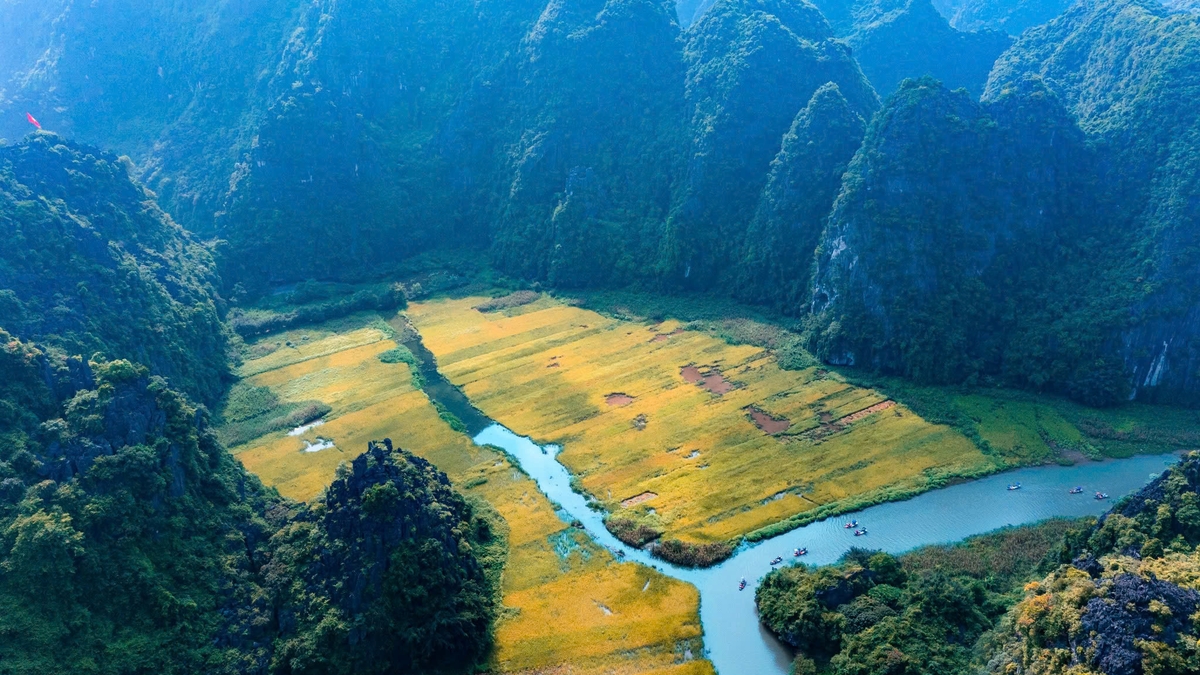
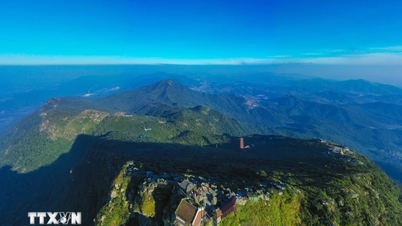
“Upper Du, Duom; Lower Luc Dau Giang/If you haven't visited Hang Pagoda, you haven't returned home.” This old folk song serves as a reminder, a promise. In the flat plains of Linh Son (formerly part of Chua Hang town, Dong Hy district), three limestone mountains rise majestically. The central mountain, named Huyen Vu, is tall and sturdy, flanked by Thanh Long and Bach Ho, lower but balanced. Seen from afar, the mountains form the shape of a throne, like a natural screen guarding the northwestern gateway of Thai Nguyen .
Deep within that mountain lies Hang Pagoda - Kim Son Tu, dating back to the 11th century during the Ly Dynasty. "Kim Son" means "golden mountain," a name associated with the legend that King Ly Thanh Tong dreamt of being led by Buddha to a beautiful land in Dong Hy. Queen Y Lan, acting on behalf of the king, saw the picturesque scenery and fascinating caves, and immediately bestowed a title to build a pagoda to worship Buddha.
The ancient temple is nestled within a vast limestone cave. Upon reaching the cave entrance, two guardian statues stand majestically: the Good Man riding an elephant and the Evil Man riding a tiger. The cave's vault is high, with long, cascading stalactites. Stone columns rise in fantastical shapes. The cave walls bear the inscriptions of renowned scholars such as Vu Quynh, Dang Nghiem, and Cao Ba Quat… These words, carved into the stone, are silent, enduring, and clear, as if anchoring time so that people today can still read the heartfelt sentiments of their ancestors.
The Dragon's Eye Well lies deep within the cave, its waters abundant and cool year-round. Locals call it the Fairy Cave, a legend that says fairies once descended here to stroll, play chess, and bathe. "A mountain's fame doesn't lie in its height; a fairy's presence brings fame; a body of water's sacredness doesn't lie in its depth; a dragon's presence makes it sacred." Therefore, the sacredness of Hang Pagoda lies not only in its geographical location but also in the layers of cultural and religious heritage accumulated over generations.
In the 20th century, this place was not only a place of worship but also a revolutionary stronghold. The pagoda once sheltered cadres, stored weapons, and served as a communication station. Venerable Thich Tam Lai, one of the early advocates for the revival of Buddhism in the early 20th century, served as its abbess. Later, Abbess Thich Dam Hinh continued to restore, preserve, and expand charitable and social activities here. In each period, Hang Pagoda has been associated with a part of the history of the land and people of Thai Nguyen.
In 1999, the Hang Pagoda scenic site was recognized as a national historical site. Since 2011, a planning and restoration project has been implemented on an area of over 8 hectares with 27 components. Over the past fifteen years, the main hall, the triple gate, the ancestral house, the bell tower, etc., have gradually been completed thanks to social contributions. The precious gilded wooden statues and the exquisitely carved pillars and beams are not only architectural works but also the embodiment of community faith.
But what captivates people isn't just the grandeur, but the refreshing coolness when stepping deep into the cave. It's the sound of bells ringing amidst the spring rain, the slowing pace of their steps in the midst of a hurried life.
Spirituality and worldly life are in harmony.
The Spring Festival at Hang Pagoda in 2026 will take place on the 19th and 20th of January. According to Abbot Thich Duc Tri: On the morning of the 19th, there will be a procession of palanquins and the recitation of prayers for favorable weather; followed by the opening ceremony with the beating of gongs and drums. In the afternoon and on the 20th, there will be cultural performances by troupes from within and outside the province. Especially in the evening, artists from the Central Cai Luong (Vietnamese traditional opera) Center will perform outstanding plays and excerpts for the general public. The festival will include competitions such as throwing the "con" (a type of ball), bamboo pole dancing, tug-of-war, human chess, stick pushing, and volleyball…
After the historic flood at the end of 2025, the water level rose to within a few steps of the main hall. Many structures were submerged, the sound and electrical systems had to be replaced, and damaged religious artifacts had to be restored. Before welcoming the Lunar New Year, the temple, along with the people and Buddhist followers, spent many days cleaning up mud, disinfecting, and repairing every small corner. Quietly and persistently, they did this, like a community preserving its "shared home."
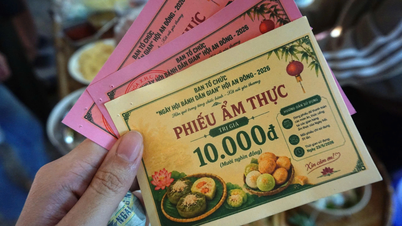
This year, the temple has also added areas for resting, enjoying tea, and practicing calligraphy. Three calligraphy spots are located in the two empty pavilions and in the courtyard of the Ancestral Hall. A "wish-granting path" is lined with prayer cards. Each card represents a small but sincere wish from visitors and Buddhist followers.
Having attended the Hang Pagoda festival for many years, 22-year-old Duong Thi Tuoi from Kha Son commune said: "Usually, I go to the pagoda once or twice a month. At the beginning of the year, I usually go to Hang Pagoda because it has very beautiful scenery with its caves and majestic rocky mountains. This year, I think Hang Pagoda has been decorated much more beautifully. And the scenery has also changed a lot."
 |
| The Hang Pagoda Festival always attracts a large number of visitors and Buddhist followers. |
Meanwhile, Mr. Vu Xuan Dai from Phan Dinh Phung ward shared his feelings: "I always remember the scene at Hang Pagoda amidst the bustling crowd: an elderly woman leaning on a cane walking slowly; a group of students laughing in the drizzle; a young family carrying a small child lighting incense sticks at the beginning of the year. Each person had their own aspirations. But we all shared a feeling of relief when the bells rang out in the heart of the mountain."
Therefore, Hang Pagoda is not just a historical site, but a living cultural space. There, the ceremonial part is simple, leaning towards meditation; the festive part is lively yet maintains tradition. There, spirituality and life are not separate, but go hand in hand.
In early spring, standing on the mountaintop and looking down, the high-rise buildings stand beside the lush green rice fields, the Cau River flows gently like a silk ribbon, and clouds drift lazily around the rocky arches. The sound of bells blends with the wind, and at the foot of the mountain, a constant stream of people ascends and descends, like the enduring breath of this land.
In the gentle drizzle, beside a cup of sweet tea, the traveler suddenly feels a sense of calm. A new cycle begins. The wishes on this "path of wishes" may differ, but the belief remains the same: belief in goodness, in the enduring nature of culture, and in the richness of history.
Source: https://baothainguyen.vn/van-hoa/202603/dau-xuan-ve-kim-son-tu-93f3756/



























































Comment (0)