

 |
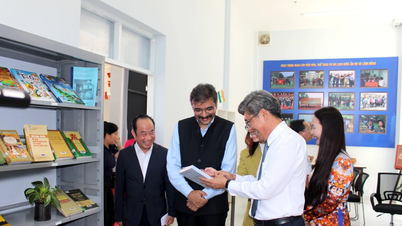
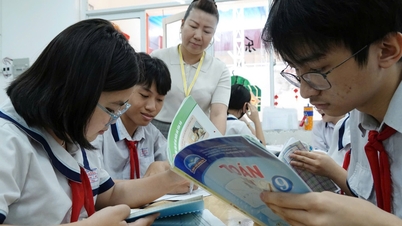
| Reading is a good habit that helps children improve their knowledge and gain many useful things. (Photo: Hong Dat) |
In the fast-paced world of the digital age, people have countless ways to access information. Nevertheless, books still hold a unique place. Reading culture not only reflects individual habits but is also a crucial indicator of a community's level of development.
Books have long been regarded as symbols of knowledge. Each page is the culmination of experiences and reflections across generations. When reading, people not only receive information but also embark on a journey of contemplation and self-dialogue. Therefore, reading becomes a process of learning with depth and systematic understanding.
From a personal perspective, reading contributes to shaping one's way of thinking, feeling, and acting. Scientific books help broaden knowledge, train logical thinking, and improve analytical skills. Literature nurtures emotions, evokes empathy, and sparks imagination. Books on history, skills, or life experiences contribute to forming character and attitudes toward life.
Unlike many forms of rapid information acquisition, reading requires concentration and patience. Readers need to actively think, connect ideas, and form their own opinions. This process creates intellectual depth—something that short bursts of information can hardly replace. Reading doesn't provide immediate answers, but it helps people learn to ask the right questions and find sustainable paths forward.
On a broader scale, reading culture reflects the quality of a society's human resources. A community with a reading habit typically possesses a solid knowledge base and high adaptability. When each individual is conscious of self-learning, society will have the impetus for innovation and long-term development. In fact, countries with high reading rates are often associated with strong development of the knowledge economy .
However, current reading culture faces many challenges. The explosion of digital technology has changed the way people receive information. Many people today are accustomed to receiving information quickly, concisely, and continuously, leading to a tendency towards superficial reading lacking depth. In particular, young people are easily swept along by the flow of information on social media without taking the time to verify or reflect on it.
Although technology helps to spread knowledge more widely, without guidance, people can easily fall into a state of "lots of information but little understanding." When accustomed to fragmented pieces of information, systemic thinking and the ability to conduct in-depth analysis are also affected.
This raises a thought-provoking issue: When information becomes abundant, without the ability to filter and think critically, readers can easily become overwhelmed while still lacking substantive knowledge. Reading then ceases to be a process of accumulating value and becomes merely superficial reception. Therefore, what is needed is not to read more, but to read selectively, thoughtfully, and with clear goals, so that knowledge can truly be transformed into action and value.
 |
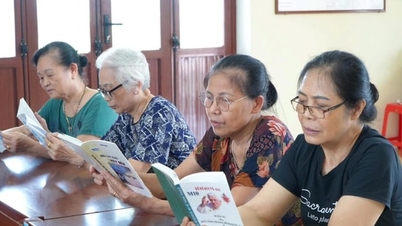
| Cultivating a reading habit in children is extremely important. (Source: Hanoimoi) |
Therefore, building a reading culture requires a long-term and synchronized approach. The family can be considered the starting point, creating a positive reading environment for children. Schools continue to nurture this habit by encouraging diverse reading, not only for academic purposes but also for holistic development. At the same time, appropriate policies and activities are needed to make books more accessible to everyone.
Furthermore, the roles of the author and publisher are also crucial. Each book is not just a product, but also contributes to the common spiritual life. Therefore, content quality must be prioritized, ensuring accuracy and humanistic value. When readers find truly meaningful books, their belief in and interest in reading will be strengthened.
In this new context, reading culture is not opposed to technology. E-books, audiobooks, and online platforms can all become useful tools if used correctly. The key lies not in the form, but in how it is accessed.
When reading becomes a natural need, people will turn to books to gain more understanding and broaden their world. At that point, each individual will not only acquire knowledge but also be able to create and contribute back to society.
More broadly, promoting a reading culture affirms the role of knowledge in sustainable development. In a constantly changing world, self-learning abilities and deep thinking are fundamental to human adaptation. And reading books in a simple yet persistent way is the path to nurturing those abilities.
It can be said that reading culture is not formed in a short time but is a long journey. However, the values it brings will be sustainable for both individuals and the community. In today's increasingly fast-paced life, dedicating time to reading is also a way for people to not only accumulate knowledge but also to better understand themselves.
In modern society, with the impact of technology, it's not just about how much you read, but how you read. An effective reader is someone who knows how to choose, how to reflect, and how to transform knowledge into their own understanding. When reading is linked to the need for personal development, knowledge truly becomes a driving force.
Source: https://baoquocte.vn/de-doc-sach-khong-chi-la-thoi-quen-384293.html


![[Photo] General Secretary and President To Lam receives Amazon's Senior Vice President David Zapolsky](https://vphoto.vietnam.vn/thumb/1200x675/vietnam/resource/IMAGE/2026/05/22/1779466547770_a1-bnd-3513-6601-jpg.webp)

















































































Comment (0)