

How do higher education institutions adapt to meet the learning needs of students and the labor market?
Opportunities abound for learners.
Dr. Do Viet Tuan – Head of the Department of Information Technology and Communications (Academy of Educational Management) predicts that in the next few years, at least 500,000 more workers in the information technology field will be needed. The average salary for workers in this field in 2024 will range from $1,100 to $3,000. Experts in specific fields such as AI and cybersecurity may even earn exceptionally high salaries of up to $10,000.
In recent years, many higher education institutions have opened new or expanded and developed majors and specializations related to information technology, while also innovating training programs to meet new requirements in order to satisfy the needs of learners and adapt to the labor market.
According to Dr. Do Viet Tuan, the Academy of Educational Management has developed and implemented a plan to improve its training programs based on five strategic action groups, aiming to adapt to the development trends of artificial intelligence (AI) and the new demands of the labor market. Firstly, it updates training objectives to focus on developing digital competencies. Secondly, it redesigns the training program to be more flexible and interdisciplinary. AI is converging with many fields such as healthcare , finance, education, engineering, and law. Therefore, students need interdisciplinary work skills to adapt.
Third, invest in developing digital infrastructure and a smart learning ecosystem. Accordingly, students need to learn in a digitized environment that mirrors the real-world working environment of businesses operating with AI. Fourth, retrain and enhance the capacity of faculty. Fifth, connect with businesses and build an innovation ecosystem.
In 2026, Thang Long University reviewed, adjusted, and updated its entire training program, reducing the study duration from 4 years to 3 or 3.5 years while maintaining the same tuition fee for the entire course; and adding content to meet the demands of the labor market.
Dr. Nguyen Thi Thu Ha – advisor on training and quality assurance – and permanent member of the Admissions Council, stated that the university is strengthening students' digital technology capabilities. For example, the Business Administration major is enhancing its expertise in Modern Management, Digital Management, and Digital Business. The Marketing major is strengthening its focus on Digital Marketing. The Logistics and Supply Chain Management major is strengthening its focus on Digital Logistics. Or the Finance and Banking major is strengthening its focus on Fintech (Financial Technology).
Dr. Nguyen Thi Thu Ha affirmed that the training programs will provide students with both in-depth knowledge of the field, meeting the requirements of the labor market, and the ability to master digital technology so that they can confidently enter the labor market with a full set of professional and digital skills.
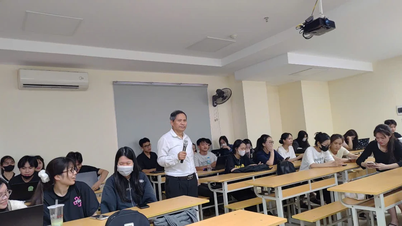
 Candidates learn about the majors/training programs offered by Thang Long University. Photo: NTCC
The university is innovating its curriculum.
Currently, all technology programs at CMC University (Hanoi) are designed according to US standards and are practical and real-world in nature. Associate Professor Dr. Vu Viet Vu – Head of the Faculty of Information Technology and Communications – stated that since the previous academic year, the university has proactively applied AI in various aspects of its operations. In training, students are supported by an AI-powered teaching assistant system upon enrollment. This is a significant change in the university's training process.
AI is creating profound changes in higher education, especially in information technology programs. Dr. Do Viet Tuan observes that AI is impacting the organizational model of training. Many universities have proactively opened new majors such as AI, Data Science and AI, in order to specialize training and increase its adaptability to reality.
Furthermore, AI also acts as a catalyst for close collaboration between schools and businesses, facilitating the development of blended learning models, hands-on learning, and project-based learning, helping students enhance their application skills in the workplace after graduation.
AI directly impacts the content of training programs. The rapid development of AI forces universities to update and restructure their curricula to meet the new demands of the labor market.
Previously, information technology programs primarily focused on traditional content such as programming with C, C++, Java, database administration, or basic algorithms. However, in the context of the AI boom, content related to machine learning, deep learning, data engineering, intelligent model development, and automated system building is increasingly emphasized.
Furthermore, subjects that were once central, such as operating systems or computer networks, are gradually giving way to subjects like AI application development and cloud-AI integration.
According to Dr. Do Viet Tuan, AI promotes innovation in teaching methods. AI contributes to transforming traditional teaching methods into modern learning models. Personalized learning through AI-integrated online learning platforms is becoming increasingly popular.
Furthermore, AI technology supports automation in assessment and testing, as well as enhancing the application of project-based learning methods, helping learners develop practical skills more effectively. In addition, the required output skills are also changing.
Based on the above situation, Dr. Do Viet Tuan emphasized that information technology students need to equip themselves with more in-depth skills related to AI to meet new recruitment demands. While previously learning mainly revolved around database administration, now knowledge of big data processing, data analysis, and intelligent data system management has become essential.
Similarly, traditional information security skills are expanding into the field of AI-based security, requiring students to have a thorough understanding of both algorithms and security threats in intelligent systems.
Currently, information technology fields with high recruitment demand include: AI and machine learning; cybersecurity; data science, software development, mobile applications, and blockchain technology. Professor Ha Huy Khoai, Director of the Thang Long Institute of Mathematics and Applied Sciences and Head of the Faculty of Information Technology at Thang Long University, stated that compared to many other training programs at the university, information technology students have relatively easy job prospects. Many students have secured employment as early as their third or fourth year. This demonstrates that the demand for human resources in this field remains very high.
Regarding the new regulations for university admissions in 2026, Professor Ha Huy Khoai advised candidates to choose a major that suits their abilities and interests. To pursue a long-term career and develop professionally, students need to have a genuine passion for their chosen field, thereby maintaining a spirit of self-learning and continuously improving their skills.
Source: https://giaoducthoidai.vn/don-con-khat-nhan-luc-cong-nghe-thong-tin-post778086.html
![[Image] Hanoi's urban life under the challenge of a "scorching hot" environment](https://vphoto.vietnam.vn/thumb/1200x675/vietnam/resource/IMAGE/2026/05/25/1779706979265_nang-nong-t5-2026-minh-duy-7-4636-jpg.webp)




![[Image] Close-up view of the interchange connecting the two expressways and Long Thanh Airport.](https://vphoto.vietnam.vn/thumb/1200x675/vietnam/resource/IMAGE/2026/05/25/1779703378210_ndo_br_z7863716673926-224453a31600126cce10622af6290afd-4549-jpg.webp)



























































































Comment (0)