

According to statistics submitted by candidates, the Vietnamese language score distribution is the lowest among all subjects. Even top-scoring and second-highest scorers, despite achieving perfect scores in two sections, still did not have impressive Vietnamese language scores.
The Vietnamese language section of the first aptitude test wasn't actually too difficult and was much better than previous aptitude tests, but it did have a high degree of differentiation.
Key points to note from the first Vietnamese language exam.
Sentences about spelling, word usage, grammar, and real-life situations are all closely related to our daily language habits. The professor found it difficult because these are words the students don't usually use, such as "desperate" or "desperate thinking," and Sino-Vietnamese words like "old friend" or "ancient person."
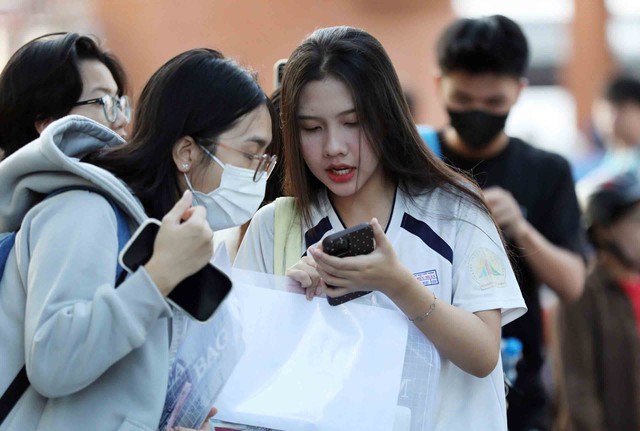
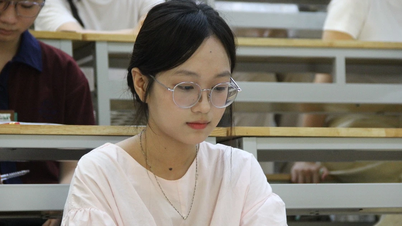
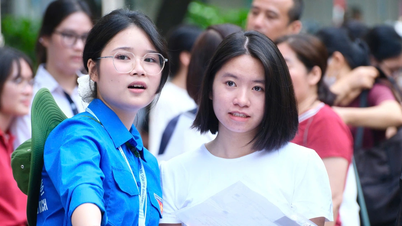
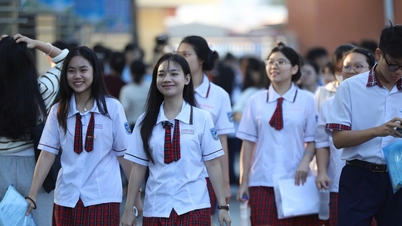
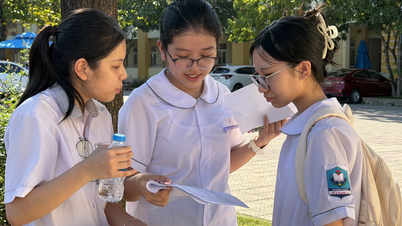
Candidates who have completed the first phase of the 2026 National University of Ho Chi Minh City's aptitude test.
PHOTO: NGOC DUONG
The two reading comprehension passages, one informative and one argumentative, delve deeply into the ability to apply the characteristics of each text genre to answer the questions. This is a highlight, showing that the exam closely follows the 2018 general education curriculum in the Vietnamese language and literature subject.
Besides the two reading comprehension passages (comprising 10 questions), the exam includes 11 reading comprehension questions on literary texts, covering various levels of recognition and understanding. This section is quite long, with literary texts from many different genres: mythology, medieval poetry and prose, drama, non-fiction, short stories, etc. Preliminary statistics show: there is one question about folk tales, two questions about rhetorical devices in poetry and short stories, one question about the characteristics of dramatic characters, one question about the characteristics of symbolic poetry, one question about the lyrical self in essays, and two questions about medieval poetry and prose… This indicates that the exam assesses not only depth but also breadth of ability.
The questions are diverse and highly challenging in terms of reading comprehension. Besides questions familiar to candidates such as: characteristics of folk tales, rhetorical devices, main content, and character traits; there are also questions about the meter and rhyme scheme of Tang Dynasty poetry, the characteristics of the "self" in non-fiction texts, or symbolic poetic imagery… This is a relatively new type of question. Therefore, it is possible that this "novelty" will continue in the second exam.
What should candidates do for the second exam session?
This is the time for candidates to engage in two types of practice: reading practice and exam practice. Reading practice helps candidates read quickly, grasp the main ideas well, and avoid struggling when tackling a long exam. Exam practice helps candidates become familiar with time constraints, and their brains become accustomed to processing information from multiple perspectives.
The discipline that candidates need to establish at this stage is to try to solve 3 practice tests per week. They should attempt each test within a fixed time limit of 150 minutes to get used to the time factor.
For questions related to language usage habits (such as spelling, grammar, word usage, etc.), besides practicing with sample tests (to learn new vocabulary), candidates should not spend too much time on these questions. Because these are questions related to habits, the shared experience is: for this type of question, you can only answer "I know" or "I don't know." Therefore, spending time thinking about these questions during the exam is unnecessary; instead, you should allocate your time to other questions and subjects.
Students need to master the characteristics of various text genres: poetry, short stories, plays, folk literature, non-fiction, informational texts, and argumentative texts. They should review their knowledge of genres. Not only do they need to master this knowledge, but they must also practice using it to understand specific texts by working through practice questions from reputable sources.
Source: https://thanhnien.vn/de-lam-tot-phan-tieng-viet-bai-thi-danh-gia-nang-luc-185260504184314343.htm
![[Image] Close-up view of the interchange connecting the two expressways and Long Thanh Airport.](https://vphoto.vietnam.vn/thumb/1200x675/vietnam/resource/IMAGE/2026/05/25/1779703378210_ndo_br_z7863716673926-224453a31600126cce10622af6290afd-4549-jpg.webp)



![[Image] Hanoi's urban life under the challenge of a "scorching hot" environment](https://vphoto.vietnam.vn/thumb/1200x675/vietnam/resource/IMAGE/2026/05/25/1779706979265_nang-nong-t5-2026-minh-duy-7-4636-jpg.webp)





























































Comment (0)