

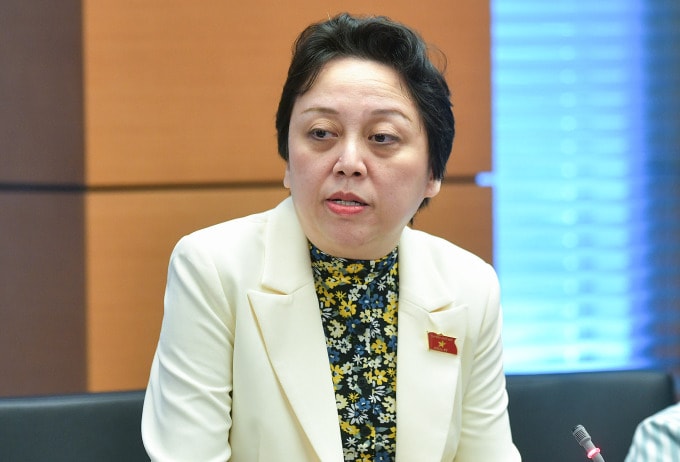
During a group discussion on socio-economic issues at the National Assembly on the morning of October 26th, the Director of the Ho Chi Minh City Food Safety Department expressed his concern: "Vietnam is striving to increase the birth rate, but Party members who have a third child are still being disciplined."
She cited a case where a party member had a third child, and doctors concluded that despite using contraception, she still experienced an "unplanned pregnancy." Subsequently, the doctors had to work with authorities to verify whether issuing a certificate of unintended pregnancy was correct.
"For officials and Party members who are about to be appointed to a new position and have a third child, it's pretty much over. Especially close to the grassroots Party Congress, some people have no shortcomings but still receive complaints for having a third child," Ms. Lan stated, describing the current situation.
Therefore, the female delegate from Ho Chi Minh City suggested that the authorities should amend these regulations soon, because "these are all matters within their purview."
"The policy of disciplining party members who have a third child may have been correct in the past, but now that Vietnam's birth rate is low, we need to change our perspective on having children," Ms. Lan said.
Agreeing with Ms. Lan's viewpoint, Professor Nguyen Thien Nhan said he had previously suggested to the competent authorities that they abolish the disciplinary regulation against party members who have a third child to be in line with the new situation.
In modern society, families who feel they cannot afford to raise children simply have fewer children. Only families who are capable of raising children well have many children.
While Vietnam's birth rate is declining rapidly, the authorities need to amend regulations soon to remove barriers and eliminate the reluctance of officials and Party members to have a third child.
Removing the disciplinary regulation against party members for having a third child also aims to communicate to the public about population policy in the new context.
Mr. Nhan expressed concern that Vietnam's fertility rate in 2023 was 1.96, while the ideal replacement fertility rate is 2.1 children per woman. Seven years ago, the Central Committee requested that the total replacement fertility rate be maintained, but this has not been achieved.
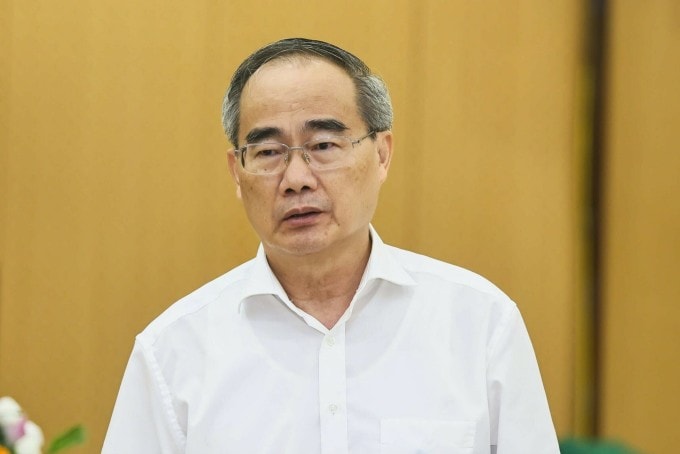
Therefore, he "earnestly requested" the Government to add the total replacement fertility rate index to the socio-economic report in order to take measures to raise the birth rate. "This is a crucial national indicator, related to human development and the sustainability of the country," Mr. Nhan explained.
At the same time, Mr. Nhan hopes that the Government will soon announce the minimum living wage and the minimum living wage for a family of four.
"A minimum living wage means that a working person can support their dependents and raise their children. Only then can we increase the birth rate, with each family having two children. If we don't announce a minimum living wage and don't raise it, we have no way to increase the birth rate," Professor Nhan suggested.
The government also needs to develop a happiness index for Vietnamese people, taking into account global best practices, in order to build happy lives for Vietnamese people.
Local authorities base their development policies on the national happiness index.
Representative Pham Duc An, Chairman of the Board of Directors of Agribank, agreed that declining birth rates are a long-term problem for Vietnam. The rate in urban areas is the most worrying, as families lack the necessary economic resources, housing, income, and education, thus hesitating to have children.
Mr. Ấn warned that the consequences of Japan's aging population serve as a clear lesson for Vietnam. "There are factories that used to produce diapers for babies now switching to making diapers for adults," Mr. Ấn said. The delegate suggested that the government needs fundamental, long-term solutions to comprehensively address this issue.
According to the Population Ordinance of 2003, amended in 2008, each couple or individual decides the timing and spacing of childbirth; they can have one or two children, except in special cases as stipulated by the Government.
Meanwhile, the 2017 Central Resolution on population policy in the new situation emphasizes the pioneering and exemplary role of cadres and Party members in implementing population policies, especially having two children.
Party members who have a third child are considered to be in violation of population policy and may be subject to disciplinary action, except in a few specific cases.
TB (according to VnExpress)Source: https://baohaiduong.vn/de-xuat-bo-quy-dinh-ky-luat-dang-vien-sinh-con-thu-ba-396525.html
![[Photo] First session of the 14th Congress of the Vietnam Trade Union](https://vphoto.vietnam.vn/thumb/1200x675/vietnam/resource/IMAGE/2026/06/03/1780465947883_ndo_br_img-3852-jpg.webp)
![[Photo] General Secretary and President To Lam presides over a meeting with the Central Organizing Committee.](https://vphoto.vietnam.vn/thumb/1200x675/vietnam/resource/IMAGE/2026/06/03/1780482764658_a1-bnd-4741-3342-jpg.webp)

![[Photo] Secretary of the National Assembly Party Committee, Chairman of the National Assembly presides over the meeting of the Standing Committee and Executive Committee of the National Assembly Party Committee.](https://vphoto.vietnam.vn/thumb/1200x675/vietnam/resource/IMAGE/2026/06/03/1780480353201_ndo_br_bnd-2585-jpg.webp)


















































![[Video] Sunset at Lap An Lagoon – Where the sun sets over the fishing nets](https://vphoto.vietnam.vn/thumb/1200x675/vietnam/resource/IMAGE/2026/05/31/1780192137701_beach-landscape-sea-water-nature-grass-745871-pxhere-com.jpeg)




































Comment (0)