

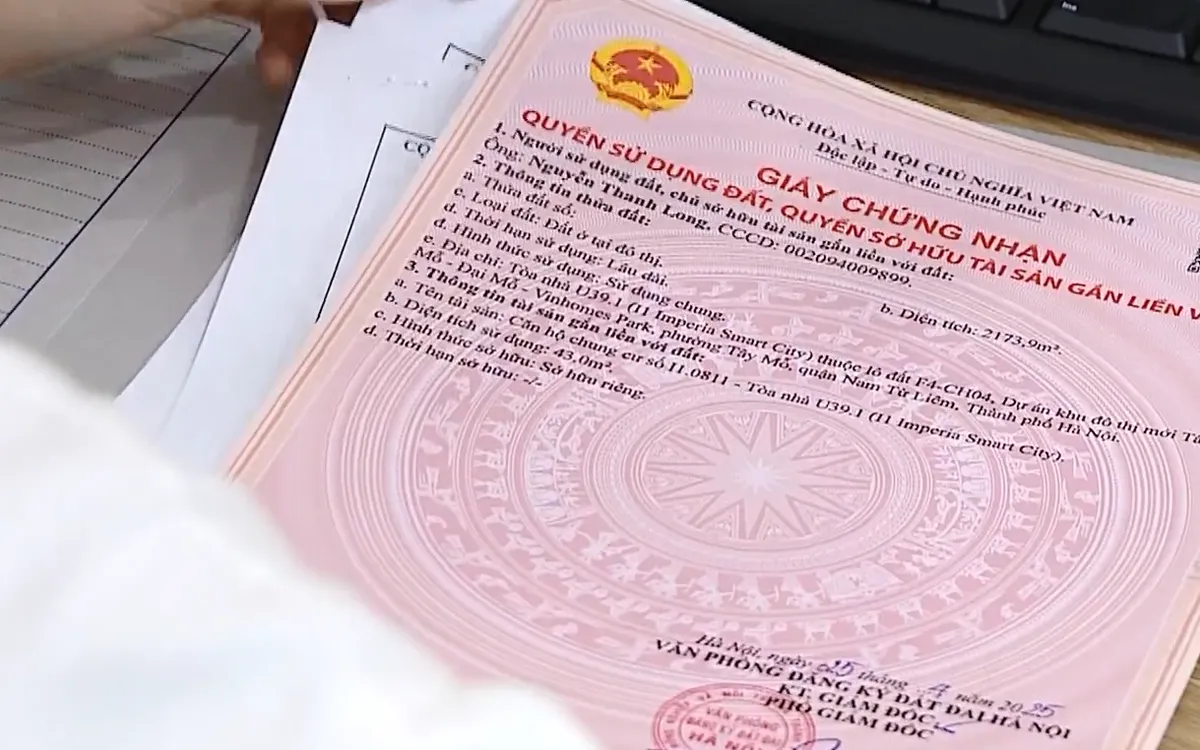
Proposal to issue land ownership certificates for land bought and sold using handwritten agreements.
Specifically, in its proposal to include the draft Law amending and supplementing several articles of the Land Law in the 2026 legislative agenda, the Ministry of Agriculture and Environment stated that for over a decade, a large number of land transfer transactions have encountered legal obstacles. Cases of buying and selling houses using handwritten documents are not granted land use rights certificates (red books). Landowners are restricted from transactions and mortgages, and disputes are likely to arise.
Therefore, to ensure the rights of the people, the Ministry proposes recognizing land use rights for cases of buying and selling with handwritten documents during the period from July 1, 2014 to August 1, 2024 - the date the 2024 Land Law comes into effect. This controlled legalization not only protects the legitimate rights of the people but also helps bring "off-the-books" transactions into the official management system.
Another noteworthy issue concerns the rights of land users during the period when a land acquisition notice has been issued but no decision has yet been made. Currently, in this "gap," land users can still conduct transactions such as transferring, gifting, or contributing land use rights as capital, creating a phenomenon of buying and selling in anticipation of compensation in order to benefit from the policy.
To close this loophole, the Ministry proposes that transferees during the aforementioned period be entitled only to compensation, support, and resettlement rights corresponding to those of the previous land users. This approach is expected to curb speculation while ensuring fairness in the compensation and land clearance process.
Regarding rice-growing land, the draft also proposes adjustments aimed at reducing administrative procedures. Specifically, individuals who acquire rice-growing land exceeding the permitted limit but have a suitable investment project will no longer be required to prepare additional land use plans as before, and will not be required to establish an economic organization.
In addition, cases involving land with complex origins, such as those involving encroachment or unauthorized allocation in the past, are being handled more flexibly, based on practical usage and minimizing disputes.
Source: https://vtv.vn/de-xuat-cap-so-do-cho-dat-mua-ban-bang-giay-viet-tay-100260508130544975.htm


![[Image] Close-up view of the interchange connecting the two expressways and Long Thanh Airport.](https://vphoto.vietnam.vn/thumb/1200x675/vietnam/resource/IMAGE/2026/05/25/1779703378210_ndo_br_z7863716673926-224453a31600126cce10622af6290afd-4549-jpg.webp)

![[Image] Hanoi's urban life under the challenge of a "scorching hot" environment](https://vphoto.vietnam.vn/thumb/1200x675/vietnam/resource/IMAGE/2026/05/25/1779706979265_nang-nong-t5-2026-minh-duy-7-4636-jpg.webp)





















































































Comment (0)