

 |
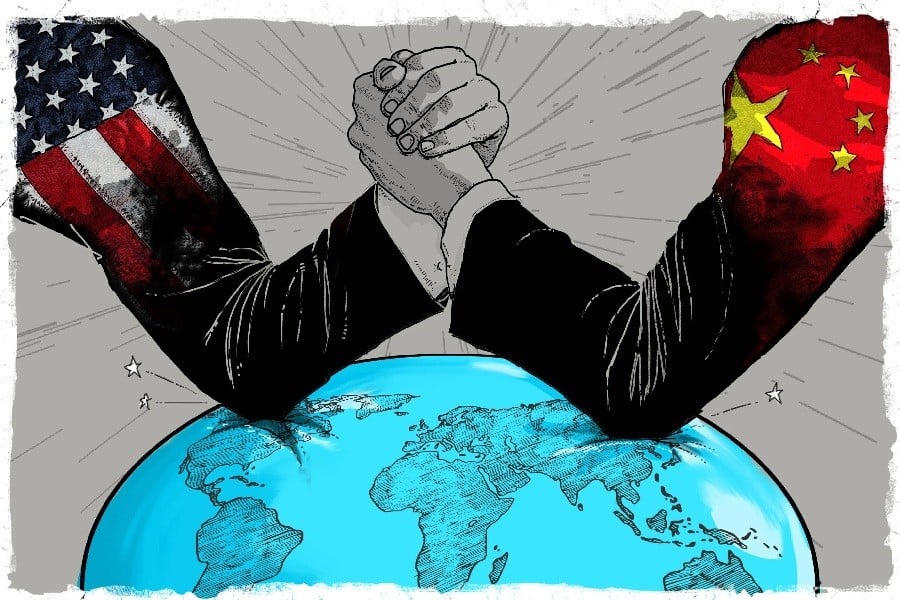
| US-China rivalry: It's time for Beijing to retaliate and declare it can no longer remain silent... (Source: SCMP) |
For many years, economic tensions between the US and China have been at times loud and at times simmering, but have never shown any sign of ending.
In 2019, as the US-China trade war heated up, the People's Daily predicted that China's monopoly on rare earth minerals, crucial for manufacturing state-of-the-art hardware, would become a tool to counter pressure from the US.
According to data from the Organization for Economic Cooperation and Development (OECD), the number of export control measures implemented by China increased ninefold between 2009 and 2020. However, these restrictions are often random, informal, and targeted at narrow objectives. This move is seen as more of a random warning than a strategic move.
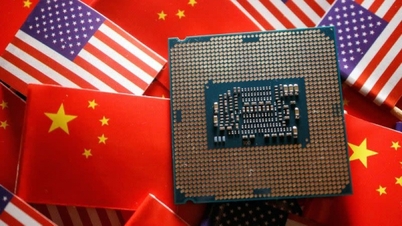
As the U.S. intensified sanctions against China, preventing Western chip companies from selling advanced semiconductors and chip-making machinery to Chinese customers, new and rapid retaliatory measures from Beijing began to mount.
In early July, after China announced its latest export controls, this time on two key metals used in chips and other advanced technologies, a former U.S. Commerce Department official suggested that these measures were “just the beginning” of China’s retaliation.
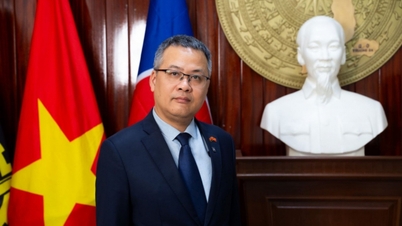
On July 20, Ta Phong, China's new ambassador to the United States, said that his country "cannot remain silent" in the escalating technology war.
In response to U.S. efforts to curb China's technological ambitions, Chinese President Xi Jinping has called on regulators to resist U.S. coercion in what he calls an "international legal struggle."
As a result, many lawmakers are being rallied in an effort to create a framework for China to respond more forcefully in the trade war with the United States.
A list of “unreliable entities,” created in 2020, punishes any company that undermines China’s interests. The export control law of the same year established the legal basis for the export licensing regime.
In 2021, the anti-sanctions law allowed for retaliation against organizations and individuals implementing sanctions imposed by other countries.
A sweeping foreign relations law enacted this year, spurred by Western sanctions against Russia, allows for the use of countermeasures against a range of economic and national security threats facing Asia's number one economy, and came into effect on July 1st.
On the same day, an anti-espionage law also came into effect, expanding the scope of operations for Chinese security agencies. Meanwhile, Beijing tightened various cybersecurity and data security rules. The new rules were implemented, as opposed to merely serving as a warning.
In February, Lockheed Martin and a unit of Raytheon, two American arms manufacturers that do not conduct arms business in China, were placed on a list of unreliable entities after shipping weapons to the territory of Taiwan (China).
American companies are blocked from making new investments, conducting trade, and facing numerous other restrictions in China.
In April, Micron, a US chip manufacturer, was investigated by China's cybersecurity authorities under a new cybersecurity law. After Micron failed a security review, US regulators banned the use of its chips in critical US infrastructure.
The ambiguous wording of the law makes it difficult for American and Western companies to assess the potential impact on their business operations in China. Several foreign law firms in China have been asked by their Western clients to assess the risks of investigations.
The results of potential investigations in China note that American technology companies that manufacture components, such as Micron's memory chips, should be wary of unexpected investigations.
Meanwhile, China's new laws, which allow the government to restrict various minerals and components, are also creating uncertainty for the business operations of its foreign partners.
David Oxely, an expert at the international consulting firm Capital Economics, noted that Western green energy technology manufacturers will certainly be affected. In particular, battery manufacturers are heavily reliant on China throughout their entire supply chain.
Last year, China's Ministry of Commerce proposed a ban on the export of ingot casting technology used to manufacture solar panels.
If implemented, this ban could stifle the development of solar energy technology in the West, harming Western manufacturers while increasing demand for solar panels of Chinese origin.
Restrictions on two key metals in chip manufacturing, gallium and germanium, could cause headaches for U.S. strategists. The rules, effective August 1, require exporters to obtain licenses to sell the metals to foreign customers.
China produces 98% of the world's crude gallium, a key component in advanced military technology. A shock to the gallium supply could cause long-term problems for the U.S. defense industry, according to an assessment by the CSIS research institute, a Washington-based strategic think tank.
Furthermore, a gallium-based compound, gallium nitride, could form the basis for a new generation of high-performance semiconductors. Keeping gallium out of reach of foreign countries would certainly hinder Western efforts to develop this technology.
However, from another perspective, Peter Arkell, an expert from the China Global Mining Association (a lobbying group), notes that China may have to re-import many finished products manufactured abroad using rare earth elements, so the bans could backfire and harm Chinese companies themselves.
Ewa Manthey, an analyst at the Dutch bank ING, commented that complete export bans would also prompt the West to build its own suitable production capacity and seek substitutes. This, in the long run, would weaken China's leverage.
Furthermore, labeling large Western companies operating in China as untrustworthy entities could backfire, jeopardizing thousands of Chinese jobs.
For example, Raytheon has an aerospace subsidiary, Pratt & Whitney, that employs 2,000 people in China. This may explain why, instead of blacklisting all of Raytheon's subsidiaries, the Chinese Ministry of Commerce limited the ban to the company's defense unit.
Source
![[Photo] General Secretary and President To Lam presides over a meeting with the Central Organizing Committee.](https://vphoto.vietnam.vn/thumb/1200x675/vietnam/resource/IMAGE/2026/06/03/1780482764658_a1-bnd-4741-3342-jpg.webp)

![[Photo] First session of the 14th Congress of the Vietnam Trade Union](https://vphoto.vietnam.vn/thumb/1200x675/vietnam/resource/IMAGE/2026/06/03/1780465947883_ndo_br_img-3852-jpg.webp)


![[Photo] Secretary of the National Assembly Party Committee, Chairman of the National Assembly presides over the meeting of the Standing Committee and Executive Committee of the National Assembly Party Committee.](https://vphoto.vietnam.vn/thumb/1200x675/vietnam/resource/IMAGE/2026/06/03/1780480353201_ndo_br_bnd-2585-jpg.webp)








































![[Video] Sunset at Lap An Lagoon – Where the sun sets over the fishing nets](https://vphoto.vietnam.vn/thumb/1200x675/vietnam/resource/IMAGE/2026/05/31/1780192137701_beach-landscape-sea-water-nature-grass-745871-pxhere-com.jpeg)






























Comment (0)