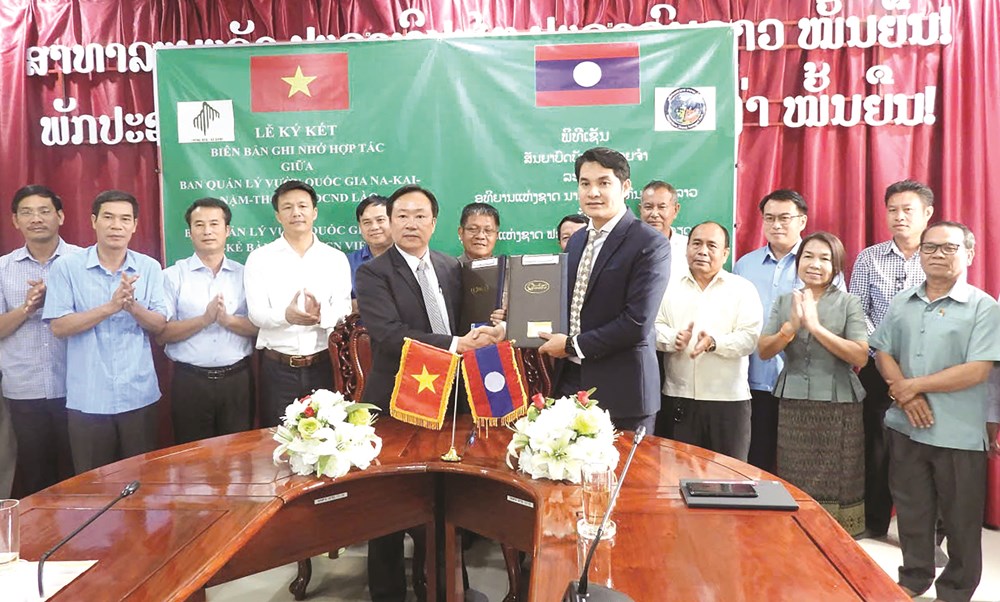
 Every year, Quang Binh and Khammouane provinces meet to reach agreements aimed at contributing to the preservation of the cross-border heritage of both sides.
A cross-border romance
Phong Nha-Ke Bang National Park and Hin Nam No National Park are highly regarded by scientists and international organizations for their conservation value and global significance in terms of science, education , and development. Since June 1998, Phong Nha-Ke Bang National Park and Hin Nam No National Biodiversity Conservation Area (now Hin Nam No National Park, Khammouane) have established a formal cooperation relationship through a Joint Declaration on Cross-Border Biodiversity Conservation. Since then, along with the development and strengthening of ties between the two countries and provinces, cooperation between Phong Nha-Ke Bang National Park and Hin Nam No National Park has continued to achieve many new successes, aiming towards the goal of creating a cross-border heritage site.
A significant milestone in the cooperation between the two National Parks was in 2016, when, with the support of the German International Cooperation Organization (GIZ) through the Phong Nha - Ke Bang Regional Project, the two sides completed a joint map of Phong Nha - Ke Bang and Hin Nam No National Parks; established a working group to support cross-border cooperation, and began conducting regular dialogues and exchanging technical information.
Subsequently, in 2020, the Ministry of Culture, Sports and Tourism sent a delegation of experts, including members from the Department of Cultural Heritage, Phong Nha - Ke Bang National Park, and the Department of International Cooperation, to assist Laos in completing the dossier for Hin Nam No National Park to submit to the United Nations Educational, Scientific and Cultural Organization (UNESCO).
The proposal to recognize Phong Nha - Ke Bang and Hin Nam No as a transboundary heritage site not only affirms the global value of the area but also opens up opportunities for international cooperation in conservation and sustainable development. Once recognized, this area will become a model for cross-border cooperation in protecting natural heritage and jointly developing tourism .”
(Mr. Nguyen Chau A , General Director of Oxalis Co., Ltd.)
At the workshop commemorating the 20th anniversary of Phong Nha - Ke Bang National Park being recognized as a World Natural Heritage Site (2023) organized by Quang Binh province, Mr. Khamkeo Latthayod - Director of Hin Nam No National Park - stated: If Hin Nam No National Park's nomination as a World Natural Heritage Site is accepted by UNESCO, and it becomes a transboundary extension of the Phong Nha - Ke Bang National Park World Natural Heritage Site, it will be the first World Natural Heritage Site in Laos.
Most recently, on June 29, 2024, Quang Binh and Khammouane provinces signed an agreement on comprehensive cooperation in tourism development, conservation and promotion of values, as well as further completing the joint dossier for the first transboundary World Natural Heritage site in Southeast Asia: Phong Nha-Ke Bang National Park and Hin Nam No National Park.
Mr. Pham Hong Thai, Director of Phong Nha - Ke Bang National Park, said: “Quang Binh province has provided full support to Laos to expedite the submission of documents to the relevant authorities. Both sides are actively cooperating on conservation and promotion of shared values in biodiversity, geology, and geomorphology. Every year, Quang Binh and Khammouane meet to reach agreements aimed at contributing to the preservation of cross-border values and landscapes of both sides.”
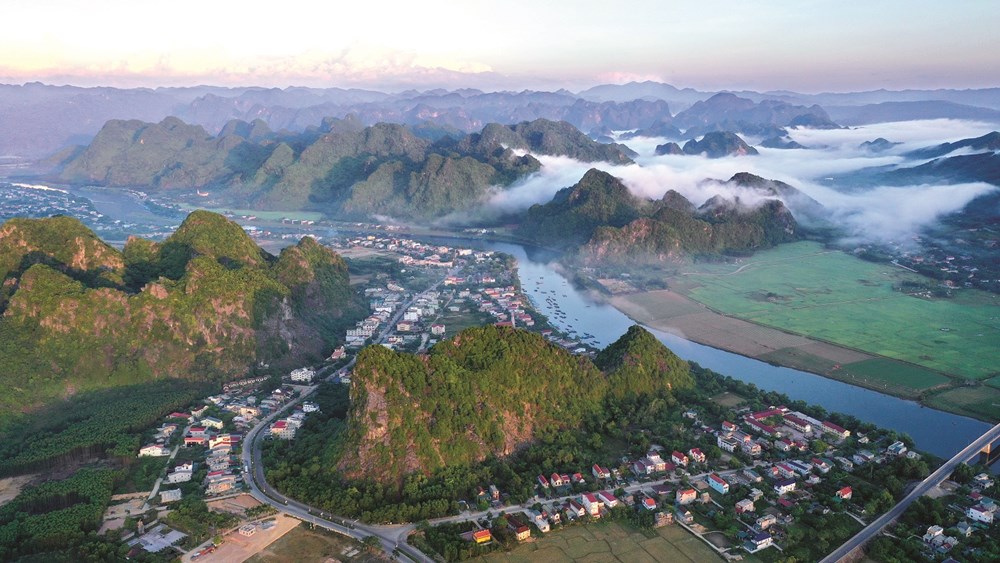 Phong Nha - Ke Bang National Park has a seamless geological and geomorphological connection with Hin Nam No National Park (Laos).
Sparkling blue "diamonds"
Often described as sparkling blue diamonds, Phong Nha-Ke Bang National Park and Hin Nam No National Park are magnificent natural treasures located on the Vietnam-Laos border.
Phong Nha - Ke Bang National Park covers over 125,700 hectares, spanning two districts, Bo Trach and Minh Hoa (Quang Binh province). Characterized by dense limestone formations, Phong Nha - Ke Bang is considered the "Kingdom of Caves," boasting over 400 caves of varying sizes, including Son Doong Cave, which the British Royal Cave Association considers the world's largest cave. The park also possesses a system of underground rivers and rare flora and fauna, many of which are listed in the Vietnamese Red Book and the World Red Book. With its invaluable global geological, geomorphological, and biodiversity values, Phong Nha - Ke Bang National Park has been twice recognized by UNESCO as a World Natural Heritage Site.
Across the border, Hin Nam No National Park, located in Bualapha District (Khammouane Province, Laos), covers a total area of over 82,000 hectares. With its rich ecosystem nestled among continuous limestone mountains, it is home to a diverse range of animals, including 40 species of mammals, over 200 species of birds, 25 species of bats, 46 species of amphibians and reptiles, over 100 species of fish, and more than 520 species of plants. Many rare species can be found here, such as the red-footed langur, the white-cheeked black gibbon, the Vu Quang muntjac, the fruit bat, the spotted bat, the Io bat, the hornbill, and the black rock thrush.
A unique feature of Phong Nha-Ke Bang and Hin Nam No is their geological continuity. Both belong to ancient karst formations created over millions of years, forming hundreds of caves with unique structures. According to Mr. Dinh Huy Tri, Deputy Director of the Phong Nha-Ke Bang National Park Management Board, both national parks are considered among the most important ecological areas in Southeast Asia, with vast karst areas of global value in terms of biodiversity. Therefore, the management and protection of biodiversity in the Phong Nha-Ke Bang and Hin Nam No areas are interconnected.
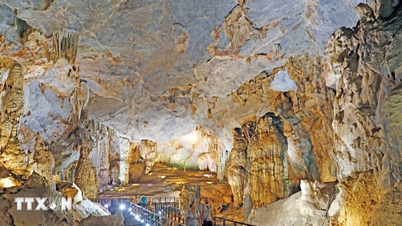
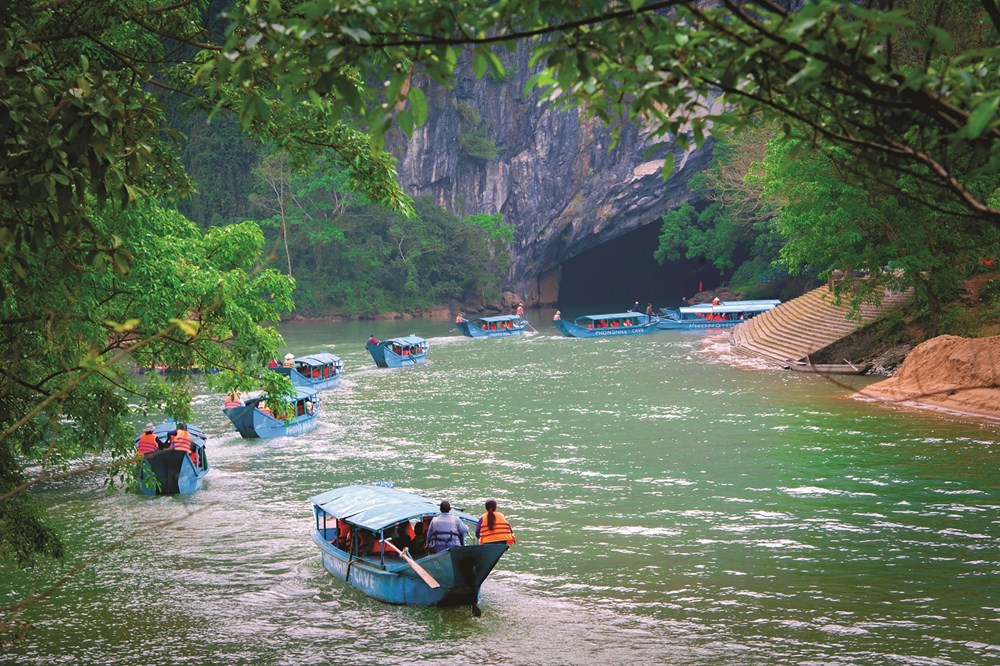 Tourists visiting Phong Nha Cave. Photo: PVT
Working together to develop tourism.
Beyond their natural value, these two areas are also closely linked culturally and in terms of tourism. The communities living around Phong Nha-Ke Bang and Hin Nam No, such as the Bru-Van Kieu and the indigenous Lao people, possess unique cultural characteristics reflecting the historical connection between the two ethnic groups. The journeys across the border are not merely about material trade, but also about cultural ties. Furthermore, the songs and festivals of the Bru and Lao people show clear similarities, from their rituals for worshipping forest spirits to their harvest festivals.
In particular, Phong Nha - Ke Bang National Park and Hin Nam No National Park have great potential for cave tourism.
After a long journey with the unity and support of the two countries, Vietnam and Laos, the tireless efforts of the ministries and departments of the two provinces of Quang Binh and Khammouane, and especially the important role of Phong Nha - Ke Bang National Park, in February 2024, the nomination dossier for Hin Nam No National Park was submitted to UNESCO.
Movement, adventure, ecology, indigenous communities. Once Phong Nha-Ke Bang National Park and Hin Nam No National Park combine into a joint national park, this transboundary heritage will form one of the world's largest limestone mountain regions.
In terms of tourism, this shared national park will also become a major destination attracting foreign tourists for cave exploration, geological and geomorphological research, and biodiversity studies, as well as for developing cross-border tours. One of the outstanding initiatives is the "Cross-border Green Tourism" program, connecting destinations in Phong Nha - Ke Bang and Hin Nam No.
Mr. Nguyen Chau A, General Director of Oxalis Co., Ltd., a tourism operator in Phong Nha - Ke Bang, said that Phong Nha - Ke Bang and Hin Nam No share similarities in their tourism development orientations and approaches, and will become partners. According to Mr. A, the proposal to recognize Phong Nha - Ke Bang and Hin Nam No as a transboundary heritage site not only affirms the global value of the area but also opens up opportunities for international cooperation in conservation and sustainable development. Once recognized, this area will become a model for cross-border cooperation in protecting natural heritage and jointly developing tourism.
Phong Nha - Ke Bang and Hin Nam No are not only treasures of nature but also symbols of solidarity and cooperation between Vietnam and Laos. Protecting and promoting the value of this cross-border heritage site brings not only economic and social benefits but also makes a significant contribution to preserving precious heritage sites of humanity.
The greatest hope of both the local people and conservationists is that this area will soon be recognized as the first transboundary heritage site in Southeast Asia. When that happens, the natural, cultural, and tourism values of Phong Nha - Ke Bang and Hin Nam No will be better protected, while also bringing more opportunities for sustainable development to the community.
Source: https://baovanhoa.vn/du-lich/di-san-lien-bien-gioi-chung-tay-phat-trien-du-lich-119747.html





![[Image] Nearly 125,000 Hanoi students completed the Literature exam for the 10th grade entrance exam.](https://vphoto.vietnam.vn/thumb/1200x675/vietnam/resource/IMAGE/2026/05/30/1780117233041_ndo_br_thiet-ke-chua-co-ten-2-png.webp)















































![[Video] Sunset at Lap An Lagoon – Where the sun sets over the fishing nets](https://vphoto.vietnam.vn/thumb/402x226/vietnam/resource/IMAGE/2026/05/31/1780192137701_beach-landscape-sea-water-nature-grass-745871-pxhere-com.jpeg)





























Comment (0)