

Pioneering the reforestation of barren land and hills.
Leading us up a high mountain at the edge of the village, veteran Ho Van Cho (born in 1945), a Bru-Van Kieu ethnic minority member with 59 years of Party membership, from An Bai village, Kim Ngan commune, shared: "Previously, this area was all natural forest. During the resistance war against the American imperialists, the land of Kim Ngan was ravaged by bombs and bullets, resulting in the loss of a large area of forest."
Furthermore, due to low levels of education, many people still hold the mindset of "not worrying about hunger, not celebrating when full," so whenever they lack food, they brazenly go into the forest to "hunt, catch, gather, and collect," "cut, burn, clear, and plant," even becoming "forest bandits" who aided deforestation for a long time. As a result, many areas in the old-growth forest have become barren land and deforested hills.
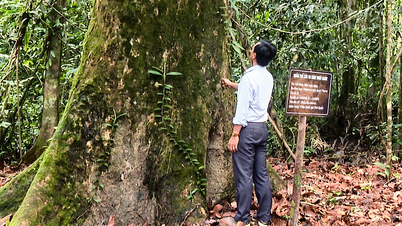
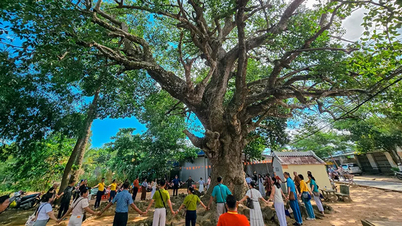
Clapping on a large acacia tree trunk, veteran Ho Van Cho recounted: "To atone for our mistakes with the green forest, from 1990 to 2005, the former Le Thuy district had a policy of strengthening the reforestation of barren land and hills in the western part of the district. At that time, many officials in Kim Ngan commune, including myself, were assigned by our superiors to mobilize people to boldly accept barren land and hills to plant trees and create forests; the results of the reforestation campaign were used to evaluate the level of task implementation each year."
 |
| Many households in Kim Ngan commune are developing ecotourism and experiential activities from the forest to increase their income - Photo: VM |
Back then, as a village militia leader and a Party member, Mr. Chờ persistently went to each household in An Bai village to encourage people to participate in reforestation. To increase his persuasiveness, he read and collected additional documents, especially the teachings of President Ho Chi Minh on the effectiveness and benefits of reforestation, to disseminate to the people.
After being informed about the initiative, some households boldly agreed to plant 2-3 hectares of forest. However, many others, upon hearing about reforestation, quickly refused, arguing that they lived right next to a vast natural forest with many valuable timber trees, and that they barely made enough to live on from daily harvesting and selling, let alone planting a few acacia or eucalyptus trees that would take many years and wouldn't produce valuable timber.
Fearing they wouldn't complete their assigned task, at that time, Mr. Chờ and several other commune officials such as Hồ A Lai, Hồ Viết Tình, Hồ Văn Mừng (Cồn Cùng village), Nguyễn Văn Thạch (Km 14 village), Hồ Văn Bôn (Còi Đá village), Nguyễn Văn Thạch (Cẩm Ly village)... accepted to take on an average of tens of hectares per household to plant forests to green barren land and hills. While working, they also encouraged more relatives and friends to participate. "Generally, as officials and Party members, we must learn from President Ho Chi Minh about the spirit of pioneering and exemplary conduct in all our work...", veteran Hồ Văn Chờ explained about his family's decision to take on additional forest land for planting.
Nguyen Van Hung, Vice Chairman of the People's Committee of Kim Ngan commune, added: "Besides the large-scale plantation owners who are Bru-Van Kieu people, Kim Ngan commune also has quite a few large-scale plantation owners originally from the lowlands..."
Transformation thanks to the forest.
Kim Ngan commune currently has 67% of its population belonging to ethnic minorities (mainly the Bru-Van Kieu people), living in 24 villages. The total forested area of the commune is nearly 81,000 hectares (including over 60,000 hectares of natural forest; nearly 16,000 hectares of planted forest that has matured; the remaining area is planted forest that has not yet matured), with a forest cover rate of 86.62%.
 |
| The rubber plantation owned by Mr. Ho Viet Tinh, former Secretary of Kim Thuy commune (now Kim Ngan commune), yields high economic returns - Photo: VM |
The family of Mr. Ho A Lai, from Con Cung village, Kim Ngan commune, has planted over 10 hectares of hybrid acacia trees. Previously, due to difficult conditions, his family could only harvest the trees after about 4-5 years, averaging about 60 to 70 million VND per hectare. In the most recent reforestation project, the family used hybrid acacia seedlings suitable for large timber production, extending the harvesting period to 8 years (harvesting in 2024).
"Although the harvesting time is long, the economic efficiency from planting large timber forests is 1.5 to 2 times higher than planting ordinary acacia trees. In general, forestry has brought my family a very comfortable, fulfilling, and sustainable life, something I never even dared to dream of before…," Mr. Lai shared.
“Following President Ho Chi Minh's teachings, the Bru-Van Kieu people in Kim Ngan commune now understand that working together to protect and develop forests effectively is key to ensuring prosperity for their villages. Many households, who once struggled with hunger, have now built spacious houses and provided for their children's education, all thanks to the forest economy…,” affirmed Mr. Ho Viet Tinh, former Secretary of Kim Thuy commune (now part of Kim Ngan commune).
According to Nguyen Van Hung, Vice Chairman of the People's Committee of Kim Ngan commune, in implementing President Ho Chi Minh's teachings, in recent years the commune has implemented many policies to promote forestry development, creating conditions for businesses and households to develop forests. Every year, the locality organizes the "Tree Planting Festival in memory of President Ho Chi Minh" to educate people about the value and benefits of planting and protecting trees to protect the ecological environment, develop the economy, and build the homeland.
To improve the quality and efficiency of tree planting and reforestation, forest management units and forest-planting households in the area have gradually organized forestry production according to value chains, replicating effective forestry production models. Initially, many units and forest owners have formed linkages between forest planters and processing and consumption facilities for forestry products, associated with sustainable forest management; gradually shifting from extensive to intensive forest planting methods; and developing models for transforming small-timber forests into large-timber forests.
To date, some forest owners in the area have contracted out forest protection to create more jobs and income for the people; they are boldly exploiting the forest's potential to develop eco-tourism and experiential tourism, bringing relatively high economic efficiency and being environmentally friendly...
Thanks to their collective efforts in effectively protecting and developing forests, many Bru-Van Kieu households in Kim Ngan commune are gradually unlocking the potential and advantages of their locality to rise up, become wealthy, and build a prosperous, environmentally friendly life right on their homeland.
Civilized
Source: https://baoquangtri.vn/kinh-te/202605/giu-rung-giu-lay-am-no-46c5775/


![[Video] Sunset at Lap An Lagoon – Where the sun sets over the fishing nets](https://vphoto.vietnam.vn/thumb/1200x675/vietnam/resource/IMAGE/2026/05/31/1780192137701_beach-landscape-sea-water-nature-grass-745871-pxhere-com.jpeg)






![[Video] Sunset at Lap An Lagoon – Where the sun sets over the fishing nets](https://vphoto.vietnam.vn/thumb/800x450/vietnam/resource/IMAGE/2026/05/31/1780192137701_beach-landscape-sea-water-nature-grass-745871-pxhere-com.jpeg)






































![[Video] Sunset at Lap An Lagoon – Where the sun sets over the fishing nets](https://vphoto.vietnam.vn/thumb/402x226/vietnam/resource/IMAGE/2026/05/31/1780192137701_beach-landscape-sea-water-nature-grass-745871-pxhere-com.jpeg)



























Comment (0)