

- Traditional craft villages are disappearing.
- Preserving cultural beauty through traditional crafts.
- Developing tourism from traditional craft villages.
- Deeply committed to traditional crafts.
Facing numerous challenges
From large and small boats traversing the waterways of the Mekong Delta to forge agricultural tools, knives, scissors, etc., and with skillful hands and experience passed down through generations, the blacksmithing craft in Ngan Dua (Hong Dan Commune) has become famous throughout and beyond the province.
According to many elders in the craft village, during its heyday, many families in Ngan Dua practiced blacksmithing or related trades such as sewing, making handles, and opening shops selling forged products. Blacksmithing provided a stable income for the people during their leisure time between farming seasons. However, nowadays, only a few households in Ngan Dua remain dedicated to the craft, with most of the craftsmen being elderly.
Regretting the decline of this traditional craft, Mr. Tran Van Tan from Hong Dan Commune shared: " Income from this profession is currently very unstable. If there isn't a new direction, if there aren't people willing to learn and follow the trade, it won't be long before those blacksmiths' forges that once blazed with fire are nothing but ashes and cold furnaces. Just thinking about it makes me sad! "
Mr. Tran Van Tan meticulously finishes the newly sculpted forged product.
Like many other traditional craft villages, the mat weaving craft in Ngan Dua is facing numerous difficulties. The increasing availability of convenient mats made from plastic fibers and rubber mats has led to a decline in consumer interest in traditional mats. Furthermore, the shrinking area for growing sedge has resulted in a dwindling supply of raw materials for weaving. From several hundred households practicing the craft, only a handful remain in Ngan Dua today.
With the development of the modern economy and industry, consumer demand has changed, and inexpensive, convenient industrial products are often preferred by consumers. Lacking resources and modern technology to improve products, traditional craft villages face difficulties in competing with imported or industrial products.
This is also the reality in the traditional bamboo and rattan weaving village of Ninh Thanh Loi commune. The bamboo and rattan weaving craft in Ninh Thanh Loi commune was formed and developed about 60 years ago, concentrated in Nha Lau 1 and Nha Lau 2 hamlets. Many experienced weavers share that this area used to be a swampy, acidic, and saline land, overgrown with reeds taller than a person, allowing for only one rice crop per year with very low yields. Then, bamboo and rattan gradually became the main crops for many households, and the bamboo and rattan weaving craft developed accordingly. However, like many other traditional craft villages in the province, the bamboo and rattan weaving craft in Ninh Thanh Loi is gradually being replaced.
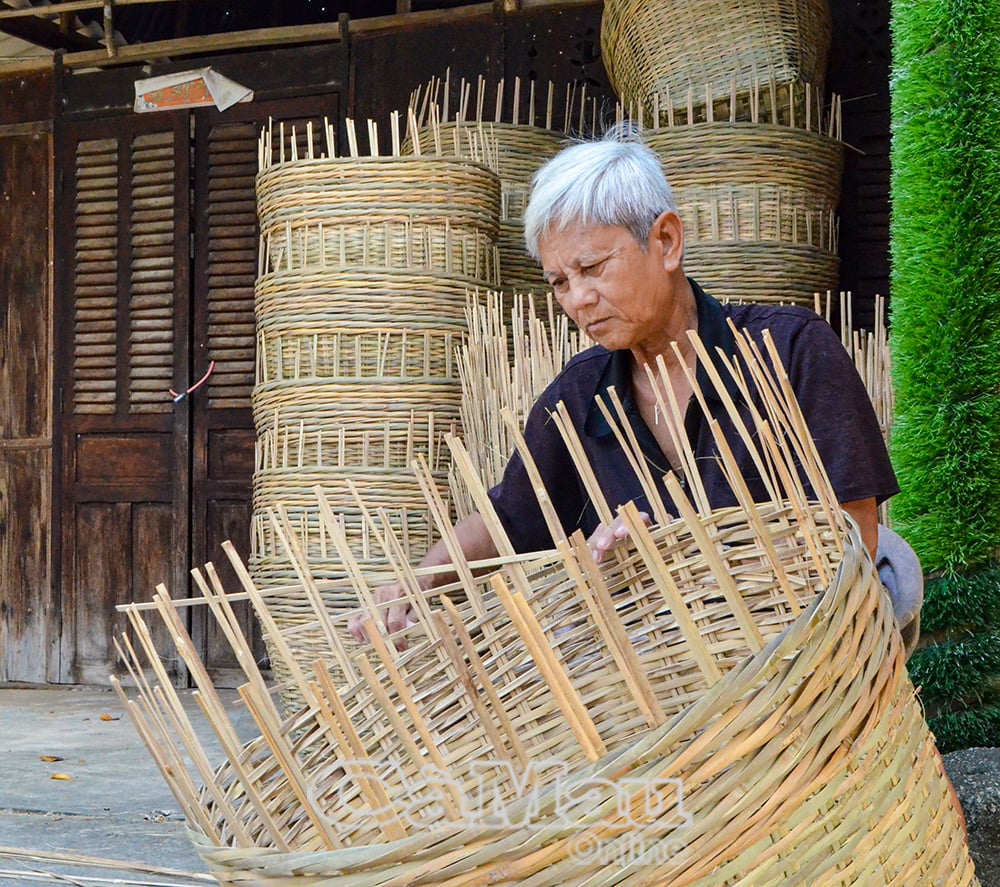 Traditional basket weaving is now practiced only by the elderly.
The reasons include a lack of successors, the difficulty of handicraft products competing with industrial goods, the monotony in variety, the scarcity of raw materials, and the fact that prices do not reflect the labor involved. Low income prevents many people from staying in the profession.
Ms. Vo Thi Thoa, from Nha Lau 1 hamlet, Ninh Thanh Loi commune, shared: “ I’ve been doing this job since I was a young girl, and now I’m over 70. This profession used to be the main source of income for many families. However, now only elderly people like me continue it. I know that every profession has its ups and downs, but it’s a real shame to see the profession I’ve been involved in for decades disappear! ”
Finding new ways to "keep the flame alive" in traditional craft villages.
One of the reasons why traditional craft villages are losing their appeal is their inability to adapt to market demands, as their products are mostly unprocessed and have low added value. The development of brands and trademarks, as well as intellectual property protection, has not received sufficient attention, leading to low competitiveness of the products. The decline of traditional craft villages means the loss of long-standing cultural values, causing much regret. Therefore, preserving and promoting traditional craft villages is a necessary task, not only contributing to the preservation and honoring of national cultural values, but also helping to create jobs and increase income for people, especially in rural areas.
Over the years, in addition to the central government's support mechanisms and policies for the development of craft villages, the province has implemented many effective solutions. Local authorities have proactively developed and implemented investment plans for the construction of industrial clusters and zones in locations with favorable infrastructure, aiming to create a concentrated and synchronized development space for craft village businesses and enterprises. At the same time, they have focused on attracting businesses to invest in the production and trading of traditional crafts and the development of craft villages, prioritizing sectors such as weaving, knitting, blacksmithing, carpentry, wood processing, and agricultural products.
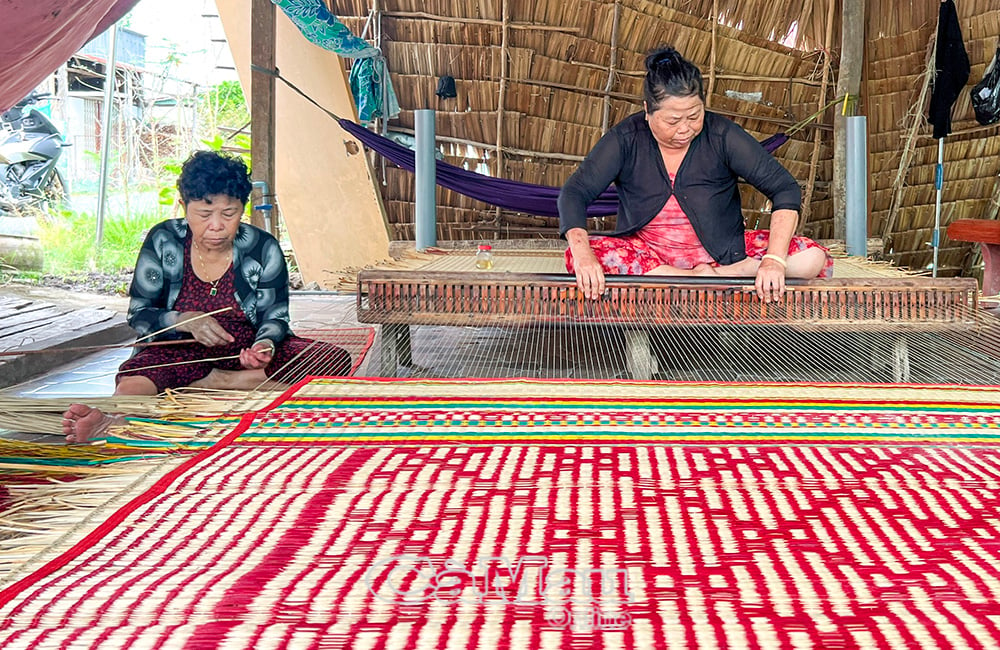 The mat weaving craft in Ngan Dua is gradually dying out.
Alongside this, efforts should be intensified to support establishments and businesses in organizing handicraft production, focusing on strengthening cooperation and linkages along the value chain from production to consumption; proactively developing raw material areas according to food safety and labor safety standards; and promoting innovation and the development of high-tech production. Emphasis should be placed on product promotion, boosting investment, and providing vocational training for rural workers.
The orientation towards developing OCOP products in craft villages, linked to the criteria of improving product quality, is considered a foundation and a "support" for craft village products and traditional craft villages to change and affirm their brands in the market. The province has mobilized funding from the National Target Program for New Rural Development, related programs and projects, and other legal funding sources to support businesses and production facilities in craft villages in overcoming difficulties.
"Keeping the flame alive" in traditional craft villages not only brings tangible value but also preserves a part of the memory of our homeland. Because the products of these craft villages are not only the dedication of the artisans but also the culmination of creativity nurtured and passed down through many generations.
Nguyen Linh
Source: https://baocamau.vn/giu-gin-ky-uc-xua-a129247.html


![[Photo] The General Secretary, President and his wife begin their state visit to the Philippines.](https://vphoto.vietnam.vn/thumb/1200x675/vietnam/resource/IMAGE/2026/05/31/1780230559452_anh-man-hinh-2026-05-31-luc-19-28-11.png)
![[Photo] Admire the coral "masterpiece" amidst the million-year-old heritage of Dak Lak province.](https://vphoto.vietnam.vn/thumb/1200x675/vietnam/resource/IMAGE/2026/05/31/1780221235105_anh-man-hinh-2026-05-31-luc-16-53-27.png)
![[Photo] Solemn bathing ceremony and Buddha procession in Hue](https://vphoto.vietnam.vn/thumb/1200x675/vietnam/resource/IMAGE/2026/05/31/1780228263543_1-jpg.webp)
![[Image] Hanoi Police officially crowned champions of V-League 2025/2026](https://vphoto.vietnam.vn/thumb/1200x675/vietnam/resource/IMAGE/2026/05/31/1780244769054_ndo_br_039d561b692be875b13a-jpg.webp)





















![[Video] Sunset at Lap An Lagoon – Where the sun sets over the fishing nets](https://vphoto.vietnam.vn/thumb/340x192/vietnam/resource/IMAGE/2026/05/31/1780192137701_beach-landscape-sea-water-nature-grass-745871-pxhere-com.jpeg)









































![[Photo] Admire the coral "masterpiece" amidst the million-year-old heritage of Dak Lak province.](https://vphoto.vietnam.vn/thumb/402x226/vietnam/resource/IMAGE/2026/05/31/1780221235105_anh-man-hinh-2026-05-31-luc-16-53-27.png)




































Comment (0)