

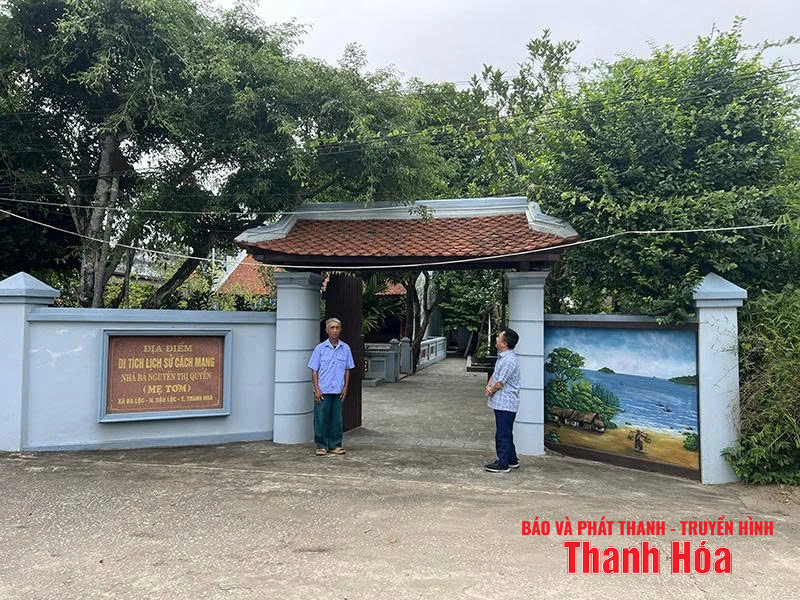
The Mother Tơm House revolutionary historical site - a place that rekindles pride in patriotic traditions for today's generation.
One roof, one revolutionary flame.
Mother Tơm, whose real name was Nguyễn Thị Quyển (1880-1953), was from Hanh Cát village, Đa Lộc commune (now Đông Thành hamlet, Vạn Lộc commune). She was a poor farmer living through difficult times. Her family was impoverished; her husband wove baskets, and her children worked as itinerant barbers to make a living. Yet, hidden behind their simple thatched-roof house was a steadfast "revolutionary fortress."
When the Ngoc Trao guerrilla base was breached (1941-1942), Mother Tom's house was chosen by the Thanh Hoa Provincial Party Committee as a temporary shelter, newspaper printing location, meeting place, and secret communication hub. Mother Tom's husband wove baskets in the yard to observe the situation; Mother Tom carried vegetables to the market, with documents and leaflets from the newspaper "Drive Out the Foreign Invaders" hidden beneath the vegetables. Her two sons, So and Hau, brought their barbers and acted as revolutionary liaisons throughout the Nga Son, Hoang Hoa, and Ha Trung regions at that time.
In that house, the poet Tố Hữu, then a secret operative, wrote and published the newspaper "Driving Out the Foreign Invaders." Important meetings of the Provincial Party Committee were also held here, with the participation of comrades such as Lê Tất Đắc, Hoàng Tiến Trình, Hoàng Xung Phong... The thatched house by the sea became the nerve center in a pristine white sand area.
But then the base was exposed. In 1944, secret police raided the place, arresting and brutally beating the couple and their two children. Sồ and Hậu were imprisoned in Thanh Hóa prison, enduring torture and beatings, but they remained steadfast in their faith, refusing to reveal anything. They were released in April 1945 and immediately returned to the organization, preparing for the August Revolution. A small house, a poor family – but it was there that a "flame" for the Vietnamese revolution was nurtured.
"Red addresses" foster tradition.
After the peace treaty, these silent contributions were respectfully recognized by the Party and the State. Mother Tom's family was awarded the "Certificate of Merit for Service to the Nation" and the "Homeland's Recognition" commemorative medal by the Prime Minister . Her two sons were awarded the title of "Revolutionary Cadre Imprisoned". In 2009, the house was recognized as a provincial-level historical revolutionary site.
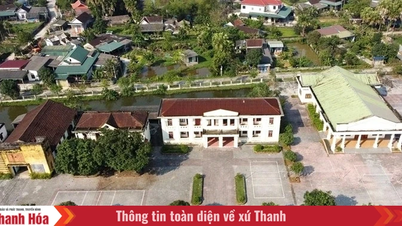
From a humble thatched hut on a sand dune, Mother Tơm's house has now become a destination for profound spiritual and traditional education . Within its nearly 700m² grounds, the three-room house, roofed with bright red tiles and shaded by lush greenery, stands elegantly while retaining its original charm. The poem "Mother Tơm," written by poet Tố Hữu after his return in 1961, is prominently displayed on the wall. In 2022, Mother Tơm's mausoleum was renovated to an area of 1,300m², becoming a place of remembrance and gratitude.
These days in July, people from all over quietly return. In the simple memorial room, Mr. Vu Ngoc Ro (65 years old) - the grandson of Mother Tom and the youngest son of Mr. Vu Duc Hau - cherishes an old wooden box containing a set of tools for itinerant barbering, earthenware jars, and rice containers that fed officials more than 80 years ago. “These are not just family mementos, but a part of our homeland’s history,” Mr. Ro said. Recently, the statue of “Mother Tom,” donated by the Thanh Hoa Artists and Journalists Association in Hanoi, has also been placed in a prominent position in the house, as an enduring spiritual symbol.
More than just a tourist destination, the Mother Tơm Memorial House is also a place where descendants of the family and local people return during major holidays. Each step back to their roots is an opportunity to listen to the memories of the past through the stories of relatives, and of Mr. Rỡ – the grandson who still preserves every relic and memory of a glorious era. Stories about meals of rice mixed with potatoes, about Mother Tơm carrying vegetables to hide documents, about her two sons working as messengers while cutting hair… are not only recalled verbally but also passed down with respect and emotion in the eyes of today's generation. This is what makes Mother Tơm's house not just a historical site, but an integral part of the people's blood, flesh, and soul, where tradition is continuously continued in simple yet sacred ways.
Ignite the spirit of patriotism.
More than just a place preserving the past, Mother Tơm's house is also a vibrant and effective "red address" for traditional education. Extracurricular activities, gratitude ceremonies, and thematic sessions for students, youth union members, and young cadres all choose this place as their destination, allowing them to experience the revolutionary atmosphere amidst everyday life.
Teacher Dao Thanh Huong, who has been associated with Da Loc Secondary School for nearly 30 years, emotionally shared: “I often bring my students here on major holidays like February 3rd, July 27th, and September 2nd. Not only do I recount historical stories, but I also help them visualize that right here in their homeland, there was once a humble family who silently sacrificed for national independence. They get to touch the relics, see every corner of the house, where an elderly mother once stayed up all night guarding for the cadres.” This is how Teacher Huong instills in his students a genuine love of country and pride, not through slogans, but through real emotions from a real place.
Sharing his thoughts on the role of the historical site, Mr. Le Ngoc Hung, Chairman of the People's Committee of Van Loc commune, said: "We consider this a spiritual symbol of the entire commune. The government regularly organizes activities to promote and honor the site, integrating traditional education into community life, so that the value of the site does not remain dormant but spreads strongly."
The war is long over, Mother Tơm and her loved ones have passed away, but the revolutionary "flame" that once burned from that home still smolders in the hearts of the people here. In the minds of generations of Thanh Hoa people, Mother Tơm remains a living symbol of indomitable spirit, loyalty, and unwavering devotion.
Text and photos: Tran Hang
Source: https://baothanhhoa.vn/di-tich-lich-su-cach-mang-nha-me-tom-noi-thap-lua-long-yeu-nuoc-255976.htm


![[Photo] General Secretary and President To Lam presides over a meeting on preparations for the review of one year of operation of the three-tiered government system.](https://vphoto.vietnam.vn/thumb/1200x675/vietnam/resource/IMAGE/2026/06/02/1780391821195_a1-bnd-4595-9717-jpg.webp)
















































Comment (0)