

Unseasonal rain, low salinity.
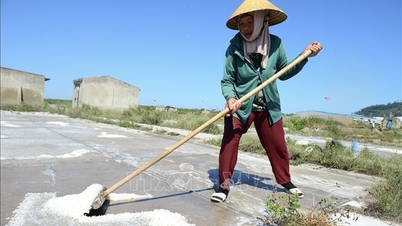
At the salt fields in An My village (An Luong commune), Mr. Phan Thuy Duong (72 years old) said that he has been working in the salt industry for over 50 years, but never before has the beginning of the season been as difficult as it is now.
According to him, the salt harvesting season started in mid-February, but the first batch wasn't harvested until March because unseasonal rains occurred continuously right when the salt was crystallizing, causing the salt crystals to dissolve again and requiring the entire process to be restarted.
Mr. Duong's family currently has two salt ponds covered with tarpaulin, each approximately 200 square meters in size. Since the beginning of the season, the family has harvested over 4 tons of salt, a decrease of half compared to the same period last year.
Despite selling at the farm gate for over 2,000 VND/kg, the yield has dropped sharply, while the costs of investing in tarpaulins, hiring laborers, and pumping seawater have increased significantly, leaving the family's income negligible.
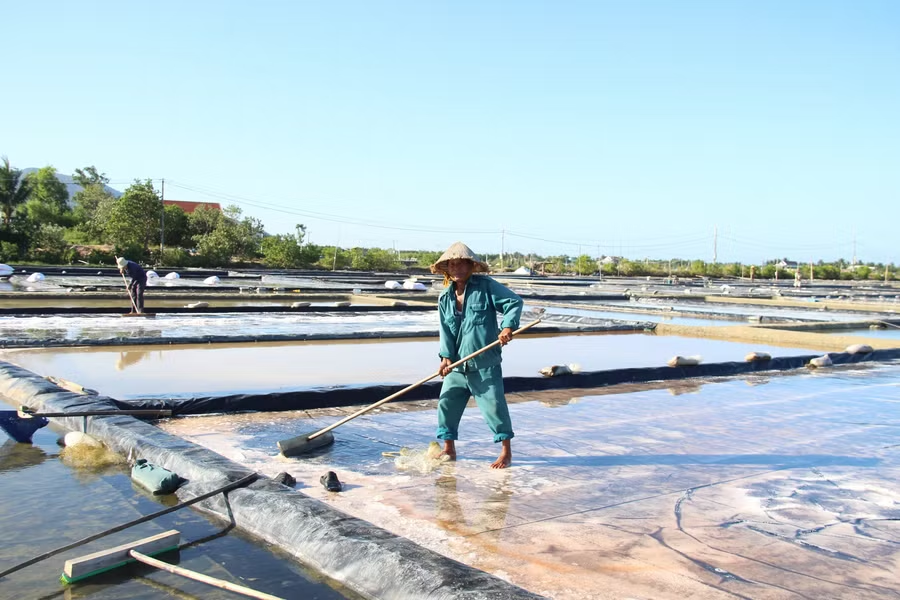
In contrast to An Luong commune, the De Gi commune experienced consistent sunshine and little rain at the beginning of this year's harvest. However, favorable weather conditions did not necessarily translate into better yields, as many salt farmers reported a decrease in the salinity of the water, which is essential for salt crystallization.
In Duc Pho 1 village (An Luong commune), Ms. Huynh Thi Thu Lan (47 years old) is processing salt on nearly 500 m² of land covered with tarpaulin. She shared: "Although there is sunshine, the water is not salty enough, so the salt doesn't rise quickly, and the yield has decreased significantly."
Currently, salt in the De Gi area is being bought by traders at around 1,500 VND/kg, lower than in An Luong. Since the beginning of the season, I have only sold a meager 5 million VND worth of salt.”
In the same area, Mr. Huynh Yen (52 years old) is also worried because his family owns 5 salt fields covering nearly 500 m². On average, he only harvests once every 3 days, but sales are quite slow.
According to him, the price of salt at the beginning of the season is not high, while rising fuel prices have led many fishing boats to limit going out to sea, resulting in a significant decrease in the demand for salt used to preserve seafood. "It's already difficult to sell at the beginning of the season, it will probably be even harder during the peak season," Mr. Yen said.
According to the Sub-Department of Quality Management of Agricultural, Forestry and Fishery Products (Department of Agriculture and Environment), this year, the entire province still has 663 salt-producing households with 1,657 workers, mainly concentrated in De Gi and An Luong communes, a decrease of about 28.7% compared to the same period in 2015.
The total area for salt production reached nearly 130 hectares, a decrease of more than 25 hectares compared to the same period last year. Of this, the area for traditional salt production was 35.8 hectares; salt crystallization ponds covered 93.27 hectares; and only 0.1 hectares were used for industrial salt production.
Mr. Tran Kim Duong, Head of the Sub-Department of Quality Management of Agricultural, Forestry and Fishery Products, said: "The main reason for the decrease in production area is the decreasing number of salt workers, with many households abandoning the profession due to unstable income."
From the beginning of the season until now, the entire province has harvested nearly 1,100 tons of salt, including more than 300 tons of traditionally produced salt and more than 700 tons of salt crystallized on tarpaulin-covered ponds, a decrease of more than 65% compared to the same period in 2025.
Businesses work together to overcome challenges related to product distribution.
Amidst declining production, slow consumption, and concerns about uncertain market outlets among many households, salt processing businesses continue to be a pillar of support for local salt farmers.
Currently, the province has two units involved in salt procurement and processing: Central Vietnam Salt and Trade Joint Stock Company - Binh Dinh Salt Branch and Binh Dinh Salt and Food Joint Stock Company.
Mr. Nguyen Van Thong, Director of Binh Dinh Salt and Foodstuff Joint Stock Company, said that the company is currently purchasing salt produced on tarpaulin-covered floors at a price of 1,700 VND/kg at the factory, equivalent to the same period last year.
To ensure a reliable supply of raw materials for production, the company procures through local intermediaries instead of collecting directly from individual households, thereby optimizing transportation and procurement costs.
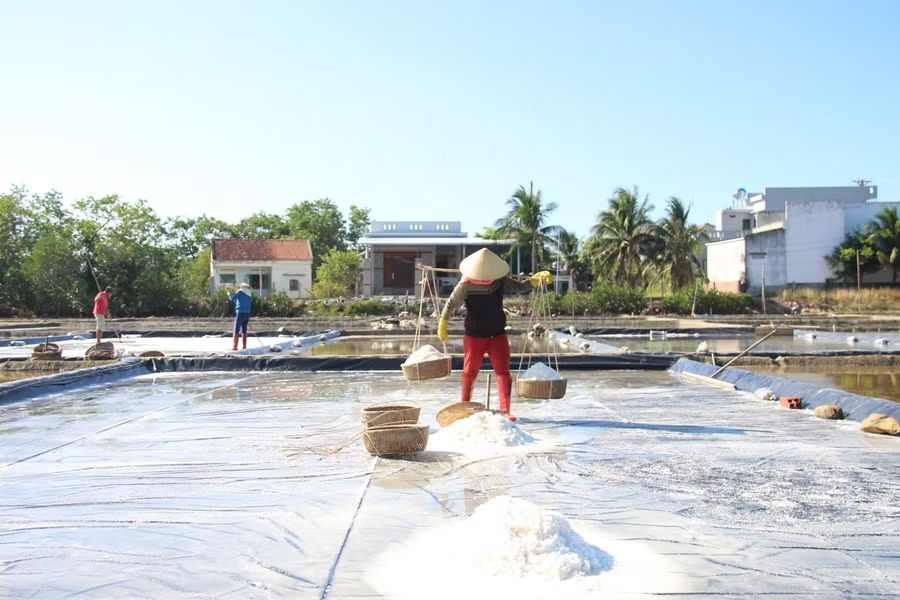
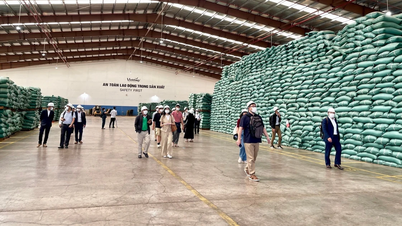
Currently, the company processes and markets an average of 250-300 tons of various types of salt per month. The company's strengths lie in its range of food-grade salts, such as iodized salt, rock salt, and refined salt.
According to Mr. Thong, De Gi salt has a milder, less pungent taste than salt from some other regions, making it suitable for food processing and as an ingredient in fish sauce. However, for industrial salt used in the mineral water, animal feed, and metallurgy industries, the company still has to import additional raw materials from Khanh Hoa province.
The reason is that the locality has not yet been able to produce long-crystallized salt (1-3 months) on a large scale using machinery, while local salt has high porosity and is easily lost during industrial processing. Currently, Binh Dinh Salt and Foodstuff Joint Stock Company maintains a consumption linkage with salt farmers in An My village (An Luong commune) on an area of more than 20 hectares.
"Each year, the company purchases about 1,000 tons of salt in this area, contributing to stabilizing the output for salt farmers, especially during a period when the consumer market is still volatile," Mr. Thong said.
To enable salt farmers to make a living from salt production and to mitigate the current situation of fluctuating salt prices, which are largely dependent on traders, the authorities of De Gi and An Luong communes hope that the State will implement a salt purchasing policy to stabilize prices. This is also the aspiration of all salt farmers in these two localities.
Source: https://baogialai.com.vn/diem-dan-gia-lai-chat-vat-ngay-tu-dau-vu-muoi-post587205.html



![[Video] Sunset at Lap An Lagoon – Where the sun sets over the fishing nets](https://vphoto.vietnam.vn/thumb/1200x675/vietnam/resource/IMAGE/2026/05/31/1780192137701_beach-landscape-sea-water-nature-grass-745871-pxhere-com.jpeg)


















![[Video] Sunset at Lap An Lagoon – Where the sun sets over the fishing nets](https://vphoto.vietnam.vn/thumb/800x450/vietnam/resource/IMAGE/2026/05/31/1780192137701_beach-landscape-sea-water-nature-grass-745871-pxhere-com.jpeg)














































![[Video] Sunset at Lap An Lagoon – Where the sun sets over the fishing nets](https://vphoto.vietnam.vn/thumb/402x226/vietnam/resource/IMAGE/2026/05/31/1780192137701_beach-landscape-sea-water-nature-grass-745871-pxhere-com.jpeg)





























Comment (0)