

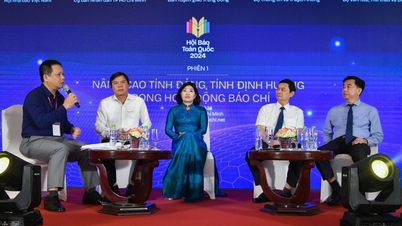
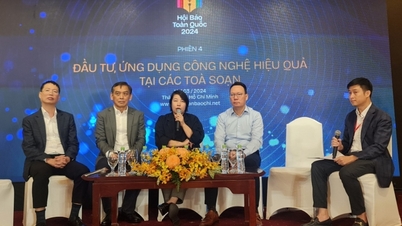
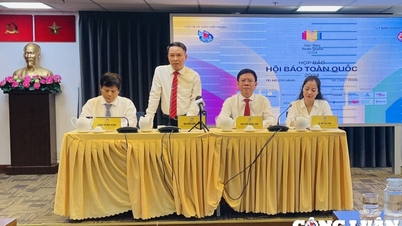
(BLC) - On the afternoon of March 15, 2024, in Ho Chi Minh City, the Vietnam Journalists Association held its first National Press Forum 2024. The forum consisted of 12 sessions with engaging topics related to the top concerns of press agencies and press management agencies.
Attending the opening session of the Forum were: Mr. Nguyen Trong Nghia, Secretary of the Central Committee of the Communist Party of Vietnam, Head of the Central Propaganda Department; Mr. Tran Luu Quang, Member of the Central Committee of the Communist Party of Vietnam, Deputy Prime Minister; Mr. Phan Van Mai, Member of the Central Committee of the Communist Party of Vietnam, Standing Deputy Secretary of the Ho Chi Minh City Party Committee, Chairman of the People's Committee of Ho Chi Minh City; Mr. Nguyen Manh Hung, Member of the Central Committee of the Communist Party of Vietnam, Minister of Information and Communications , Deputy Head of the Central Propaganda Department, Vice Chairman of the National Committee on Digital Transformation; Mr. Tran Thanh Lam, Deputy Secretary of the Ben Tre Provincial Party Committee; On the side of the Vietnam Journalists Association were: Mr. Le Quoc Minh, Member of the Central Committee of the Communist Party of Vietnam, Editor-in-Chief of Nhan Dan Newspaper, Deputy Head of the Central Propaganda Department, President of the Vietnam Journalists Association; Mr. Nguyen Duc Loi, Former Member of the Central Committee of the Communist Party of Vietnam, Standing Vice President of the Vietnam Journalists Association; Mr. Tran Trong Dung, Vice President of the Vietnam Journalists Association (in charge of the South).
Also attending the opening session of the Forum were distinguished delegates and guests representing press agencies, press management agencies, leaders of agencies, departments, and businesses, and representatives of central, Ho Chi Minh City, and local news agencies.
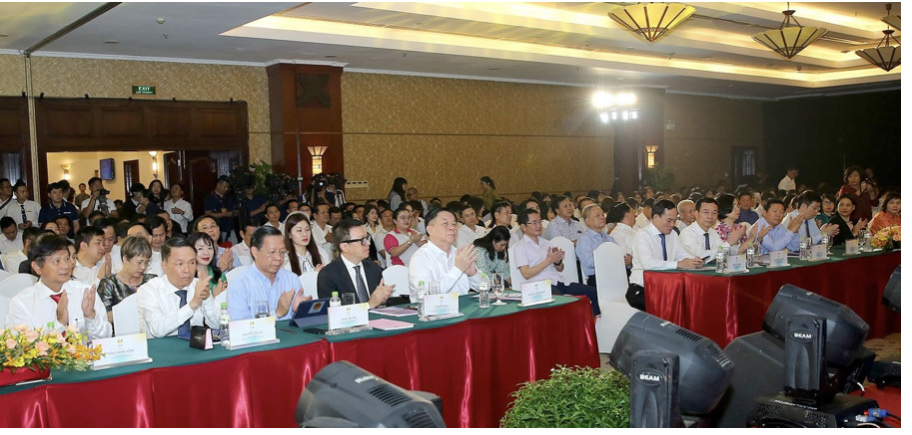
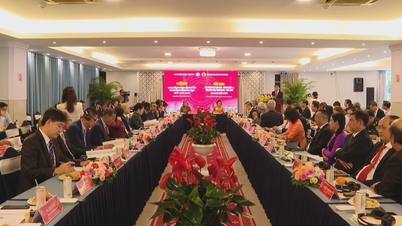
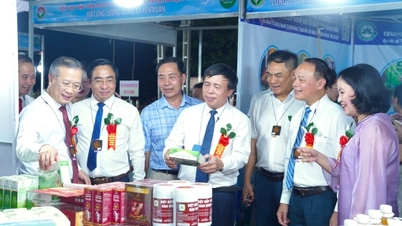
Delegates attending the 2024 National Press Forum.
Vietnamese revolutionary journalism is approaching its 100th anniversary. Throughout nearly a century of development, Vietnamese revolutionary journalism has increasingly demonstrated its guiding principles, upholding its mission and responsibility, and improving its operational efficiency. It has progressively affirmed its professionalism, humanistic values, and modernity, making a significant contribution to the overall achievements of the country and the nation.
In the current era, journalism has continuously innovated, been creative, flexible, and effective, promoting the application and mastery of modern communication technologies with the emergence of many new programs and products, spreading widely across digital platforms, and having a positive impact on society.
However, facing increasingly fierce competition from new forms of information such as social media, the current situation is extremely difficult for the world's press, as well as the Vietnamese press. The development of technology, changes in public information consumption habits and behavior, and the rampant spread of fake and misleading information have led to a decline in public trust in the press, while advertising revenue continues to fall across all forms of media, including online. While the press provides useful information to society, its crucial role and power, built over centuries, are being threatened by constant changes, especially in the last decade.
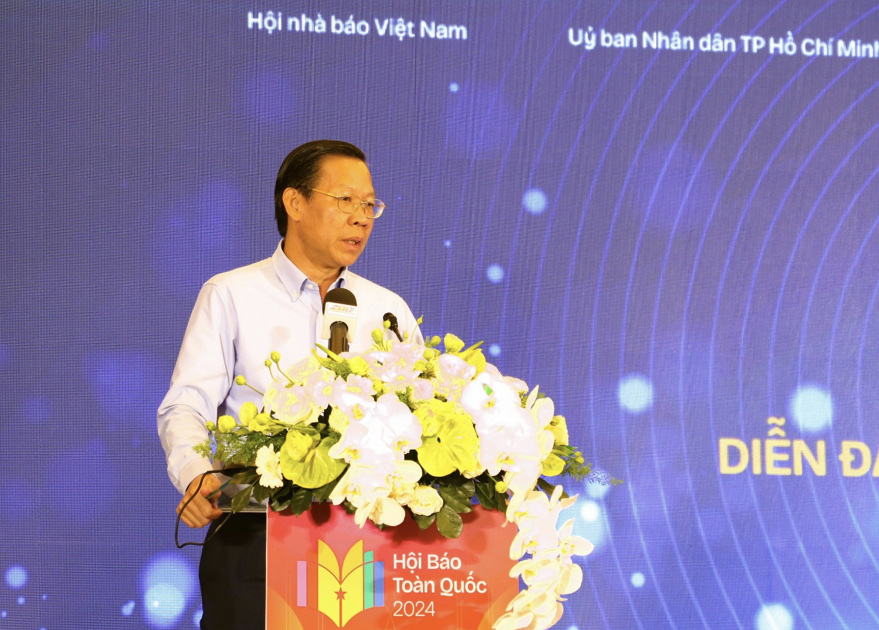
Mr. Phan Van Mai - Member of the Central Committee of the Party, Standing Deputy Secretary of the City Party Committee, and Chairman of the People's Committee of Ho Chi Minh City - delivered a rather impressive speech about Ho Chi Minh City…
In his opening remarks at the Forum, Mr. Phan Van Mai, Chairman of the People's Committee of Ho Chi Minh City, emphasized that the 2024 National Press Conference is an extremely significant event not only for the press but also for the socio-economic development of Ho Chi Minh City.
According to Mr. Phan Van Mai, revolutionary journalism has made significant contributions to the city's development over the past period. City leaders have also received much attention and feedback from the press.
"Therefore, we consider the press, from the central to local levels, as an integral force contributing to the city's development. We are very grateful for the contributions of the press agencies and hope that this partnership between the press agencies and the city's leaders will continue in the future," Mr. Phan Van Mai expressed.
Sharing his views on Ho Chi Minh City's socio-economic situation at the Forum, noting that the three strategic breakthroughs in institutions, infrastructure, and human resources are also three bottlenecks for the city, Mr. Phan Van Mai hoped that the central leaders and especially the press, who have already shown interest, would continue to pay even more attention to help the city better understand these strategic bottlenecks and identify solutions for the journey ahead.
Specifically, according to Mr. Phan Van Mai, firstly, recognizing the institutional bottleneck, the Politburo issued Resolution No. 31 for Ho Chi Minh City, which identified directions and tasks for the city's development. The National Assembly also issued Resolution 98, opening up mechanisms for Ho Chi Minh City. "Therefore, in terms of direction and institutions, there is Resolution 31 of the Politburo, Resolution 98 of the National Assembly, and the city is also proposing many mechanisms and policies," Mr. Mai said.
Secondly, to address the strategic infrastructure bottleneck, Ho Chi Minh City is focusing heavily on investing in transportation infrastructure, including ring roads, connecting expressways, and the Metro system. The city will concentrate on urban and social infrastructure to improve traffic conditions, population distribution, and address issues such as flooding, environmental problems, and traffic congestion. It will also invest in digital infrastructure to promote the digital economy, digital government, and digital society.
Thirdly, regarding human resources and administrative reform, the issue of improving the quality of human resources is being addressed. The city is developing and plans to implement the Ho Chi Minh City Public Service System Project in the second quarter to build a high-quality and efficient workforce within the political system, businesses, and among the people; contributing to increased productivity of the city's economy.
"These are the issues that the city hopes to receive feedback on from media agencies, experts, and journalists to help Ho Chi Minh City better identify and choose the right issues, in order to achieve its goals faster," Mr. Mai expressed his wish.
In particular, at the Forum, the Chairman of the People's Committee of Ho Chi Minh City shared that, historically, the city is known as a very dynamic and creative locality that is always thinking and exploring new ways of doing things.
"But how to be dynamic and innovative in the current context is a question we very much hope that the press and journalists, with their experience, can further analyze and suggest ways to unleash the inner driving force of dynamism and creativity for the development of the city and the country, while still ensuring compliance or that the results from that practice are quickly summarized, legalized, and institutionalized," said Mr. Phan Van Mai.
According to the Chairman of the People's Committee of Ho Chi Minh City, in 2025, we will celebrate the 50th anniversary of the liberation of Southern Vietnam and the reunification of the country. Ho Chi Minh City, as a locality witnessing this historical event, has issued directives and plans, and the People's Committee has also developed many sub-plans for implementation. We will report to the Central Committee and the Secretariat.
The Ho Chi Minh City People's Committee has also implemented many initiatives, from literary and artistic creation contests to launching special campaigns from the beginning of 2022 until April 30, 2025. In addition, Ho Chi Minh City is implementing 50 outstanding city-level projects and initiatives to celebrate, along with many other activities.
"We hope that the press will participate in these 50th anniversary celebrations, not only in terms of publicity but also by engaging more actively in the activities of Ho Chi Minh City, the South, and the whole country," Mr. Phan Van Mai suggested.
Speaking at the Forum, Mr. Nguyen Manh Hung, Minister of Information and Communications, stated that digital technology has had the first and strongest impact on the field of journalism and media, creating fundamental changes in this sector.
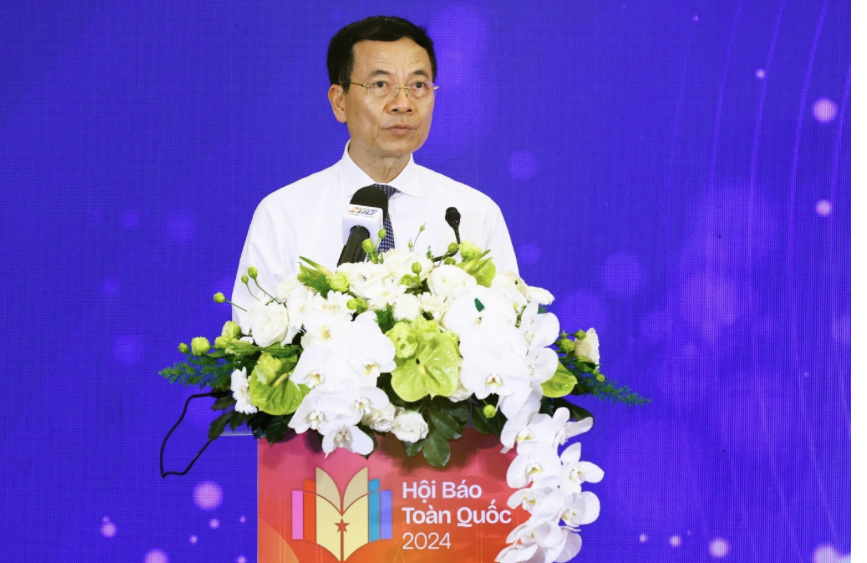
According to Mr. Nguyen Manh Hung, cyberspace is now the main battlefield, the primary battleground for journalism. "Victory or defeat hinges on this! The Fourth Industrial Revolution, digital technology, and digital transformation have been underway for over a decade. Now, it's not just about venturing into cyberspace, but about reclaiming it and creating a mainstream presence. The main source of revenue for journalism will eventually come from cyberspace."
However, while CNS takes away some old things, it also creates new ones. "So, the press must do new things. Journalistic innovation lies in the press doing more than what it is currently doing," the Minister of Information and Communications questioned, arguing that the press needs a broader space than just "Who, what, when, and where," meaning a broader scope than simply reporting the news. Readers want to know what lies behind so much news. This could be an interpretation, analysis, or commentary on the news. It could be a multi-faceted perspective, a deep and insightful understanding, an interesting and thought-provoking interpretation, or a solution to the country's problems.
Minister Nguyen Manh Hung also clarified that innovation is not an overly difficult task. Innovation is about finding an easier way to do something more difficult. This new way of doing things often emerges from a different perspective, a different approach. In the early stages of a new industrial revolution, the new way of doing things is often the opposite.
"Let's use digital technology to do the opposite. Instead of writing, let's create a platform for others to write. Instead of letting people read on our website, let them read on various platforms. Instead of providing information, let's provide knowledge. Instead of doing things ourselves, let's collaborate. Instead of letting reporters process a lot of information, let them process things with very little information and let AI handle the vast amount of information. Instead of avoiding accidents, let's control accidents," Mr. Hung shared.
Mr. Nguyen Manh Hung argued that for journalism to develop, it needs a new space, a new productive force, new production resources, new production factors, and new driving forces. The new space is the digital space. The new productive force is digital technology. The new production resource is digital human resources. The new production factor is digital data. The new driving force is digital innovation. "Therefore, investing in digital technology, digital human resources, digital data, and digital innovation will be an investment in the future of journalism," Mr. Hung stated.
In particular, Minister Nguyen Manh Hung stated that digital technology, especially AI, is more powerful than nuclear energy, so the problems, challenges, and risks it brings will also be greater than those of nuclear power. "That's the rule. The three previous Industrial Revolutions were like that. This fourth Industrial Revolution, with digital technology at its center, and AI at the center of digital technology, will surely be the same," Mr. Hung said.
Mr. Nguyen Manh Hung argued that to solve the problems of new technologies, one must use new institutions and the new technologies themselves. Digital technology, the Internet, and social media are powerful catalysts for journalistic innovation. This innovation will only enhance the role and contribution of revolutionary journalism to the cause of building a strong and prosperous Vietnam.
For the forum's discussions, the Ministry of Information and Communications will fully participate, listen, explain policies, absorb feedback, and support the development of the press.
In particular, at the opening session of the Forum, Mr. Le Quoc Minh - Member of the Central Committee of the Party, Editor-in-Chief of Nhan Dan Newspaper, Deputy Head of the Central Propaganda Department, and President of the Vietnam Journalists Association - gave an overview presentation entitled: "Vietnamese Journalism: Challenges and Opportunities".
The Chairman of the Vietnam Journalists Association clearly outlined the development trends and the overall picture of Vietnamese journalism today. He also frankly pointed out the challenges and significant opportunities that Vietnamese journalism in particular, and world journalism in general, are facing.
Specifically, firstly, there is the emergence of artificial intelligence (AI). While affirming that AI is contributing to improving the work of journalists, the comrade also stated that AI offers enormous potential for the world and for journalism, but also carries inherent risks, therefore, extreme caution is necessary. Many large news organizations around the world share concerns about the risks that AI may bring, especially in the field of content production.
Secondly, the world's press is currently facing the problem of fake news. Many individuals have used AI to distort images and create deep fakes, causing serious consequences.
Thirdly, the increasing number of new devices appearing has created great opportunities for the development of journalism. "In 2024, we will witness the emergence of new devices beyond smartphones, using interactive methods such as voice commands, eye movements, or hand gestures," Comrade Le Quoc Minh informed.
Speaking about immediate tasks, the Chairman of the Vietnam Journalists Association stated that media organizations need to promote the enactment of legal regulations to protect the intellectual property of journalism, preventing it from being used and analyzed by AI systems without consent and without adequate financial compensation.
In addition, media organizations need to identify niche markets and experiment with new business models. Clearly defining the target audience is crucial for developing profitable media business models with high profit margins, loyal users, or direct relationships with specific advertisers, without being dependent on technology platforms.
"Besides advertising, organizations need to seek other revenue sources, and revenue from readers should be considered a top sustainable strategy," suggested Mr. Le Quoc Minh.
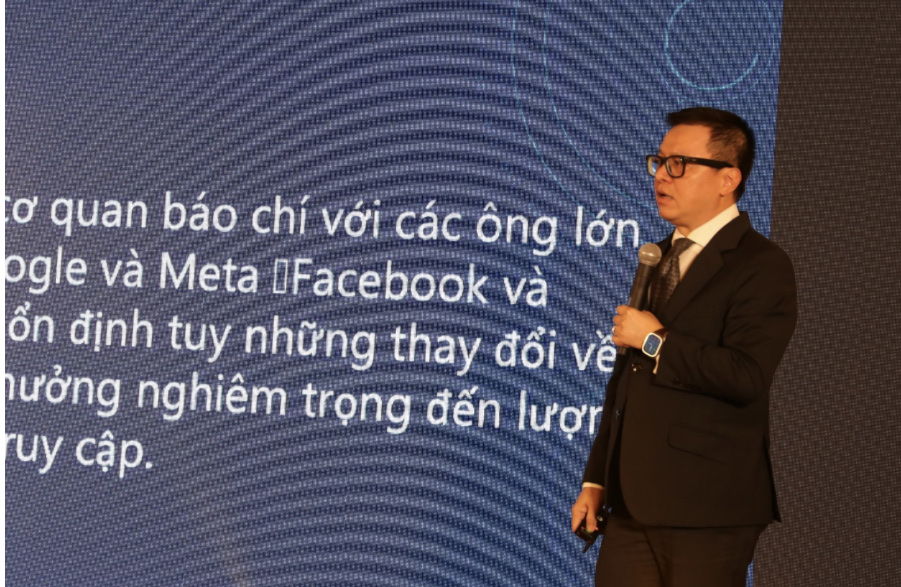
Mr. Le Quoc Minh - Member of the Central Committee of the Communist Party of Vietnam, Editor-in-Chief of Nhan Dan Newspaper, Deputy Head of the Central Propaganda Department, and President of the Vietnam Journalists Association - gave an overview presentation entitled: "Vietnamese Journalism: Challenges and Opportunities".
Next, Mr. Le Quoc Minh argued that prioritizing digital content does not mean prioritizing social media. In particular, the Chairman of the Vietnam Journalists Association emphasized that it is time to bring readers back to news websites. Along with that, print newspapers need to be cherished and treated as a high-end product, providing valuable information with depth and understanding that only humans can offer.
Amidst the general economic difficulties both domestically and globally, the overwhelming competition from social media, and the shifting public information preferences, the global press in general, and the Vietnamese press in particular, have faced numerous challenges, the most difficult of which is the economic aspect of journalism. In recent times, to maintain operations, many media outlets have had to drastically cut costs and personnel…
However, challenges always present opportunities. The important thing for Vietnamese media outlets today is to identify these opportunities so that each media organization, whether central or local, large or small, can find its own path forward.
Source



![[Photo] General Secretary and President To Lam presides over the meeting to approve the draft report on the results of the second inspection by the Politburo of the Standing Committee of the Hanoi City Party Committee.](https://vphoto.vietnam.vn/thumb/1200x675/vietnam/resource/IMAGE/2026/05/26/1779789811432_a2-bnd-4430-9620-jpg.webp)






























































Comment (0)