

Bathrooms, especially toilets, are always the most breeding grounds for bacteria, odors, and stubborn stains in the home. From a chemical perspective, these yellow stains are actually precipitates of minerals found in hard water (mainly calcium and magnesium) combined with uric acid salts in waste products. Under the influence of a humid environment, they quickly calcify, cling tightly to the porcelain enamel, and create an extremely unpleasant odor.
To address this problem, consumers often turn to industrial cleaning chemicals containing high levels of chlorine or hydrochloric acid. While these offer immediate results, the overuse of these toxic chemicals leads to many negative consequences. They release toxic gases that affect the respiratory system, erode the stain-resistant enamel coating of toilet bowls, and, more seriously, destroy beneficial anaerobic microorganisms in the septic tank, leading to frequent toilet blockages.
In this context, the application of natural ingredients like white vinegar is becoming a smart home maintenance trend. The solution of pouring vinegar into the toilet bowl overnight offers groundbreaking effects that many people didn't expect.
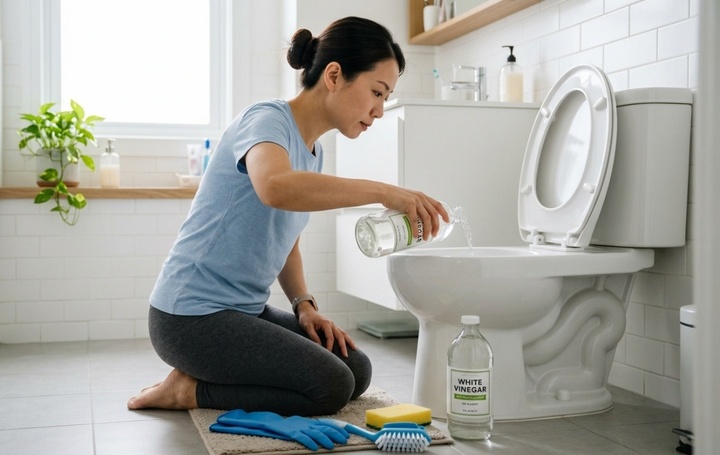
Pouring vinegar into the toilet bowl overnight helps clean stains and limescale. (Photo: HTCH)
4 benefits of pouring vinegar into the toilet bowl overnight.
The power of white vinegar lies in its chemical composition, containing approximately 5-7% acetic acid. Although it is a mild acid, when given enough time to interact, it produces incredibly impressive reactions.
Breaking down yellow stains and limescale : Acetic acid in vinegar acts as an ideal biological solvent. Upon contact with calcium carbonate deposits (limescale), a slow chemical reaction occurs, loosening the molecular bonds of the mineral. Soaking overnight for 6 to 8 hours is the "golden" time for the mild acidity of vinegar to penetrate deeply, completely liquefying stubborn deposits without the need for strenuous scrubbing.
Completely neutralize and eliminate odors : The characteristic odor of toilets mainly comes from ammonia gas (which is alkaline). When vinegar is poured into the toilet bowl, the acidity of the vinegar will immediately neutralize the alkalinity of the ammonia, thereby eliminating the source of the odor. When flushed the next morning, your bathroom will be fresh again, without any lingering foul or strong chemical odors.
Antibacterial and antifungal properties : The acidic environment created by vinegar is not ideal for most pathogenic bacteria and mold to thrive. Acetic acid can penetrate the cell membranes of bacteria, altering their protein structure and killing them. Therefore, vinegar safely disinfects toilet bowl surfaces.
Protecting the porcelain enamel and the septic tank ecosystem : This is the most significant advantage of vinegar compared to chemical cleaning agents. Vinegar cleans surfaces very gently, without scratching or dulling the shine of high-quality porcelain enamel. Importantly, when it flows down into the septic tank, the organic acids are quickly diluted, causing no harm to the bacteria that decompose waste in the septic tank, thus extending the lifespan of your family's sewage system.
The process of using white vinegar to clean the toilet bowl.
Step 1: Prepare about 1 to 2 cups of white vinegar (use only distilled white vinegar, not apple cider vinegar or rice vinegar, as the sugar content in these types of vinegar can leave residue).
Step 2: Pour the vinegar directly into the toilet bowl. Start pouring from the top edge of the bowl so that the solution spreads evenly to all corners, passing through the small flush holes before collecting in the drain funnel.
Step 3: Close the toilet lid to prevent the vinegar fumes from escaping and leave it closed overnight (at least 6-8 hours).
Step 4: The next morning, simply use a toilet brush to gently scrub the surface. At this point, the softened limescale will immediately come off. Finally, flush the toilet to wash away all the dirt.
For toilets that have been neglected for too long and have thick yellow stains, you can combine vinegar with baking soda. Sprinkle half a cup of baking soda into the toilet bowl first, then pour vinegar on top. The powerful effervescent CO2 reaction between the alkali and acid will act like millions of tiny scrubbing machines, instantly loosening the buildup before you let the vinegar sit overnight.
Note : When using chemicals for household cleaning, there is one absolute safety rule that users must remember: never mix vinegar with chlorine-based bleach.
The combination of acetic acid and sodium hypochlorite in bleach creates a reaction that releases chlorine gas, an extremely toxic substance. Inhaling chlorine gas in confined spaces like bathrooms can cause respiratory burns, severe coughing, eye irritation, and in severe cases, can be life-threatening.
Source: https://vtcnews.vn/do-giam-vao-bon-cau-qua-dem-co-tac-dung-gi-ar1020708.html
![[Photo] First session of the 14th Congress of the Vietnam Trade Union](https://vphoto.vietnam.vn/thumb/1200x675/vietnam/resource/IMAGE/2026/06/03/1780465947883_ndo_br_img-3852-jpg.webp)


![[Photo] Secretary of the National Assembly Party Committee, Chairman of the National Assembly presides over the meeting of the Standing Committee and Executive Committee of the National Assembly Party Committee.](https://vphoto.vietnam.vn/thumb/1200x675/vietnam/resource/IMAGE/2026/06/03/1780480353201_ndo_br_bnd-2585-jpg.webp)

![[Photo] General Secretary and President To Lam presides over a meeting with the Central Organizing Committee.](https://vphoto.vietnam.vn/thumb/1200x675/vietnam/resource/IMAGE/2026/06/03/1780482764658_a1-bnd-4741-3342-jpg.webp)

















































![[Video] Sunset at Lap An Lagoon – Where the sun sets over the fishing nets](https://vphoto.vietnam.vn/thumb/1200x675/vietnam/resource/IMAGE/2026/05/31/1780192137701_beach-landscape-sea-water-nature-grass-745871-pxhere-com.jpeg)






































Comment (0)