

TPO - Those who observed the recent blue supermoon on the 7th lunar month may have noticed something strange: a planet disappeared from the sky. At that time, the 'Supermoon Sturgeon' briefly obscured or passed in front of Saturn, dimming Saturn's light in the sky. An astronomical photographer captured the entire scene.
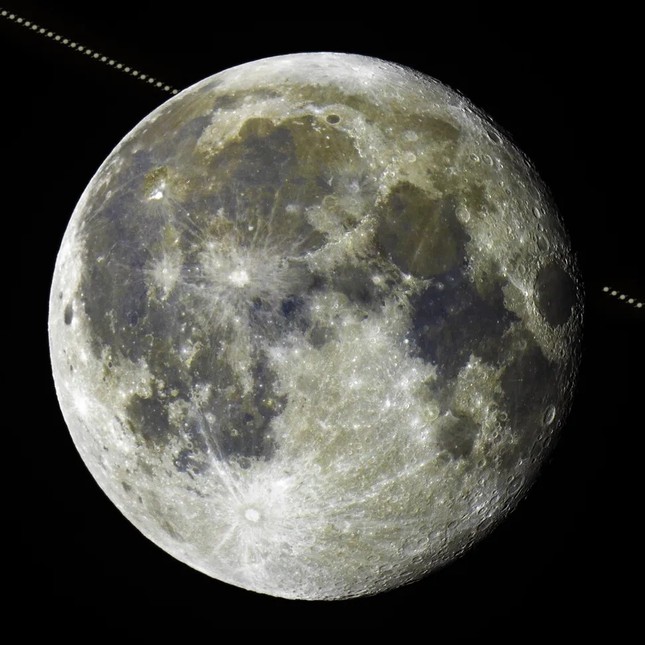 |
The entirety of the Moon's obscuration of Saturn, captured by astronomical photographer Josh Dury. |
In the early morning, the moon obscured—or completely passed in front of—Saturn, seemingly blocking Saturn's light for over an hour. This rare eclipse of Saturn was only visible from certain parts of South America, Europe, and Africa. Astronomical photographer Josh Dury was fortunate enough to capture the entire event from Somerset, United Kingdom.
Taken between approximately 4 and 5:30 a.m. local time (around 11 p.m. to 0:30 a.m. Eastern Time), Dury's images combine 30 individual photographs into a single, fast-forwarded period, capturing the entire process of the moon's eclipse.
Saturn's rings are clearly visible as it moves out from behind the northwestern edge of the full moon, reappearing in the east about an hour later. Although the two objects appear to be together in the sky, Saturn is actually hundreds of millions of miles away, making the occlusion a cosmic optical illusion similar to a solar eclipse.
At perigee, the moon may appear about 15% larger in diameter than at its farthest point from Earth (apogee), and may also appear significantly brighter, according to NASA.
The July full moon is the first of four consecutive supermoons, offering skygazers plenty of opportunities for viewing. A good pair of binoculars or a small telescope will allow you to get the best possible close-ups of the moon in the coming days.
If you missed the Saturn eclipse last week, you may have a chance to observe the next eclipse in September, depending on where you live. In the early morning of September 17th, the Moon will reappear to "swallow" Saturn. This time, viewers in certain parts of Australia and the western United States will have the best view.
This has been a busy month for skywatchers, with brilliant auroras, planetary conjunctions, and the Perseid meteor shower. Last week, astronomical photographer Dury also hiked to Scotland's ancient Stonehenge to photograph dozens of meteors falling on the ancient monument.
There are still plenty of sky-watching events in 2024, including some of the most spectacular meteor showers of the year.
According to Live Science
Source: https://tienphong.vn/doc-dao-khoanh-khac-sieu-trang-xanh-nuot-chung-sao-tho-post1666371.tpo


![[Image] Nearly 125,000 Hanoi students completed the Literature exam for the 10th grade entrance exam.](https://vphoto.vietnam.vn/thumb/1200x675/vietnam/resource/IMAGE/2026/05/30/1780117233041_ndo_br_thiet-ke-chua-co-ten-2-png.webp)

































































































Comment (0)