

Illustration: Phan Nhan |
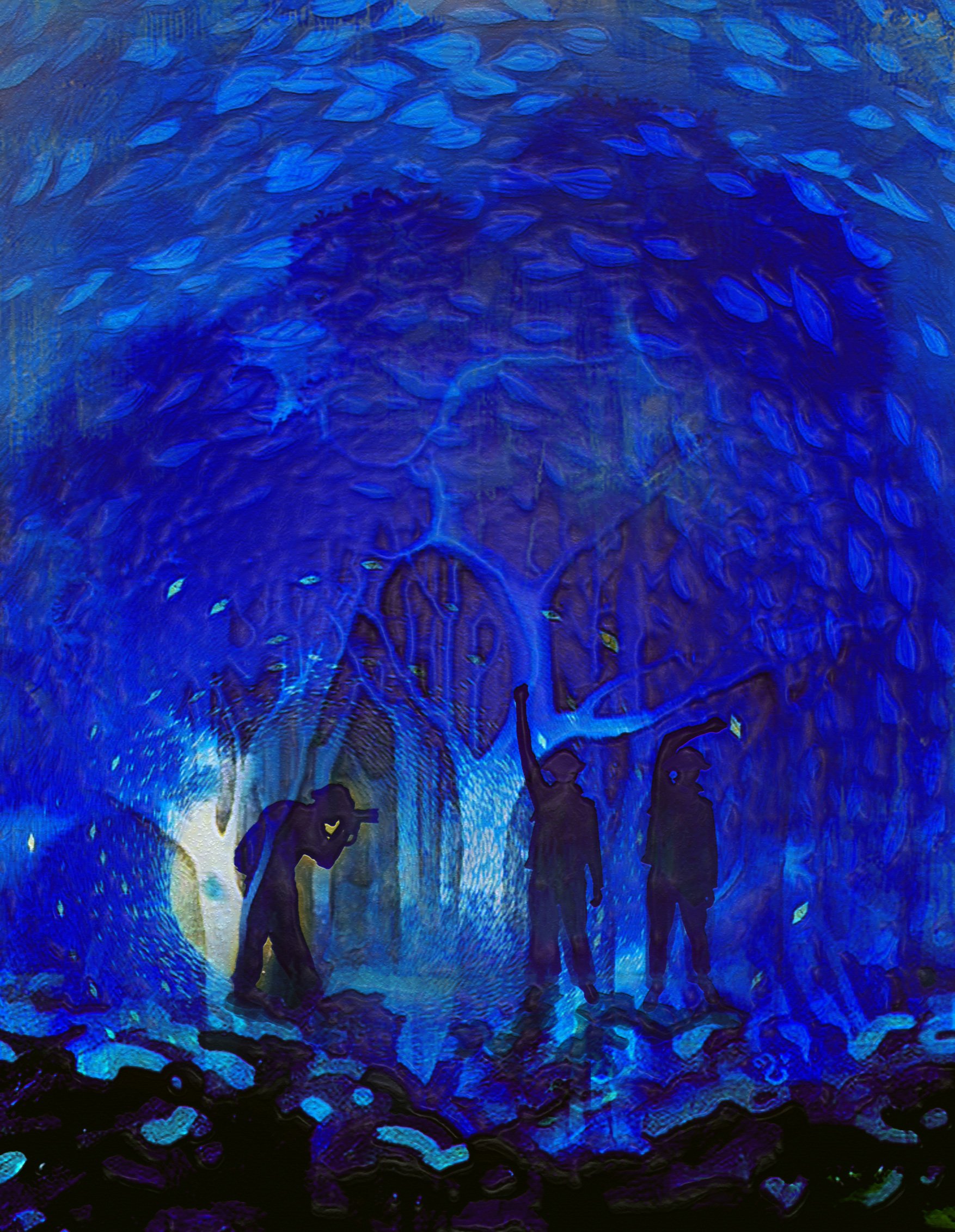
At dawn the next day, the old forest by the river was still covered in patches of morning mist. The whole group was awake. The leader's order:
- Hurry, prepare to cross the river. Take advantage of the lingering fog to avoid enemy reconnaissance planes.
Nguyen hurriedly packed his backpack, hammock, camera, and video camera, tightly bound in plastic bags, and wrapped a piece of plastic sheeting around them to create a makeshift raft to cross the river. The river water was cold, but the current wasn't strong, so the whole group crossed safely.
***
Originally from Cu Chi District, Saigon, after completing a course for war correspondents and cameramen, he was assigned to Zone 6. In the early 1960s, the battlefield had not yet opened up major campaigns. We secretly rebuilt our bases within strategic hamlets, consolidated and rebuilt suburban areas, and re-established communication lines that had been severed after Law 10/59 of the Ngo family regime. We hunted down, imprisoned, and tortured "elements aiding the Viet Cong" with the aim of psychological terror, while simultaneously pushing our armed propaganda forces away from these bases.
In the early days of his work at the Propaganda Department, he was bewildered and unfamiliar with the job, as the place lacked all necessary resources. His main task was clearing land to plant cassava to provide food for the troops sent from A. The work was monotonous and constantly tormented him. At times, he thought to himself, "Is this the revolution of my life?" Nam Long, the officer in charge of the propaganda subcommittee, who lived alongside Nguyen every day, understood the young reporter's feelings through his sighs and gestures at work.
I want to discuss this matter with you…
- What kind of work is it? Is it important?
- For now, I'll propose seeking guidance from Brother Nam (Brother Nam, the Head of the Propaganda Department) so you can make a slideshow film. Initially, it will serve the ethnic minority people in the Cat Tien base area and later in the villages and hamlets of the ethnic minorities in Da Teh, Bu Gia Map, Bu Dang, Bu Dop, Buon Go, Bom Bo... He paused for a moment, pulled a packet of tobacco from his pocket, rolled it into a ball with both hands, and continued:
- Get ready, we're going down to the ethnic minority villages around the base to do some fieldwork, write the script, and start making the film.
Nguyen was overjoyed; his mood was indescribably happy, his hands and feet fumbling, unsure of what to do. He was happy, but also worried. He thought to himself, "I've never made a slide film before, will I be able to do it?"
The projector had to be ordered from a supplier in Madagui. It projected individual film strips (slights), not in rolls like the projectors manufactured in Hanoi . Therefore, each scene was explained separately.
Dieu Xuyen, a tall, strong girl with a deep, warm voice, was chosen by the performing arts troupe. Although called a troupe, it actually consisted of only a few people, with guitars and mandolins as their instruments. With her expressive voice, Dieu Xuyen would often introduce the songs before the performance began. Nam Long called Dieu Xuyen in and said:
- I'm going to see Mr. Nguyen so he can teach me how to read film commentary.
- What kind of comment is that, uncle?
- Just get closer and you'll see.
In the beginning, Nguyen and Dieu Xuyen were initially awkward with each other, but gradually, through their work, they grew closer. Nguyen never expected that the young girl from the S'tieng ethnic group would not only be intelligent and beautiful but also attentive and follow his instructions. Later, she even creatively used expressive language, emphasizing nuances and inflections to convey emotion in her explanations. Furthermore, she also knew the Chau Ma ethnic language from the Nam Cat Tien region. This was a valuable asset for her work in the villages north of the Dong Nai River.
The challenge on the battlefield was how to obtain positive film (Poshitip) for projection films. After many sleepless nights of contemplation, even while working in the fields, he still thought about how to make films.
"Ah! I've found it!" he shouted from the field, startling everyone in the office.
"What's coming out?" a teammate asked.
- I've figured out how to make slide films.
Everyone burst out laughing, clearly he was an idiot - I thought he was something really serious.
The only way is to buy inversip film, take the picture, and develop it directly for projection, without going through the negative. The limitation is that each film is a single copy.
***
During the meeting, chaired by Uncle Nam, the Head of the Propaganda Department of the district, Nam Long presented:
- Dear Comrades, the purpose of merging the film projection team, the performing arts team, and the film projector into a single propaganda team to serve the soldiers and ethnic minority people in the base areas was a new form of expression. Combining three disciplines—music, film projection, and propaganda projection—in a single ideological battle created a powerful and positive impact on the audience. Therefore, each time they went to serve the ethnic minority people, they were often called the "film projection team."
As they crossed the stream, Nguyen held Dieu Xuyen's hand tightly. Her small, slender hand, bearing a few calluses, stirred a pang of sympathy for the young women who sacrificed their youth for the revolution. He mused, "If Dieu Xuyen lived in the city and dressed up a little, she wouldn't be inferior to anyone."
"We're almost at the village, brother!" - said Dieu Xuyen.
Far beyond the grasslands, the village of Brun nestled in the ancient forest. On this trip, he and Dieu Xuyen returned to the village to immerse themselves in the reality of the situation and write the first script for a slideshow film. Under the sweltering heat, sweat soaked the tattered shirts of the Chau Ma girls, yet smiles still bloomed on their faces. They were threshing rice, their hands moving swiftly, their mouths full of cheerful chatter. Nguyen and Dieu Xuyen observed the labor in the fields, and from that, he formed the script for the slideshow film "Golden Harvest on the Fields."
Later, when they finished making the film and brought it back to the village to sell, the girls felt incredibly embarrassed seeing themselves on screen. They mumbled and giggled, while the young men shouted loudly. The images, accompanied by narration in the local dialect, were easy for the villagers to understand and resonated with them like a cool breeze on a hot summer afternoon. The elderly were very enthusiastic; their faith and love for the revolution grew even stronger.
***
The afternoon sun shone down on the river, shimmering with golden light. A tranquil twilight was suddenly broken by the roar of an L19 reconnaissance plane's engine as it skimmed across the water. They spotted a dugout canoe approaching the shore to escape. A voice called from the cockpit:
- Eagle, do you hear me? Reply! The Owl urgently needs two more Iron Birds at coordinate X.
Then came the screeching sound of rockets, a solid "boom," a plume of white smoke rising, and the dugout canoe shattering into pieces. Two fighter planes swooped down, dropping bombs incessantly on the dense forest by the river, where a village of ethnic minorities lived. Columns of smoke rose high, the screeching and earth-shattering explosions tore through the tranquil space. This was followed by the barking of dogs, the clucking of chickens, and the shouts of people fleeing in all directions through the dense forest. Nguyen and his team huddled behind a large tree, his brother lying on top of Dieu Xuyen. By chance, without any other intention, a bomb exploded with a deafening roar, shaking the entire forest, leaves rustling, and the two clung tightly to each other. The buttons on her shirt came undone, revealing before him the full, blossoming breasts of a young girl. The events unfolded so quickly between life and death; the two thought of nothing but their survival instinct: relying on each other. After the bombing stopped, Dieu Xuyen's face was flushed red. She awkwardly and shyly stood up, turned around, and buttoned her shirt.
- Are you okay? That flying car was really rough.
"Thank goodness," Nguyen replied. "It didn't see us."
No one in the group was injured, only their personal belongings were damaged by a few shrapnel fragments piercing their backpacks. Acting on professional instinct, Nguyen quickly took out his camera and photographed the scene unfolding before him. A scorched old forest, uprooted trees, charred livestock, and people carrying their children and fleeing deep into the woods, their backs laden with tattered baskets and their shoulders burdened with machetes.
Nam Long understood the head of the steering committee's suggestion: "The 'shadow performance group' must produce a slideshow film about the events that occurred in the Bà Lú village on the riverbank to stir up hatred, denounce the enemy's crimes, and remind the villagers to remain vigilant." He discussed this with Nguyên:
- At all costs, you must produce a slideshow film about the bombing at Ba Lu village.
- But, that day I used negative film, and I can report to you that negative film cannot be used to make projection film.
- This is an order from above, no ifs or buts.
Nguyen's face turned ashen, and he stood there speechless. As if understanding Nguyen's feelings, Nam Long calmly said:
- Keep trying, I have faith in your resourcefulness. But as the saying goes, "Necessity is the mother of invention," so please think carefully about it.
The night in the quiet, ancient forest was still and silent, the late-night moonlight casting a slanted glow through the leaves. Nguyen tossed and turned, unable to sleep, haunted by Nam Long's words from that afternoon: "We must do something to avoid losing the trust of the leaders." The chirping of birds startled him awake. After much thought, he finally figured out how to make the film. He got up, connected the battery to the projector's light bulb, and projected the film he had taken that afternoon in the village of Ba Lu. Then he poured the film into a small basin, like a washbasin, to drain the rainwater. By the time he returned to his hammock, the roosters had already crowed at dawn. After a long sleep, he heard K'Lanh, the person in charge of the projector's generator, shouting loudly:
- What were you doing last night that made you sleep so soundly? It's already noon, Dad.
- I was developing photos, then I fell asleep without realizing it.
He answered verbally, his hands washing each photograph under the stream water before hanging them up to dry. He used inversip film to print all the images for printing. Although the quality was reduced in sharpness and black-and-white contrast after developing, they were still usable. A sigh of relief: "It's a success!"
The romantic encounter on the banks of the Dong Nai River with a S'tieng ethnic girl remained only in his subconscious. A major campaign was underway, and Nguyen, carrying his backpack, joined the army to attack the Dam Ron outpost (now Dam Rong district) in the summer of 1963. Then, in 1964, he returned to liberate Hoai Duc district (Binh Tuy province), a vast plain, the rice granary of what is now Binh Thuan province. Like a bird, he was present wherever there was a campaign until the liberation of South Vietnam...
Source: https://baolamdong.vn/van-hoa-nghe-thuat/202506/doi-hat-bong-8c53d58/



























































Comment (0)