

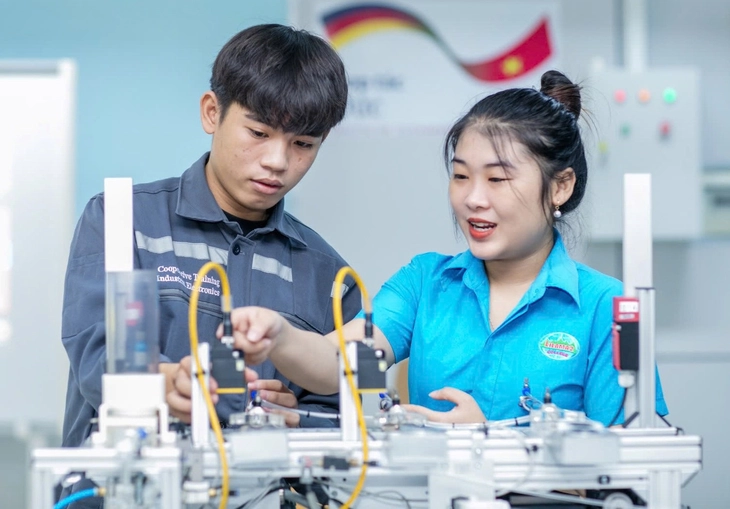
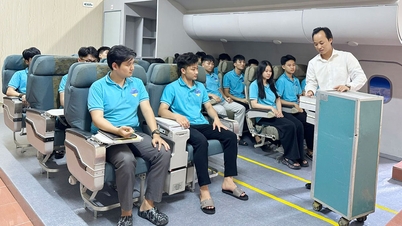
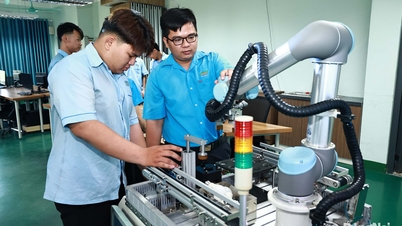
Students at LILAMA 2 International College ( Dong Nai ) practice as part of a training program oriented towards German standards - Photo: GIZ VN
Ms. Andrea Sũhl, Consul General of Germany in Ho Chi Minh City, shared with Tuổi Trẻ newspaper experiences from the German vocational training system regarding the development of high-quality vocational schools in Vietnam.
Business bottlenecks
* Considered one of the most successful countries in vocational training, especially with its dual training model, what do you believe are the core factors contributing to this success in Germany?

Ms. Andrea Suhl
The success of the German vocational training system stems primarily from a very fundamental principle: vocational training is a shared responsibility of the state, businesses, schools, and social partners.
In the dual training model, businesses are genuinely involved in the entire training process, including selecting trainees, signing training contracts, paying allowances, assigning instructors, organizing on-the-job training, and coordinating the evaluation of results.
Another crucial factor is a clear and socially trusted national occupational standards system. Each vocational training program in Germany has a specific competency framework, training content, and assessment requirements. Chambers of industry and commerce, craft chambers, professional associations, trade unions, and government agencies all participate in developing and updating these standards.
Ultimately, I believe Germany's success lies in how society views vocational education . Vocational training in Germany is seen as a formal, high-quality path to earning income early, offering good job opportunities, and still allowing for further education.
When young people, families, businesses, and the government all believe in the value of vocational skills, the vocational training system can function sustainably as it does today.
* Specifically regarding businesses, how do they participate in the vocational training process, Madam?
- Businesses play a very specific and ongoing role. They select trainees and sign training contracts. Trainees enter the business as contracted apprentices, receiving training allowances and being assigned mentors.
In the curriculum development phase, businesses participate through industry associations, chambers of industry and commerce, handicraft chambers, and organizations representing employers. Together with government agencies, vocational schools, and trade unions, they determine the necessary competencies for a profession, the required learning outcomes, which content should be taught within the enterprise, and which content is suitable for vocational schools.
During the training process, the company is responsible for organizing the on-the-job learning component. Trainees participate in production, service, or operational processes at various levels, from observation and guided practice to undertaking specific professional tasks.
On-site mentors monitor progress, instill work discipline, professional conduct, teamwork skills, workplace safety, and problem-solving abilities in real-world situations.
Regular evaluation is needed.
* Vietnam is developing high-quality vocational colleges. Based on Germany's experience, what are the key factors in building a high-quality vocational training institution?
- Based on Germany's experience, a high-quality vocational training institution must first and foremost have a strong link with the labor market. Vocational schools cannot develop in isolation from businesses. Training programs, practical equipment, teaching methods, and output standards all need to be built on the basis of the skill needs of various economic sectors.
Clear quality standards and regular self-assessment mechanisms are needed. Schools need to know their strengths and weaknesses in terms of curriculum, staff, facilities, governance, business collaboration, digital transformation, or green development. In Germany, the quality of vocational training is ensured through professional standards, assessment processes, and the participation of multiple stakeholders, including businesses.
Another crucial factor is the teaching staff and instructors at the enterprise. Vocational school teachers need to be updated on new technologies, modern teaching methods, and understand the actual work processes at the enterprise. At the same time, instructors at the enterprise also need training in training methods, assessment, and support for learners.
High-quality vocational schools need the capacity for continuous innovation. Occupations are changing rapidly due to digital transformation, automation, artificial intelligence, renewable energy, and the green transition. Therefore, vocational schools need to proactively update their curricula, develop short-term training modules, and provide retraining and advanced training for workers.
Supporting vocational schools in Vietnam
* What cooperation programs and projects has Germany been implementing in Vietnam to improve the quality of vocational training and develop vocational education institutions?
- German-Vietnamese cooperation in vocational education is currently being implemented at multiple levels, from policy consultation and support for the development of high-quality vocational schools to curriculum development and strengthening cooperation between schools and businesses. The central program is "Innovation in Vocational Education in Vietnam," funded by the German government and implemented by GIZ in collaboration with Vietnamese partners.
Within the framework of this program, Germany supports vocational education institutions in improving management capacity, self-assessing quality, training teachers, developing training programs to meet business needs, promoting digital transformation, and greening the school environment.
One key direction is to involve businesses more deeply in the training process, from establishing learning outcomes and organizing on-the-job training to evaluating learners.
The results can be seen at partner schools such as LILAMA 2, the College of Mechanical and Irrigation Engineering, the College of Technology II, and many other vocational education institutions.
Schools have been supported in developing programs according to German or international standards, building training models in cooperation with businesses, training core teachers, and implementing modules on Industry 4.0, digital skills, renewable energy, and green skills.
Source: https://tuoitre.vn/doi-moi-lien-tuc-de-xay-dung-truong-nghe-chat-luong-cao-20260517091816528.htm
![[Photo] General Secretary and President To Lam presides over a meeting with the Central Organizing Committee.](https://vphoto.vietnam.vn/thumb/1200x675/vietnam/resource/IMAGE/2026/06/03/1780482764658_a1-bnd-4741-3342-jpg.webp)




![[Photo] Secretary of the National Assembly Party Committee, Chairman of the National Assembly presides over the meeting of the Standing Committee and Executive Committee of the National Assembly Party Committee.](https://vphoto.vietnam.vn/thumb/1200x675/vietnam/resource/IMAGE/2026/06/03/1780480353201_ndo_br_bnd-2585-jpg.webp)





















































![[Video] Sunset at Lap An Lagoon – Where the sun sets over the fishing nets](https://vphoto.vietnam.vn/thumb/1200x675/vietnam/resource/IMAGE/2026/05/31/1780192137701_beach-landscape-sea-water-nature-grass-745871-pxhere-com.jpeg)


































Comment (0)