

National Assembly deputies from Ha Tinh province contributed many specific and relevant opinions, helping to improve the draft Law on the Organization of People's Courts (amended).
Continuing the agenda of the 6th Session, on the afternoon of November 9th, the National Assembly held group discussions on the draft Law on the Organization of People's Courts (amended).
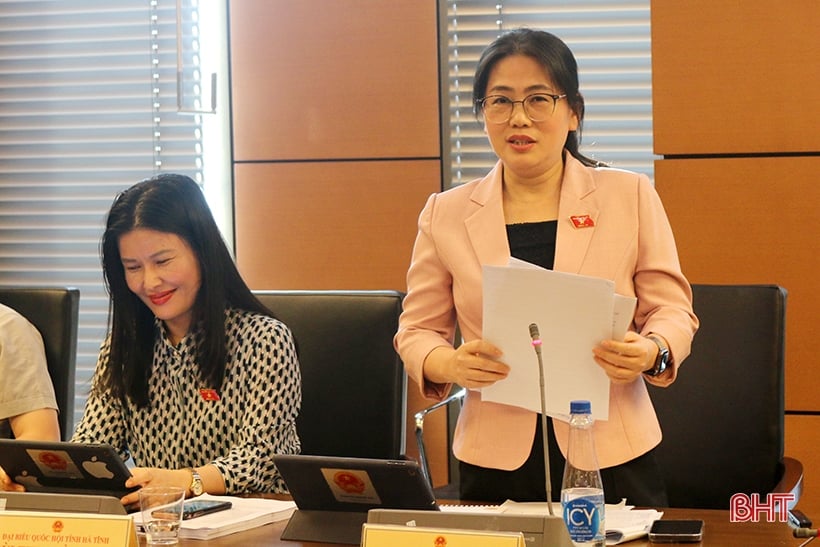
Chief Justice of the Provincial People's Court, National Assembly Representative from Ha Tinh Province, Phan Thi Nguyet Thu, delivered a speech.
During the discussion, the National Assembly deputies from Ha Tinh province unanimously agreed that amending the Law on the Organization of People's Courts is necessary to further improve the organizational structure, enhance the quality, efficiency, and effectiveness of the people's courts; and build a professional, modern, fair, strict, and honest court system that serves the Fatherland and the people.
The delegates focused their discussions on: the scope of regulation; specialized first-instance people's courts; the organizational structure of the Supreme People's Court ; the reorganization of the support staff of the High People's Court; the reform of provincial and district-level people's courts according to their jurisdiction; and regulations prohibiting inspection and investigation of judicial proceedings and the resolution of cases currently in the litigation process.
The delegates proposed not establishing a National Judicial Council, maintaining the existing regulations and adding tasks and powers to the National Council for the Selection and Supervision of Judges, enhancing effectiveness and efficiency, contributing to ensuring independence between different levels of adjudication, without increasing the number of administrative units or personnel; and emphasizing responsibility, strengthening discipline and order, and supervising judges.
The delegates discussed several issues related to judges of the People's Courts, such as: regulations on judge ranks and grades; the authority to decide the number of judges and their grades at each court level, the structure and proportion of judges; the age for appointing judges; the conditions for appointing judges; and the mechanism for protecting judges.
It was unanimously proposed that the Trial Council not be tasked with initiating criminal proceedings at the trial; that the five-year term for judges is appropriate; and that the authority to adjudicate administrative violations be supplemented as stipulated by law. Regulations related to salaries and allowances should be reviewed to ensure consistency with the Government's new salary reform policy.
The proposal to establish a specialized first-instance people's court must be submitted to the Standing Committee of the National Assembly for consideration and decision; appropriate measures should be taken regarding personnel organization for Supreme People's Court judges and judges who have violated criminal law.
Delegates suggested reviewing the provisions of the draft Law to ensure consistency and uniformity within the legal system; fully regulating the content of the courts' exercise of judicial power, ensuring interconnectedness and coordination with the duties and powers of the courts, and establishing an effective mechanism for controlling power; and clearly defining the responsibility of the courts in guiding and assisting in the collection of evidence for vulnerable parties. They also proposed reforming and improving the quality of human resources in the courts, ensuring that judges are encouraged to dedicate themselves to their work.
Quang Duc, Tran Nhung
Source



![[Image] Hanoi's urban life under the challenge of a "scorching hot" environment](https://vphoto.vietnam.vn/thumb/1200x675/vietnam/resource/IMAGE/2026/05/25/1779706979265_nang-nong-t5-2026-minh-duy-7-4636-jpg.webp)









































































Comment (0)