

Currently, most countries in the world are strongly influenced by science and technology; in particular, digital technology has become the "key" to development. Therefore, in this new phase of national development, it is no coincidence that Resolution No. 57 on breakthroughs in science, technology, innovation, and digital transformation, linked to the requirement of perfecting the legal system, is a significant step forward. This truly represents a new shift, demanding a change in thinking not only among lawmakers but throughout society. Subsequently, Resolution No. 06 of the Politburo on reforming the work of lawmaking and law enforcement also further emphasizes this requirement.
.jpg)
Notably, in this new era of development, the National Assembly not only performs the traditional function of lawmaking but also plays a leading role in institutional reform, creating new development spaces for the country. Each law enacted is not only for governance but also aims to pave the way for innovation and sustainable socio -economic development.
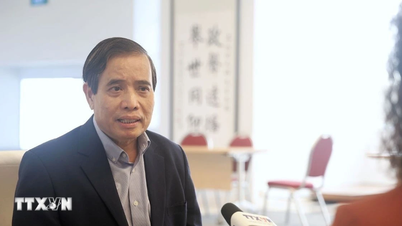
At the seminar "The National Assembly and Constitutional and Legislative Activities - From the 1946 Constitution to Institutional Reform in the New Development Era" organized by the People's Representatives Newspaper, National Assembly Delegate of the 13th term, Director of the Institute of Resources, Environment and Community Development, Associate Professor Dr. Bui Thi An stated that we are in the digital age and must adapt; failure to do so will result in being left behind. Currently, it can be affirmed that the National Assembly has fundamentally reformed its thinking on lawmaking, aiming to both ensure the requirements of state management and encourage creativity, unlocking all resources for development.
However, to do that even better, Associate Professor Bui Thi An suggests implementing the following solutions:
Firstly, in addition to adhering to principles in the digital age, the law needs to be open, flexible, reduce policy lags, and create space for innovation.
Secondly, regarding human rights in the 2013 Constitution, it is necessary to approach human rights in the context of modern, digital, AI-driven, and digital environments.
Thirdly, when drafting laws, there must be foresight, meaning they must be linked to reality, because without foresight, they will become outdated and easily lead to passivity.
Fourth, lawmaking should avoid general frameworks and instead ensure specificity, detail, and feasibility.
Fifth, we must innovate our thinking, demonstrating responsibility to the people and the country in order to have appropriate perspectives. From these perspectives will come the development and enactment of feasible laws that promote the country's development.
"I believe that the lawmaking process needs to be changed to align with current development trends, modernization, and integration, ensuring that laws are both fundamental and provide direction for the country's development. It's clear that the responsibility of National Assembly representatives is very high here," Associate Professor Bui Thi An emphasized.
Legislative work is a persistent journey of inheritance and innovation, extending from the spirit of national independence, people's happiness, democracy, and the rule of law of the 1946 Constitution to the important breakthroughs of the 2013 Constitution and the demands for institutional reform in today's new era of development. Throughout this journey, the National Assembly has always played a central role, embodying the will and aspirations of the people, and simultaneously serving as the entity that creates the legal framework for national development.
Source: https://daibieunhandan.vn/doi-moi-tu-duy-lap-phap-de-chu-dong-dan-dat-ky-nguyen-phat-trien-moi-10402312.html
![[Photo] Ba Lang An Lighthouse - the "eye of the sea" amidst the "rock museum" of Quang Ngai province.](https://vphoto.vietnam.vn/thumb/1200x675/vietnam/resource/IMAGE/2026/05/29/1780038698840_anh-man-hinh-2026-05-29-luc-14-10-42.png)

![[Image] Pleasant weather helps students enter the 10th grade entrance exam with confidence.](https://vphoto.vietnam.vn/thumb/1200x675/vietnam/resource/IMAGE/2026/05/29/1780034401612_ngay-1-thi-lop-10-minh-duy-8-5009-jpg.webp)







































































Comment (0)