

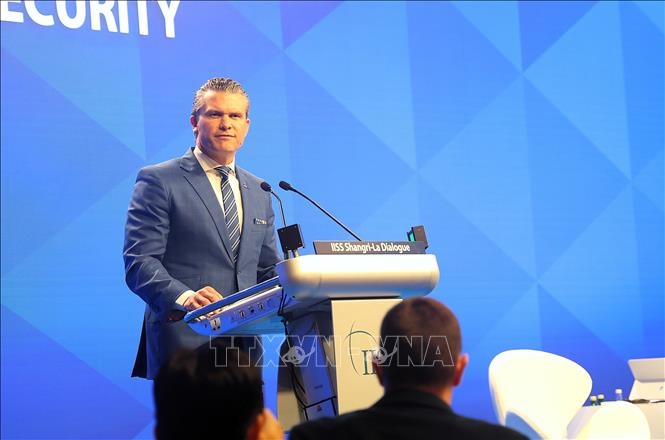
According to the South China Morning Post (SCMP) on May 27, the summit, taking place in Singapore from May 29-31, is expected to be a test of whether the meeting between Trump and Chinese President Xi Jinping will truly help de-escalate strategic competition between the two superpowers.
U.S. Secretary of War Pete Hegseth's speech at the forum will be the focus of attention for Asia-Pacific countries. Analysts believe that Hegseth's message will clearly reflect the extent of the shift in Washington's approach to Beijing following the previous U.S.-China summit.
Zhu Feng, director of the School of International Studies at Nanjing University, commented that the Pentagon chief's speech would reveal whether both sides are moving toward a more stable competition management mechanism.
According to him, if Washington continues to use a tough tone and focus on criticizing China as in previous years, it indicates that the meeting between Trump and Xi has only had a limited impact within the security and defense circles of the two countries.
The 2026 Shangri-La Dialogue also took place as the conflict in Iran entered its fourth month, raising concerns among many Asian countries about the risk of the US having its military resources diverted and its security commitments in the Indo-Pacific region being affected. Asian economies are also currently under significant pressure from soaring energy prices and trade disruptions due to instability in the Middle East.
Observers believe that many Southeast Asian countries will seek clearer signals from Washington regarding its strategy for ending the Iran conflict, as well as the level of priority the US will give to Asia in the future.
Another point worth noting is the possibility that Chinese Defense Minister Dong Jun may be absent from Shangri-La for the second consecutive year. If this happens, the chances of holding a high-level meeting between military officials from both countries on the sidelines of the forum will further diminish.
Last year, the Chinese delegation was led by Hu Gangfeng instead of the defense minister. Beijing has long been uncomfortable with the Shangri-La Dialogue, arguing that the forum is heavily influenced by Western security views and often places China in a position of criticism.
Professor Shi Yinhong, a professor of international relations at Renmin University of China, suggests that given the ongoing tensions between China and the United States and Japan, Beijing may want to avoid an environment of public dialogue that could easily lead to direct criticism regarding regional security issues.
Japan is also expected to play a prominent role at this year's forum. Tokyo has confirmed that Defense Minister Shinjiro Koizumi will attend the Shangri-La Dialogue. Sino-Japanese relations have recently continued to deteriorate following statements by Japanese Prime Minister Sanae Takaichi.
Meanwhile, tensions in the South China Sea continue to be a hot topic as China and the Philippines repeatedly clash near disputed territories. Beijing has repeatedly asserted that disputes should be resolved through bilateral negotiations or ASEAN mechanisms, while opposing the involvement of external powers.
According to analysts, any shift in tone between the US and Chinese delegations at this year's summit will be closely watched, as it could reflect whether the recent meeting between Trump and President Xi Jinping truly ushered in a new era of stability in bilateral relations or was merely a temporary de-escalation.
Source: https://znews.vn/doi-thoai-shangri-la-2026-phep-thu-cho-quan-he-my-trung-post1654832.html
![[Photo] Secretary of the National Assembly Party Committee, Chairman of the National Assembly presides over the meeting of the Standing Committee and Executive Committee of the National Assembly Party Committee.](https://vphoto.vietnam.vn/thumb/1200x675/vietnam/resource/IMAGE/2026/06/03/1780480353201_ndo_br_bnd-2585-jpg.webp)
![[Photo] First session of the 14th Congress of the Vietnam Trade Union](https://vphoto.vietnam.vn/thumb/1200x675/vietnam/resource/IMAGE/2026/06/03/1780465947883_ndo_br_img-3852-jpg.webp)
![[Photo] General Secretary and President To Lam presides over a meeting with the Central Organizing Committee.](https://vphoto.vietnam.vn/thumb/1200x675/vietnam/resource/IMAGE/2026/06/03/1780482764658_a1-bnd-4741-3342-jpg.webp)































![[Video] Sunset at Lap An Lagoon – Where the sun sets over the fishing nets](https://vphoto.vietnam.vn/thumb/1200x675/vietnam/resource/IMAGE/2026/05/31/1780192137701_beach-landscape-sea-water-nature-grass-745871-pxhere-com.jpeg)






















Comment (0)