


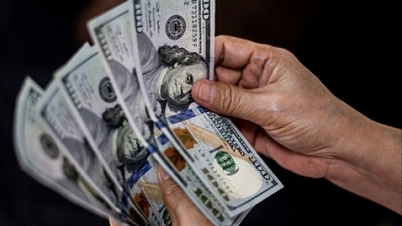
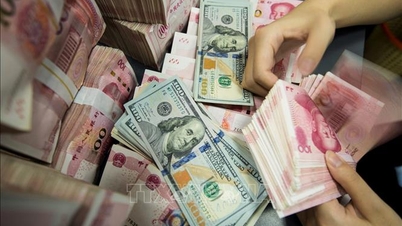
Despite a slight decline at the end of the week, the US dollar still recorded a solid month of gains thanks to sell-offs in the bond market and expectations that the Federal Reserve (Fed) will raise interest rates.
At the close of trading on May 29, the US dollar index – a measure of the greenback's strength against a basket of six major currencies – fell 0.1% to 98.92. This pullback provided momentum for major currencies, with the euro and the British pound both rising 0.1%, reaching $1.1659/euro and $1.3456/pound respectively.
Meanwhile, the Japanese yen remained stable at 159.25 yen per US dollar. This development suggests that the Japanese government 's intervention has had limited effectiveness, despite spending 11.7 trillion yen (73.46 billion USD) in the past month to stabilize the exchange rate.
Overall in May, the US dollar index rose 0.8%. This increase was mainly driven by expectations that the Fed may tighten policy in early 2027 to combat inflation, thereby increasing the attractiveness of dollar-denominated assets. However, Wall Street analysts are extremely cautious about the dollar's ability to sustain this upward trend.
Another major drag on the US dollar comes from the narrowing interest rate differential between the US and the rest of the world . Matthew Hornbach, global macro strategist at investment bank Morgan Stanley, believes the European Central Bank (ECB) and the Bank of Japan (BoJ) are expected to raise interest rates to move closer to the Fed's borrowing costs in the coming months. He assesses the current macroeconomic environment as leaning towards a weaker US dollar scenario, thereby providing support for other major currencies to break through.
In fact, the market is currently pricing in a 60 basis point interest rate hike by the ECB and a 40 basis point hike by the Bank of Japan by the end of this year, much higher than the Fed's projected 30 basis point increase by March 2027. Howard Du, a currency strategist at TD Securities USA, believes the market no longer trusts the Fed to act more aggressively than other central banks as it did in the post-pandemic period. Therefore, analysts expect the US dollar index to fall by more than 1% in the third quarter and 2% in the fourth quarter of this year.
Erik Nelson, a macro strategist at Wells Fargo Securities, believes the U.S. economy 's dominance over the rest of the world may have peaked. This will limit the dollar's potential for a breakout. He also warns that the excessive flow of capital into U.S. artificial intelligence (AI) and semiconductor stocks could put the dollar at risk of a reversal.
Besides macroeconomic factors, geopolitical developments are also gradually impacting the US dollar. News of a peace agreement between the US and Iran has sparked hope for resolving the crisis in the Strait of Hormuz. Although the situation on the ground remains tense, this expectation is reducing the demand for holding USD as a safe-haven asset.
Next week, market attention will be focused on a series of key economic data releases. In the US, markets will closely monitor the May jobs report and the Purchasing Managers' Index (PMI) for both the manufacturing and services sectors to assess the "health" of the economy amidst escalating geopolitical tensions.
Source: https://baotintuc.vn/thi-truong-tien-te/dong-usd-chot-thang-tang-gia-gioi-dau-tu-van-canh-giac-20260530124157711.htm




![[Photo] Delegation attending the 14th Congress of the Vietnam Trade Union visits the Mausoleum of President Ho Chi Minh.](https://vphoto.vietnam.vn/thumb/1200x675/vietnam/resource/IMAGE/2026/06/03/1780451842301_ndo_br_img-3824-jpg.webp)






















































































Comment (0)