

(NLĐO) - The strengthening of the US dollar in the international market is one of the factors affecting the USD/VND exchange rate.
On February 1st, the US dollar index (DXY) traded around 108.2 points in the international market, up 0.55% from the previous session. The DXY index has maintained a high level in recent days and is currently at its highest point in over two years.
In Vietnam, the US dollar exchange rate at commercial banks is trading around 24,800 VND/USD for buying and 25,300 VND/USD for selling, a decrease of about 250 VND compared to the beginning of the year. The USD/VND exchange rate has increased by about 5% last year and is predicted to continue facing pressure this year. According to experts, the strengthening of the US dollar in the international market is one of the factors affecting the USD/VND exchange rate.
In their 2025 strategic report, experts from the Analysis Center of Rong Viet Securities Company (VDSC) forecast that exchange rate fluctuations in 2025 will depend on the supply and demand of foreign currency in the domestic market; the prospect of the US dollar appreciating; and the US tariff policy towards Vietnam.
The DXY index is projected to rise by 5-10% in 2025. While the trend of central banks cutting interest rates creates a certain favorable environment for exchange rate management, pressure from the appreciating US dollar may outweigh the positive effects of the interest rate cut cycle.
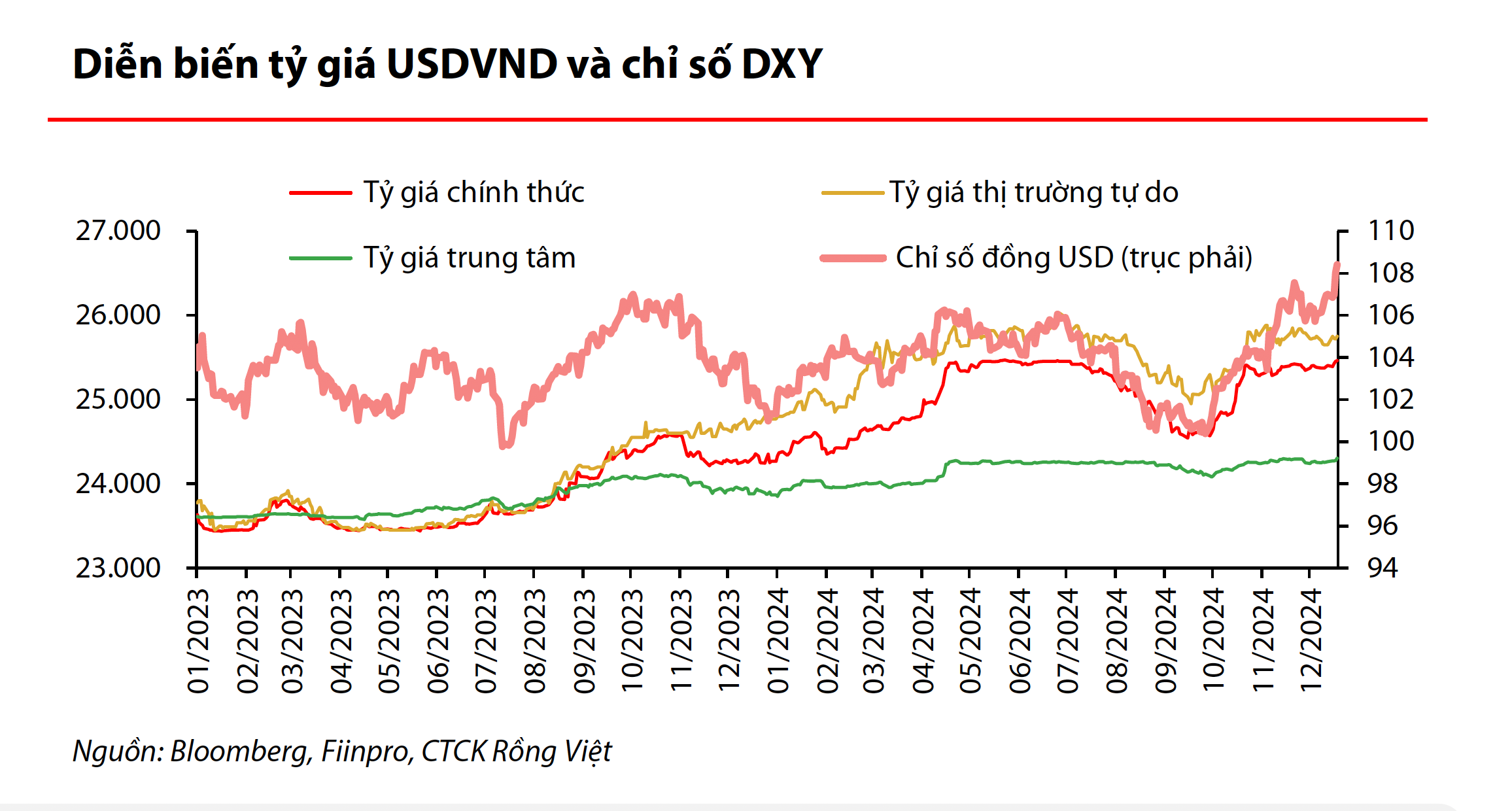
"In the base scenario: the exchange rate fluctuates within a range of +/-5% and ends 2025 at VND 26,200/USD. The risk of tariffs is usually accompanied by pressure to depreciate the currency of the taxed country, and Vietnam will be no exception. Therefore, in the negative scenario, the exchange rate could rise above VND 26,200/USD if the US imposes tariffs of 10-20% on Vietnamese exports in the second half of 2025" – Rong Viet Securities forecasts.
Analysts at Vietcombank Securities (VCBS) also stated that the strength of the US dollar remains a major factor influencing the USD/VND exchange rate fluctuations this year. However, the foreign exchange market may see some positive developments. Remittances continue to be a bright spot for foreign currency flows in 2025, consistently remaining above $13 billion for the past three years. The VND is projected to depreciate relatively against the US dollar, with a reasonable fluctuation of around 3% for the whole year.
Despite the continuous rise in deposit interest rates recently, analysts believe that lending interest rates will remain stable to support businesses and the economy .
In fact, Deputy Governor of the State Bank of Vietnam, Dao Minh Tu, stated that by the end of 2024, although deposit interest rates increased by 0.71 percentage points compared to the end of 2023, lending interest rates decreased by 0.6 percentage points compared to the beginning of the year. In managing interest rates, the State Bank of Vietnam continues to maintain the current policy interest rates, creating favorable conditions for credit institutions to access capital from the State Bank at low cost, enabling them to support businesses and the economy…
Regarding future interest rate forecasts, Ms. Tran Khanh Hien, Director of Research at MBS Securities Company, stated that she does not expect the State Bank of Vietnam to cut policy interest rates this year. The recovery of production activities and the acceleration of public investment disbursement in 2025 are expected to be important factors in boosting credit growth, thereby increasing pressure on input interest rates. However, the State Bank of Vietnam has issued directives to stabilize deposit interest rates and continue striving to reduce lending interest rates.
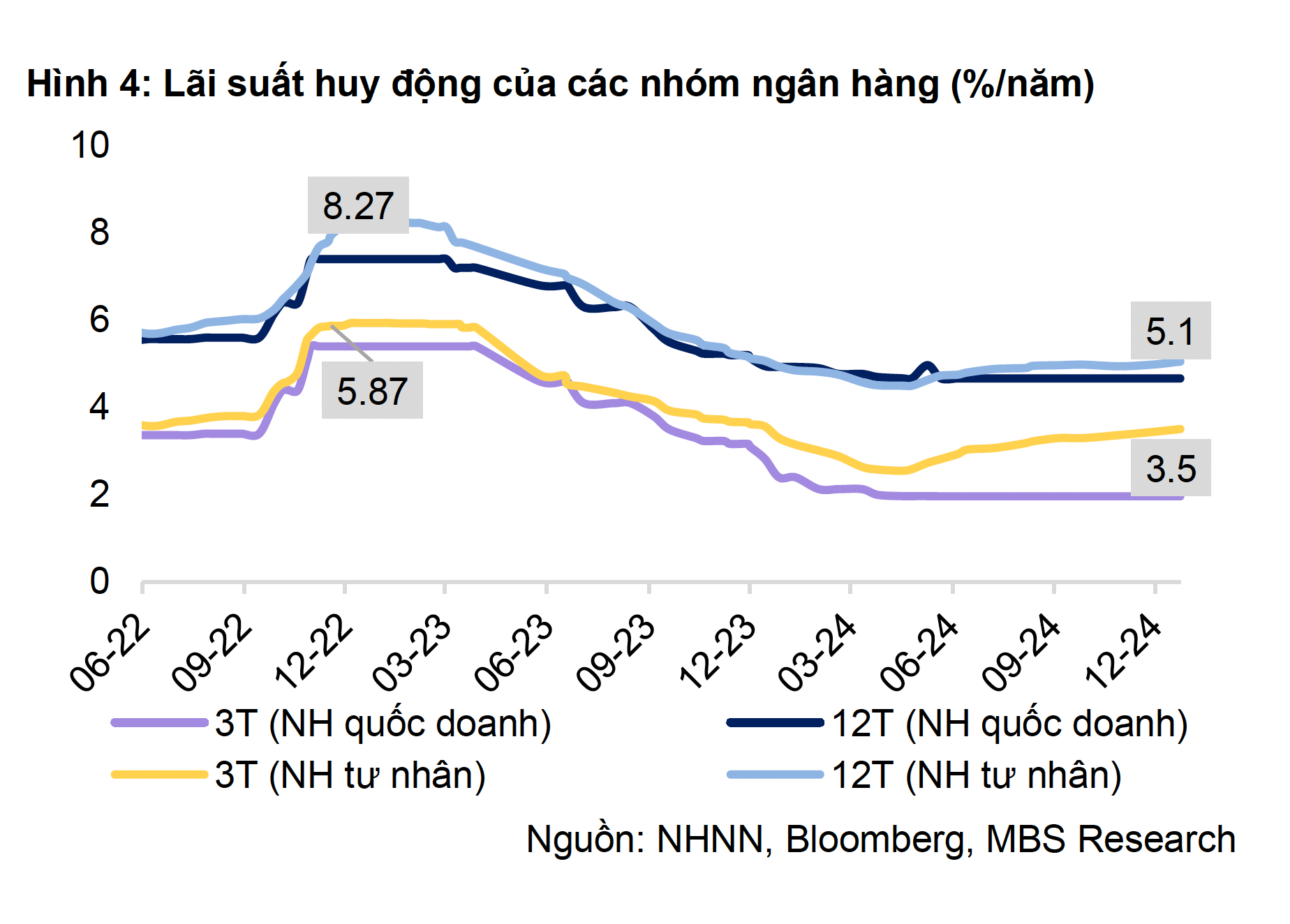
"The forecast for 12-month deposit interest rates at major commercial banks will fluctuate around 5% - 5.2% this year," Ms. Hien analyzed.
Mr. Tran Hoang Son, Director of Market Strategy at VPBank Securities Company, commented that with policies supporting growth, the State Bank of Vietnam may not immediately raise interest rates in the first six months of the year. However, in the interbank market, commercial banks have boosted lending and increased deposits; government bond yields have risen.
"The policy interest rate will increase, but most likely not in the first half of the year. If interest rates are not raised, policymakers will have to be more flexible in managing the exchange rate, allowing the VND to fluctuate within a larger range," Mr. Son analyzed.
Conversely, in the context of strong economic growth and macroeconomic stability, which are highly valued by foreign investors, FDI growth of 9.4% in 2024, corresponding to disbursements of US$25.3 billion, shows that foreign investors still favor Vietnam. Therefore, the impact of exchange rates on the Vietnamese economy in 2025 will still exist, but not as strong as in 2024.
Source: https://nld.com.vn/du-bao-moi-nhat-ve-lai-suat-gia-usd-sau-tet-196250201180238746.htm
![[Image] Pleasant weather helps students enter the 10th grade entrance exam with confidence.](https://vphoto.vietnam.vn/thumb/1200x675/vietnam/resource/IMAGE/2026/05/29/1780034401612_ngay-1-thi-lop-10-minh-duy-8-5009-jpg.webp)




![[Photo] Ba Lang An Lighthouse - the "eye of the sea" amidst the "rock museum" of Quang Ngai province.](https://vphoto.vietnam.vn/thumb/1200x675/vietnam/resource/IMAGE/2026/05/29/1780038698840_anh-man-hinh-2026-05-29-luc-14-10-42.png)









































































Comment (0)