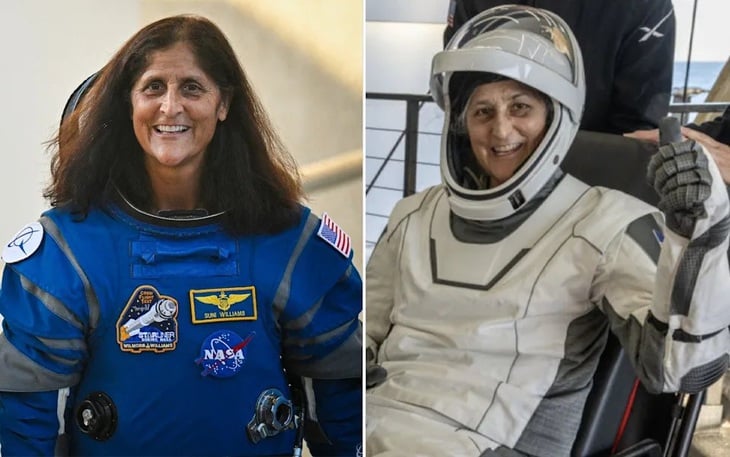
Astronaut Sunita "Suni" Williams before (left) and after her 9-month space journey - Photo: YAHOO NEWS
Researchers at the University of California (USA) have sent stem cells to the International Space Station (ISS) to examine the effects of low gravity, according to The Telegraph on September 5th.
Within two months, these cells lose some of their ability to generate new, healthy cells, their DNA becomes more vulnerable, and the protective layer at the ends of chromosomes shortens—all signs of accelerated aging.
Stem cells age faster.
The research team discovered that the journey triggered a series of changes in hematopoietic stem cells, very similar to what happens to these cells as humans age. Their ability to create new, healthy cells declined. The cells also showed signs of inflammation and stress in the mitochondria – a response that can impair immune function and increase the risk of disease.
Space travel received a lot of attention in 2025 when NASA astronauts Barry "Butch" Wilmore and Sunita "Suni" Williams returned to Earth after nine months in space and looked much older than when they left.
"Space is an extreme stress test for the human body. These findings are important because they show that stressors in space, such as microgravity and cosmic radiation, can accelerate the molecular aging of hematopoietic stem cells," said Dr. Catriona Jamieson, professor of medicine at the University of California, San Diego School of Medicine.
This will be essential knowledge as humanity enters a new era of commercial space travel and research in low Earth orbit.
Many health risks associated with space travel.
NASA has previously warned that physical changes can become "super-fast" in orbit and cause hair to turn gray in days. Astronauts also frequently experience problems with osteoporosis and muscle weakness, as well as concerns about infertility.
In 2024, research from the University of Surrey (UK) and the European Space Agency found that microgravity affects 91% of genes, including those related to muscle function, the immune system, and inflammatory responses, with many genes being switched on/off at the wrong times of day.
Although astronauts' health will gradually recover upon their return to Earth, these persistent changes could lead to long-term effects.
Another American study also found that astronauts who travel into deep space on lunar missions are five times more likely to die from cardiovascular disease than those who only perform missions in low Earth orbit or have never left Earth.
It is noteworthy that health-related problems still occur despite astronauts receiving the best medical care.
The study was published in the journal Cell Stem Cell .
ANH THU
Source: https://tuoitre.vn/du-hanh-vu-tru-lam-tang-toc-do-lao-hoa-20250905143559355.htm



![[Photo] General Secretary and President To Lam presides over a meeting with the Central Organizing Committee.](https://vphoto.vietnam.vn/thumb/1200x675/vietnam/resource/IMAGE/2026/06/03/1780482764658_a1-bnd-4741-3342-jpg.webp)
![[Photo] Secretary of the National Assembly Party Committee, Chairman of the National Assembly presides over the meeting of the Standing Committee and Executive Committee of the National Assembly Party Committee.](https://vphoto.vietnam.vn/thumb/1200x675/vietnam/resource/IMAGE/2026/06/03/1780480353201_ndo_br_bnd-2585-jpg.webp)
![[Photo] First session of the 14th Congress of the Vietnam Trade Union](https://vphoto.vietnam.vn/thumb/1200x675/vietnam/resource/IMAGE/2026/06/03/1780465947883_ndo_br_img-3852-jpg.webp)













































![[Video] Sunset at Lap An Lagoon – Where the sun sets over the fishing nets](https://vphoto.vietnam.vn/thumb/1200x675/vietnam/resource/IMAGE/2026/05/31/1780192137701_beach-landscape-sea-water-nature-grass-745871-pxhere-com.jpeg)




































Comment (0)