


The story of Ms. Le Thi Mui is an inspiring one about someone who perseveres in pursuing her beliefs. For a long time now, her personal page name, Mui Thi Le, has become extremely familiar to a community of nearly 17,000 people passionate about gardening and pursuing the journey of caring for organic gardens made from waste.
The road is not paved with roses.
Born in 1979, living in Hanoi , with a happy family and a stable job, Ms. Le Thi Mui has always been deeply concerned about the future of the next generation and the social responsibilities that a person must fulfill.
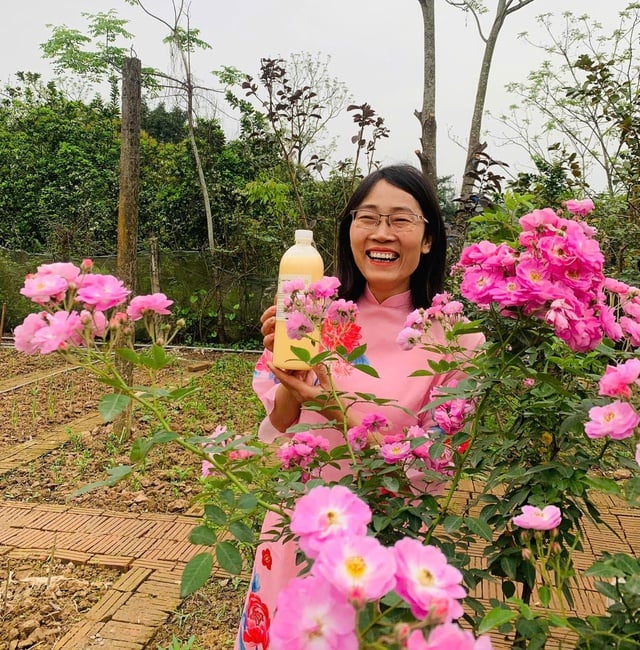
Ms. Mui with her microbial fertilizer products at Kien Vang Farm.
PHOTO: PROVIDED BY THE AUTHOR
During the social distancing period to prevent the Covid-19 pandemic, Ms. Mui grew her own organic vegetables for her family. However, buying fertilizers and nutrient-rich soil at that time was not easy, and coupled with the large amount of food and vegetable waste her family had to throw away every day, she came up with a bold idea. Having studied chemistry and biology, and not afraid to learn, she decided to research microorganisms and experiment with composting waste to make fertilizer for her plants.
The waste used for composting is organic waste, which can include leftover food, spoiled vegetables and fruits, combined with probiotics, water, and molasses. In the beginning, Ms. Mui experienced many failures, such as the cramped living environment in her city home, the odor generated during composting, and miscalculating the proportions of the mixture, resulting in the water collected after composting being used to water plants, causing them to shock and die...
Learning as she went, Ms. Mui gradually began to see the difference when applying microorganisms to composting waste. After two days of composting, the waste provided nutrients for plants, the soil gradually improved, and the leafy vegetables grew lush and green.
With the results achieved, Ms. Mui eagerly established the "Love Trash (Turning Trash into Flowers)" group on June 1, 2021, on Facebook. Thanks to her enthusiastic sharing and support, the number of members increased rapidly. Here, people share their passion for plants and work together to apply composting to grow plants, helping their families have clean vegetable gardens, fruit trees bearing abundant fruit, and vibrant flowers without using chemicals.
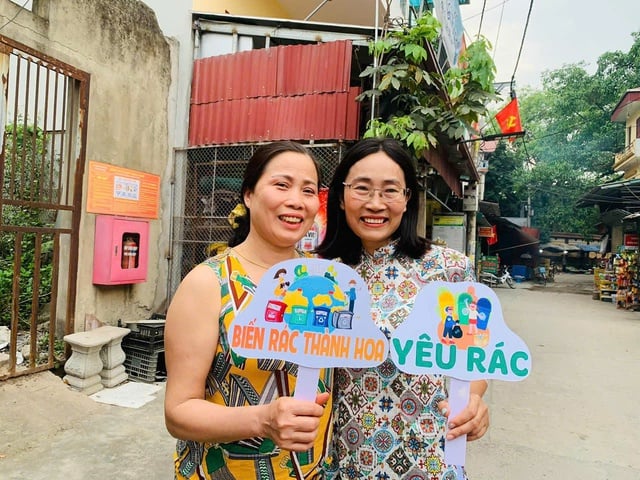
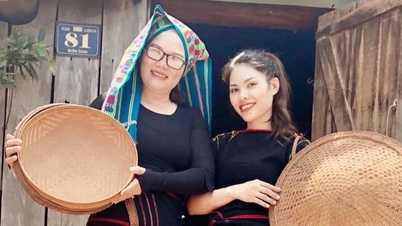
Ms. Mui (right) spreads the spirit of green living in My Duc, Hanoi.
PHOTO: PROVIDED BY THE AUTHOR
But the real challenges only began when Ms. Mui had bigger ambitions. After the Covid-19 pandemic, she realized that composting waste in the city, in small spaces with a moderate amount of waste, was enough to nourish her garden. She decided to quit her very stable government job to dedicate herself entirely to applying the microbial method to her own farm.
Ms. Mui rented a 5,000 m2 plot of land in My Duc District to establish a farm. Kien Vang Farm officially began operations with the goal of following an organic approach, applying microorganisms to livestock farming and crop cultivation, and recycling waste into fertilizer. She hired additional workers to manage the farm and applied microorganisms to address problems at Kien Vang Farm. However, the results were not as expected, and the farm was in danger of collapsing at any moment.
Around this time, her family noticed that Mui was too obsessed with "unrealistic" things, leading to a lack of common ground between her and her relatives. This was truly the most difficult period for her. There were dead ends, resentment, exhaustion, and it seemed as though she might have to give up at this point.
After sleepless nights, Ms. Mui remained confident that what she was doing was right. Regaining her spirits and reviewing the entire process, she discovered the core problem lay in the fact that the workers were still clinging to old habits and didn't believe that simply applying microorganisms thoroughly was enough. The process wasn't being implemented comprehensively, so failure was inevitable.
Finally, Ms. Mui decided to dismiss all her old staff and do everything herself, verifying the process. This can be considered one of the "historic milestones" in Ms. Mui's journey of developing her organic farm. And true to the saying, "With enough sunshine, flowers will bloom; with enough love and happiness, flowers will blossom," Kien Vang Farm has successfully applied microorganisms to its entire operation, utilizing waste materials, and using no chemical fertilizers or pesticides.
Sweet reward
Kien Vang Farm - Chemical-Free and the "Love Waste" community (Turning Waste into Flowers), with nearly 17,000 members, is the sweet fruit of Ms. Mui's efforts to date. By demonstrating the success of composting waste without odor and producing healthy plants, she has gradually attracted many others to follow suit.
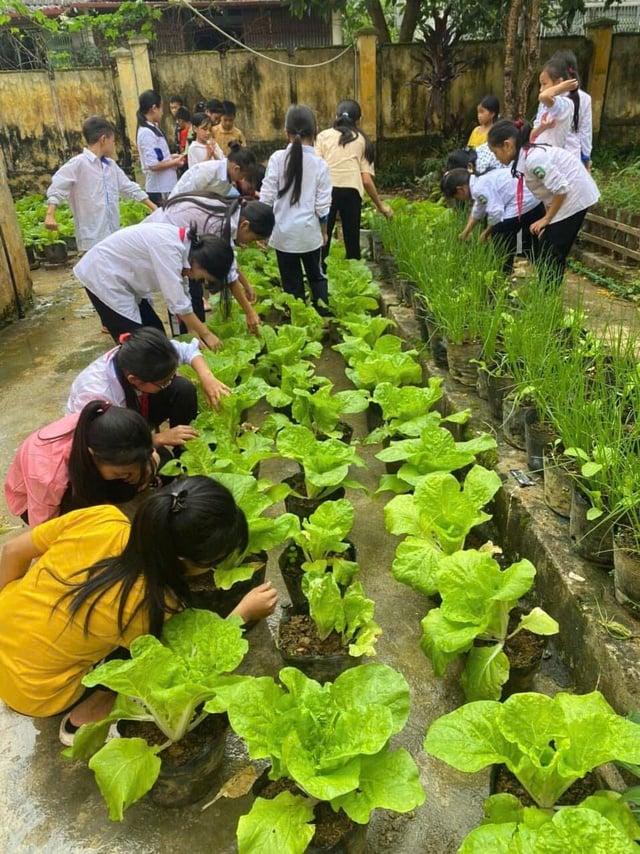
Students from the Ethnic Minority Boarding Secondary and High School in Bac Ha District ( Lao Cai Province ) participate in tending the vegetable garden.
PHOTO: PROVIDED BY THE AUTHOR
When one person achieves success, it will inspire two, three, and eventually an entire group. Ms. Mui believes that when people achieve results, experience it for themselves, and succeed, their perceptions will gradually change, and they will have more confidence in themselves. And when perceptions change, people will be ready to take concrete actions for a greener lifestyle, one that is good for their own health and the health of future generations.
Take the case of Ms. Ngo Thi Quang in Nam Tu Liem (Hanoi). Initially, she was skeptical, but when she applied it to her small family garden, it resulted in lush green plants and fertile soil. Excited to be able to grow her own clean vegetables for her children and grandchildren, she has been composting waste for five consecutive years. Her neighbor, Ms. Nguyen Thi Nhuan, came to visit and, seeing the vibrant garden and the fact that Ms. Quang's composting didn't produce any odor and that she was effectively utilizing organic waste, became enthusiastic and followed suit.
For example, Ms. Hai, who lives in Hanoi and is an active member of the "Love Trash" group (Turning Trash into Flowers), has applied composting to create a thriving 20-square-meter vegetable garden on her rooftop for her family. She also uses microorganisms to keep her chickens healthy without having to use many types of disease prevention medications.
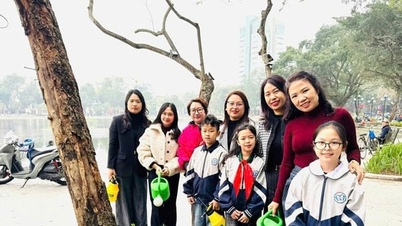
Even more noteworthy is the case of Ms. Thuy and Ms. Thao, teachers at the Bac Ha District Boarding School for Ethnic Minorities (Lao Cai province), who have applied a composting method at school to educate students about green living and encourage them to care for the vegetable garden together, improving their daily meals. They shared their pride and the meaningfulness of their work when they saw the lush green vegetable garden at school, and the students' self-awareness in caring for the plants and protecting the environment.
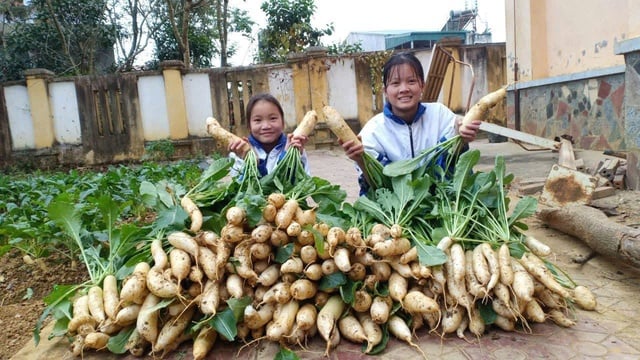
Students at the Bac Ha District Boarding School for Ethnic Minorities (Lao Cai province) are delighted with their achievements.
PHOTO: PROVIDED BY THE AUTHOR
Tay Mo Secondary School (Nam Tu Liem District, Hanoi) also applies composting to produce fertilizer for 100% of the school's green spaces. Through this, students put lessons from textbooks and environmental protection awareness campaigns into practice.
Then, many, many members of the "waste-loving" community, both domestically and internationally, successfully adopted and spread the model. Ms. Le Thi Mui doesn't count how many people she has replicated or spread the model to; she simply believes it's something she needs to do and should do. A sense of responsibility towards her own life, the lives of those around her, or more broadly, social responsibility, is a natural part of every human being. Therefore, she doesn't calculate what she has accomplished or set grand goals.
Every step Mui takes is a small step towards making the place where she lives and the people she shares with greener and healthier.
Source: https://thanhnien.vn/du-kien-tri-rac-se-no-hoa-18525052319275785.htm
![[Photo] General Secretary To Lam attends the opening session of the Peace Council on Gaza.](https://vphoto.vietnam.vn/thumb/1200x675/vietnam/resource/IMAGE/2026/02/19/1771516865192_tbttolam5-jpg.webp)






















































Comment (0)