

Find the value of coffee beans.
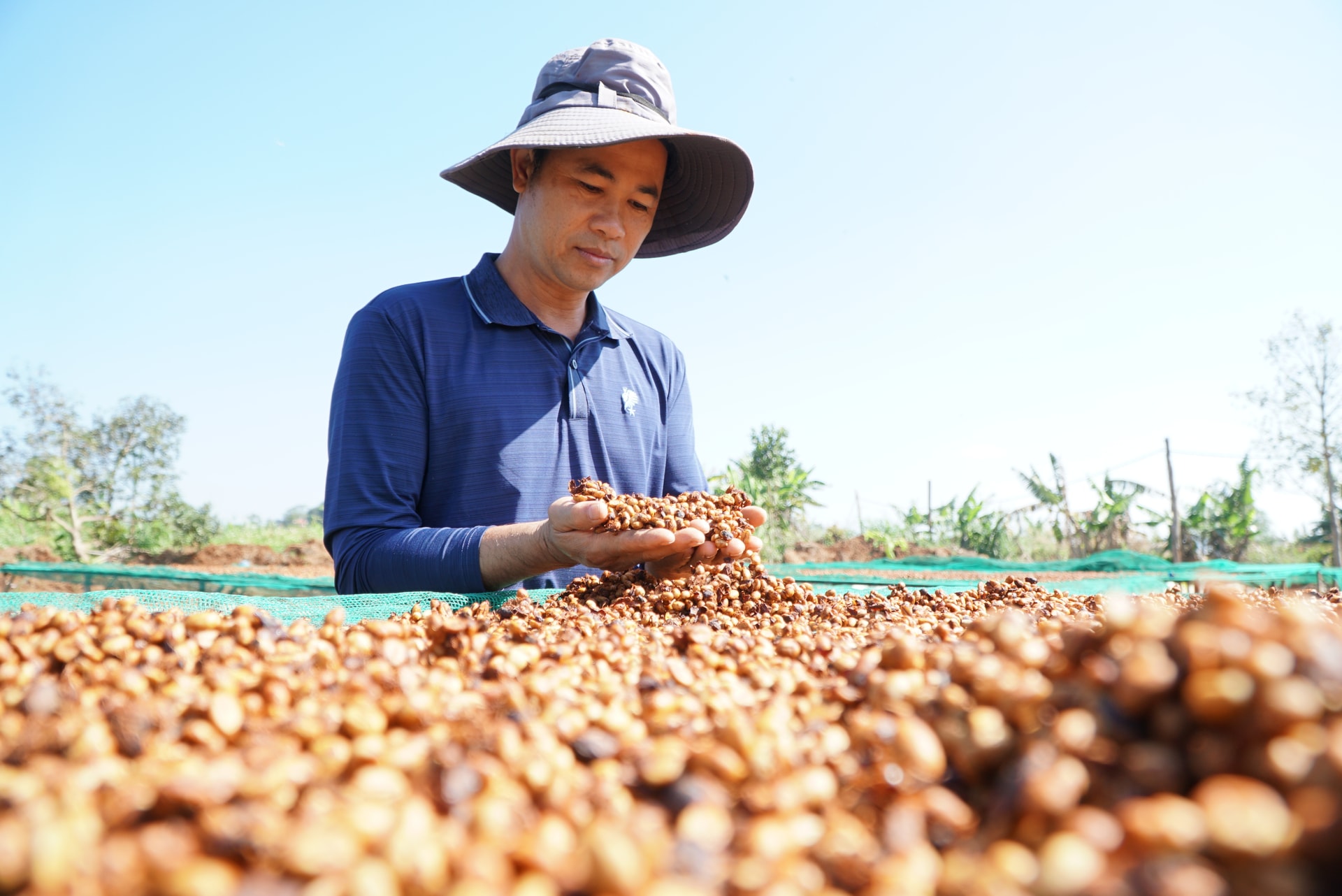
With the sun directly overhead on the drying yard, Mr. Vo Dinh Danh, from Duc Lap commune, bent down, picked up a handful of coffee beans from the drying rack, brought them to his nose, took a deep sniff, and remained silent for a few seconds, as if to ensure that this batch of dried coffee beans was of the best quality.
Mr. Danh, nearly 50 years old, was born and raised in Duc Lap commune, a region in the Central Highlands where coffee cultivation began very early. In 2012, when coffee prices plummeted, Mr. Danh began exploring sustainable development strategies for coffee farming. He participated in coffee development workshops organized by the province. There, he first heard about high-quality coffee and specialty coffee, concepts that were then very unfamiliar to most farmers.
Returning from the workshop, he lacked resources and specific guidance. Information about specialty coffee was scarce at the time. He had to figure things out and experiment on his own. He started with very small batches of ripe coffee beans, processing them experimentally in various ways. In the first harvest, after much effort and numerous failed attempts, he only obtained 70 kg of finished coffee.
He brought the coffee beans down to Ho Chi Minh City, seeking out experts to roast, grind, and taste them with him. For him, those first tasting sessions were not simply about checking the quality, but the first time he seriously confronted the product he had created.
For three consecutive years, Mr. Danh lived and breathed coffee, experimenting with hundreds of processing methods through trial and error. From replanting new varieties and caring for the plantations to determining harvesting times, processing, drying, and storage methods, he meticulously refined his techniques, introduced his product to the market, and gained acceptance. Only after perfecting his methods, introducing his product, and gaining market acceptance did he consider increasing production.
Develop processes that are "easy for farmers to follow".
To establish a sufficiently large raw material area, in 2013, Mr. Danh founded the Dak Mil Agricultural and Forestry Cooperative. The cooperative brings together coffee producers in the area to jointly produce high-quality coffee. Mr. Danh directly trains and transfers the production processes he has researched and tested to the members. These processes begin with the selection of coffee varieties, how to care for the plantations, harvesting ripe coffee beans, and processing, drying on mesh racks, and proper storage techniques, all aimed at creating a high-quality, consistent product.
The cooperative members apply organic farming practices: allowing grass to grow naturally, only weeding after fertilizing, and maintaining the grass cover to retain moisture and prevent soil erosion. Once the process is established, the cooperative organizes coffee tasting classes so that each member can self-assess their entire production process. This helps them understand their current level and identify areas for adjustment to produce high-quality coffee beans.
By 2017, the cooperative had become deeply involved in the high-end coffee production chain. Each year, the cooperative produces approximately 40 tons of high-quality specialty coffee. The purchase price of green coffee beans has increased by 30-40% compared to market prices. Lam Dong currently has about 328,000 hectares of coffee plantations, with a projected production of approximately 1 million tons for the 2025-2026 crop year. Over 98% of exported production is unroasted green coffee beans. However, the practice of harvesting unripe beans to meet production targets or due to seasonal labor shortages remains common, reducing the value of the coffee beans. This is a major obstacle preventing Lam Dong coffee from reaching the specialty segment, where value is determined by quality and brand. In this context, the approach of the Dak Mil Agricultural and Forestry Cooperative is suggesting a sustainable and effective path, gradually entering the high-end segment.
Source: https://baolamdong.vn/dua-ca-phe-lam-dong-vao-phan-khuc-cao-cap-417756.html



![[Video] Sunset at Lap An Lagoon – Where the sun sets over the fishing nets](https://vphoto.vietnam.vn/thumb/1200x675/vietnam/resource/IMAGE/2026/05/31/1780192137701_beach-landscape-sea-water-nature-grass-745871-pxhere-com.jpeg)















![[Video] Sunset at Lap An Lagoon – Where the sun sets over the fishing nets](https://vphoto.vietnam.vn/thumb/800x450/vietnam/resource/IMAGE/2026/05/31/1780192137701_beach-landscape-sea-water-nature-grass-745871-pxhere-com.jpeg)









































![[Video] Sunset at Lap An Lagoon – Where the sun sets over the fishing nets](https://vphoto.vietnam.vn/thumb/402x226/vietnam/resource/IMAGE/2026/05/31/1780192137701_beach-landscape-sea-water-nature-grass-745871-pxhere-com.jpeg)



























Comment (0)