An unavoidable mission
Ms. Ngoc Mai, a supermarket cashier, has a son in the 6th grade at NVL Secondary School (Binh Phu Ward, Ho Chi Minh City). Since the beginning of the 2025-2026 school year, her son has been dismissed at 3:30 PM. After the parent-teacher meeting on September 14th, the school announced a new dismissal time, effective from September 15th, of 4:15 PM. “Previously, to make it easier to pick up my son, I registered for a shift from 4 PM to 11 PM every day. He would arrive home just in time for my shift. Now that the school has adjusted the dismissal time to be 45 minutes later, I can’t pick him up on time. I have to ask his father to pick him up, but sometimes he forgets, causing constant arguments between us,” Ms. Mai said, shaking her head in frustration.
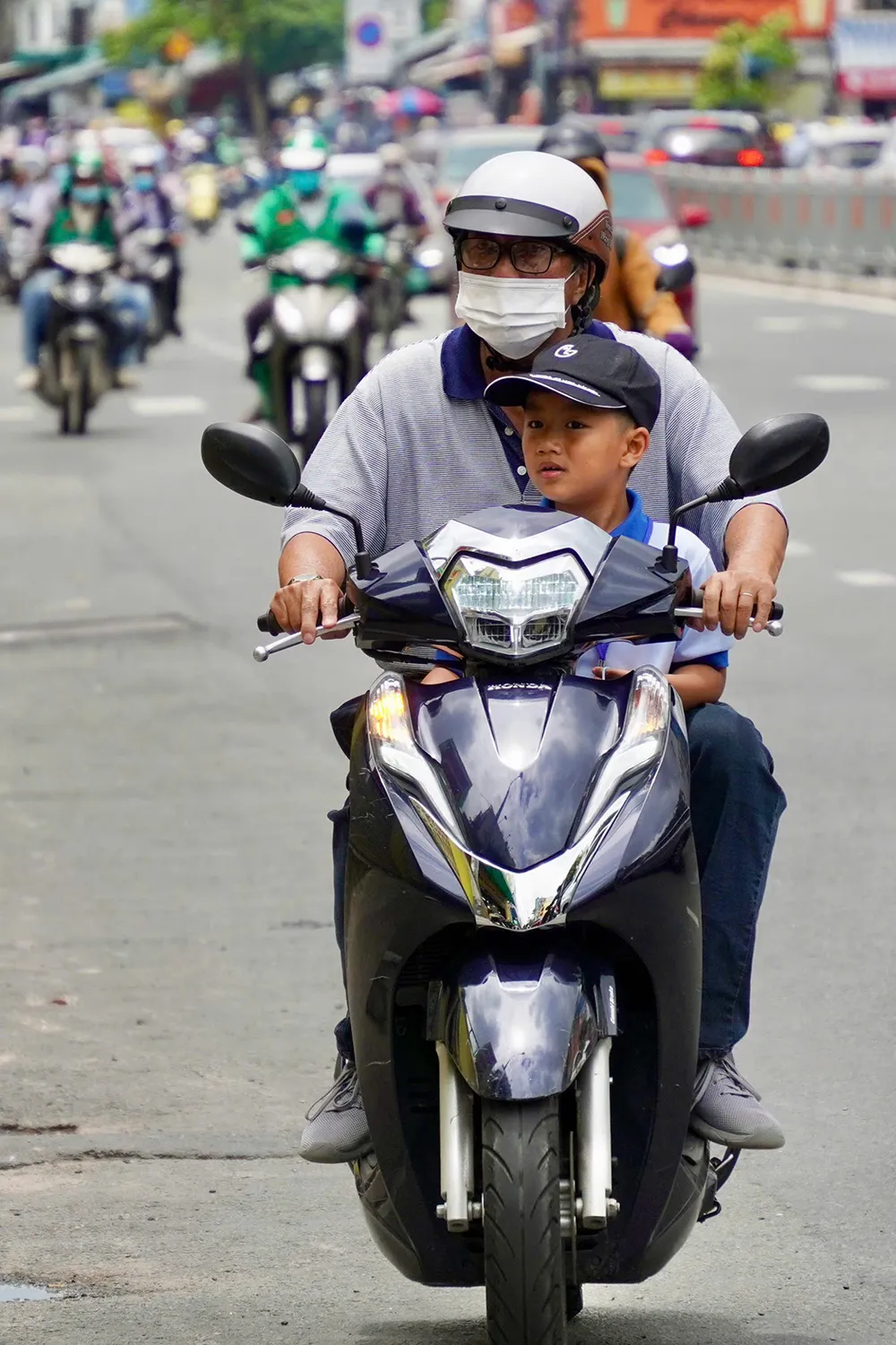
Taking children to school is a joy for parents. Photo: HOANG HUNG
Sharing a similar predicament, Mr. Minh Long, a parent whose child just started first grade at PVT Primary School (Cau Ong Lanh Ward, Ho Chi Minh City), said that after the school adjusted the dismissal time, every afternoon he and his wife would frantically call each other to see who would pick up their child, because the dismissal time was 15 minutes later than before. If they picked up their child and then returned to work, their shift would be over by the end of the workday. Conversely, if they took their child home immediately, they couldn't always request to leave work early. On days when both parents were busy with work, they would ask grandparents to pick up their child from school, but either parent had to text the name of the person picking up the child to the homeroom teacher. Only after the homeroom teacher confirmed the information could the grandparents and child leave the school. On rainy days or when one of the parties involved (grandparents, parents, homeroom teacher) couldn't be reached, the whole family would be in chaos.
In particular, the family of Mr. Duc Hung and Ms. Minh Tam (Thanh My Tay ward, Ho Chi Minh City) experienced a "cold war" after the announcement of a change in their 4th-grade son's timetable. The reason was that at the beginning of the school year, their son finished school at 3:40 PM. After the Ho Chi Minh City Department of Education and Training instructed schools not to finish earlier than 4 PM, the school sent a letter requesting parents to choose one of two options: students could read books in a self-managed library (free of charge) or register for extracurricular clubs in English, sports , or art (fees apply). Knowing her son's energetic nature, Ms. Minh Tam wanted to register him for the English club, both to help him "kill" time in a beneficial way and to have a teacher supervise him while waiting for his parents to pick him up. Conversely, Mr. Duc Hung wanted his son to develop a reading habit, while the couple would save money on after-school club fees. No one would give in to the other; the family was always like a battlefield.
Connecting the two generations emotionally.
It's safe to say that never before has the start of a school year seen such heated debates and disagreements over children's school drop-offs and after-school activities as this year. Besides arranging work schedules and dividing responsibilities for transporting children to and from school, parents must also agree on their children's educational philosophy, reflected in elective courses or after-school activities. This requires listening and sharing among family members. If parents cannot find common ground, the children will suffer the most, facing various potential problems such as: adults shirking the responsibility of drop-off and pick-up, children having to wait long at the school gate due to busy parents, and children being forced into after-school activities that don't suit their interests because the family can't arrange transportation.
Furthermore, because the dismissal time for primary and secondary schools this academic year has been adjusted to be later than in previous years, many schools have also delayed their morning classes by 15-20 minutes. According to the authorities, this adjustment aims to give students and their families more time to rest and have breakfast, avoiding having to leave home for school too early. Although the increase in "family time together" may not be significant, it is considered a valuable opportunity for parents and children to spend more time talking, bridging the gap, and strengthening quality family connections.
According to Ms. Dao Thi Ngoc Mai, a psychology expert and lecturer at RMIT University (Australia), the short 30 minutes parents spend driving their children to school can become quality time if parents and children openly share their thoughts and feelings with each other. This allows both sides to understand each other's needs and emotions. This habit will create a strong bond between family members, fostering emotional security, improving mental health, and reducing the risk of anxiety and depression.
MINH TRANG
Source: https://www.sggp.org.vn/dua-don-con-di-hoc-kheo-thu-xep-gan-ket-gia-dinh-post813983.html






























![[Photo] Reception to welcome General Secretary and President To Lam and his wife on their State visit to the Philippines](https://vphoto.vietnam.vn/thumb/1200x675/vietnam/resource/IMAGE/2026/06/01/1780295488620_vna-potal-chieu-dai-chao-mung-tong-bi-thu-chu-tich-nuoc-to-lam-va-phu-nhan-tham-cap-nha-nuoc-toi-philippines-8798060-7855-jpg.webp)



































































Comment (0)