


Education creates human capital.
Photo: NT
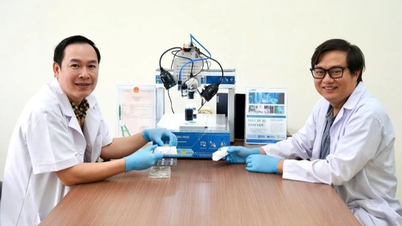
That is one of the takeaways from reading "Vietnam's Economic Leap Forward – Enhancing Productivity, Innovation, and the Path to Becoming a High-Income Country" (Industry and Trade Publishing House, Hanoi , 2026) by Dr. Dinh Truong Hinh and Professor-Doctor Nguyen Trong Hoai .
Vietnam has come a long way from a poor country to a middle-income country. But the remaining journey to becoming a high-income country may be more difficult than all that has been covered so far. This is also the central question posed in the book "Vietnam's Economic Leap Forward - Enhancing Productivity, Innovation, and the Path to Becoming a High-Income Country" by Dr. Dinh Truong Hinh and Professor Nguyen Trong Hoai.
According to the data cited in the book, in 2024, Vietnam's per capita income, using the World Bank's Atlas methodology, will reach approximately US$4,180, while the current threshold for being classified as a high-income country is US$14,005. This means we have only covered about one-third of the journey. The question is not just about whether growth is fast or slow, but about what the growth is based on.
New productivity is the key.
One of the book's most important arguments is that Vietnam is unlikely to become a high-income country if it continues to rely primarily on expanding investment and labor.
The authors point out that the contribution of total factor productivity (TFP), a factor reflecting technological level, management quality, and resource efficiency, is low and unstable. A thought-provoking observation is that if Vietnam's TFP in recent decades had reached the average level of emerging economies, its current per capita income could be about 30% higher than it actually is. That's a telling figure. It shows that the middle-income trap, ultimately, is a productivity trap.
A country can experience rapid growth for a period thanks to investment capital, resources, or cheap labor. But to become a high-income country, growth must be based on productivity, technology, and innovation.
From "Made in Vietnam" to "Created in Vietnam"
The book devotes a significant portion to analyzing industrialization and Vietnam's position in the global value chain.
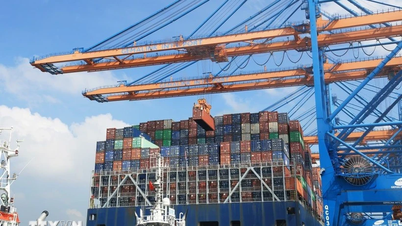
Over the past two decades, Vietnam has become an important manufacturing hub for the world. Textile and garment exports increased by an average of approximately 16.6% per year between 2000 and 2020; the manufacturing sector grew by over 15% per year. However, the proportion of value added retained domestically has not increased proportionally. This paradox reflects the reality that Vietnam is increasingly involved in global supply chains but remains primarily in low value-added stages.
Therefore, the overarching message of the book is that Vietnam needs to shift from "Made in Vietnam" to "Created in Vietnam." This is not just about artificial intelligence (AI), semiconductors, or high technology. For a developing economy, innovation is primarily about the ability to absorb, adapt, improve, and upgrade technology; it is the capacity to learn in order to create more value from the same amount of resources. This is also the path that Japan, South Korea, Taiwan, and Singapore have taken.
From this perspective, it is noteworthy that although the book was completed in 2024, many of the authors' analyses and recommendations are "strongly linked" to major policies recently issued by Vietnam, such as Resolution 57 on national science, technology, innovation and digital transformation, or Resolution 68 on the development of the private economy.
However, international experience shows that the biggest challenge often doesn't lie in defining the right strategy. The more difficult task is building an institutional environment conducive enough for businesses to make long-term investments in research, technology, and innovation.

A nation can move quickly with capital and technology, but it can only go far with its people.
Photo: NT
Ultimately, we are all human beings.
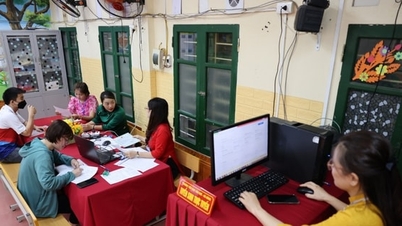
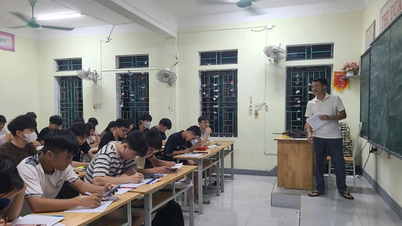
What struck me most was that the authors devoted more than a third of the book to human capital. From education, the labor market, reverse migration, population aging to the role of women workers. This is not a secondary part of the book; on the contrary, it is perhaps the most insightful section.
For many years, we have often viewed education as a social policy. But from the perspective of this book, education is first and foremost a development policy. Education creates human capital. Human capital enhances productivity. Productivity determines the ability to overcome the middle-income trap.
The figures presented are quite thought-provoking. In 2020, only about 11.1% of Vietnam's workforce had a university degree or higher, while approximately 76% lacked specialized technical training. In 2021, Vietnam had only about 55 STEM (science, technology, engineering, and mathematics) students per 10,000 people, significantly lower than many developed countries.
More notably, although the number of international scientific publications from universities has increased rapidly, reaching approximately 17,625 papers in 2021, the rate of patent registrations from higher education institutions is only about 15.5%. The gap between research and technology commercialization remains quite large.
The book dedicates an entire chapter to "reverse migration," demonstrating that the authors view human resources not only within the national context but also within the global Vietnamese knowledge network.
If Resolution 68 positioned private enterprises as the driving force for growth, and Resolution 57 considered science and technology a strategic breakthrough, then Resolution 71 on education and training is the foundation for realizing those goals. Because businesses need human resources; innovation needs knowledge; technology needs research; and all of these converge in education and higher education.

The book "Vietnam's Economic Leap Forward - Enhancing Productivity, Innovation, and the Path to Becoming a High-Income Country" by Dr. Dinh Truong Hinh and Professor-Doctor Nguyen Trong Hoai
Photo: PTB
There are no shortcuts.
The most valuable aspect of Vietnam's Economic Leap Forward—Enhancing Productivity, Innovation, and the Path to High-Income Status— is not that it raises entirely new issues, but rather that it connects productivity, innovation, private enterprise, education, and human capital into a unified development logic. Of course, not all solutions are easy to implement. Vietnam does not lack sound strategies. The greater challenge lies in consistent and sufficiently long-term implementation.
But that's precisely why the book is worth reading. It doesn't promise shortcuts. It reminds us that to achieve an economic leap, we must have a leap in productivity; to achieve a leap in productivity, we must have a leap in knowledge. And to achieve a leap in knowledge, Vietnam must start with its people, with education, and with a university system strong enough to become the driving force of national innovation and development.
A nation can progress quickly with capital and technology, but it can only go far with its people.
Source: https://thanhnien.vn/duong-den-quoc-gia-thu-nhap-cao-cuoi-cung-van-la-con-nguoi-18526060311263215.htm
![[Photo] First session of the 14th Congress of the Vietnam Trade Union](https://vphoto.vietnam.vn/thumb/1200x675/vietnam/resource/IMAGE/2026/06/03/1780465947883_ndo_br_img-3852-jpg.webp)
![[Photo] General Secretary and President To Lam presides over a meeting with the Central Organizing Committee.](https://vphoto.vietnam.vn/thumb/1200x675/vietnam/resource/IMAGE/2026/06/03/1780482764658_a1-bnd-4741-3342-jpg.webp)

![[Photo] Secretary of the National Assembly Party Committee, Chairman of the National Assembly presides over the meeting of the Standing Committee and Executive Committee of the National Assembly Party Committee.](https://vphoto.vietnam.vn/thumb/1200x675/vietnam/resource/IMAGE/2026/06/03/1780480353201_ndo_br_bnd-2585-jpg.webp)






















































![[Video] Sunset at Lap An Lagoon – Where the sun sets over the fishing nets](https://vphoto.vietnam.vn/thumb/1200x675/vietnam/resource/IMAGE/2026/05/31/1780192137701_beach-landscape-sea-water-nature-grass-745871-pxhere-com.jpeg)


































Comment (0)