

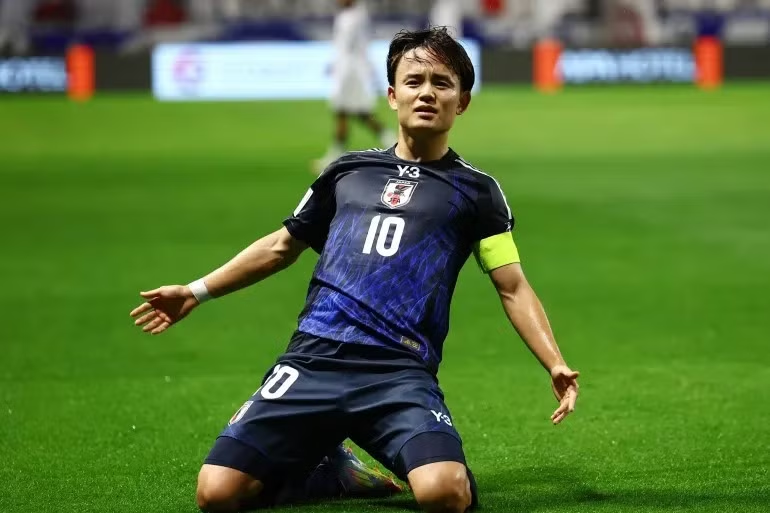
Japan national team profile
| Criteria | Detailed information |
| Position on the FIFA rankings | 18 |
| Affiliated federation | AFC |
| Head Coach | Hajime Moriyasu |
| Captain | Wataru Endo |
| Number of World Cup appearances | 8 times |
| Best achievement | Round of 16 (2002, 2010, 2018, 2022) |
| Recent World Cup performance | Round of 16 |
| How to qualify for the finals | Qualified through the Asian regional qualifiers. |
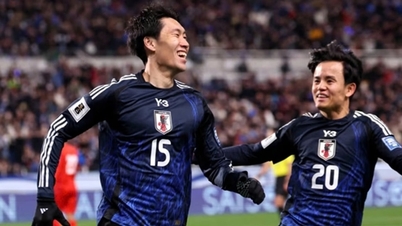
| Notable star | Wataru Endo, Takefusa Kubo |
| Realistic goals for the 2026 World Cup | Quarterfinals |
The journey to qualify for the 2026 World Cup.
Japan's path to the biggest football event on the planet in 2026 has been marked by absolute dominance in the Asian region. Following their impressive performance at the 2022 World Cup, coach Hajime Moriyasu has once again been entrusted with the responsibility of steering the Samurai Blue, and he has not disappointed the fans.

Throughout the qualifying rounds, Japan displayed a devastating performance with a series of consecutive wins, scoring numerous goals and keeping clean sheets for most of the time. Their consistency and superior class allowed them to easily crush their opponents in the group, thus securing their official ticket to North America early on without any significant obstacles.
Japanese style of play
Under the guidance of coach Hajime Moriyasu, Japan's playing style is a perfect blend of discipline, skillful individual technique, and lightning-fast transitions. Their tactical system is extremely flexible, frequently switching between a 4-2-3-1 and a 3-4-2-1 variant depending on the opponent on the field.
Japan's attacking play begins with solidity in the back line, flowing through the calm, ball-distributing feet of captain Wataru Endo in the midfield. Speed and unpredictability come from the flanks, where dribbling specialists like Doan and Kubo constantly tear apart opposing defenses with their superior technique.
In particular, the Blue Samurai possess an incredibly synchronized high-pressure pressing ability and sharp, highly effective counter-attacks as soon as they regain possession of the ball.
Notable star
- Wataru Endo: The quiet captain, but an irreplaceable link in the team. Although not frequently used at Liverpool, this midfielder remains a crucial choice for the national team. Endo brings composure, excellent interception skills, and superb vision in controlling the tempo of the game, acting as a solid shield for the defense.
- Hiroki Ito: He is the new "cornerstone" of Japanese football. Ito is increasingly establishing himself at Bayern Munich. Last season, he played 26 matches and scored 1 goal, a remarkable statistic. This will be a foundation for Ito to continue developing at the 2026 World Cup.
- Takefusa Kubo: "The Japanese Messi" is soaring at Sociedad with his magical left foot. Kubo provides endless creativity, keen vision, and deadly assists in the final third of the pitch.
Japan's strengths
- A squad of highly experienced players in Europe: Almost the entire Japanese starting lineup is currently playing in the top 5 European leagues. This high-level experience has given them a strong mentality and prevents them from being overwhelmed by the big teams.
- Discipline and teamwork: The greatest strength of the Blue Samurai lies in their collective cohesion. They play with absolute adherence to tactical strategies, run tirelessly, and are always ready to cover for each other.
- The diversity of attacking options— speed on the flanks, skill in the midfield, and the ability to seize opportunities from counter-attacks—makes Japan's offense incredibly unpredictable.
Weaknesses and question marks
- The center forward dilemma: Despite possessing many excellent attacking midfielders, Japan is still struggling to find a world- class "number 9" who can hold off defenders and finish sharply in tight matches.
- Missing Mitoma: Despite possessing many players capable of penetrating the defense like Kubo, Ito, and Doan, Japan is still struggling to find someone to fill the void left by Mitoma. Mitoma was a versatile player, capable of both creating chances and scoring goals. Without him, Japan will lose a heavyweight, if not the "heaviest," weapon.
- The pressure of breaking the jinx: Four bitter exits in the Round of 16 have created a significant psychological barrier. They need a cool head to overcome the crucial moments in the knockout rounds.
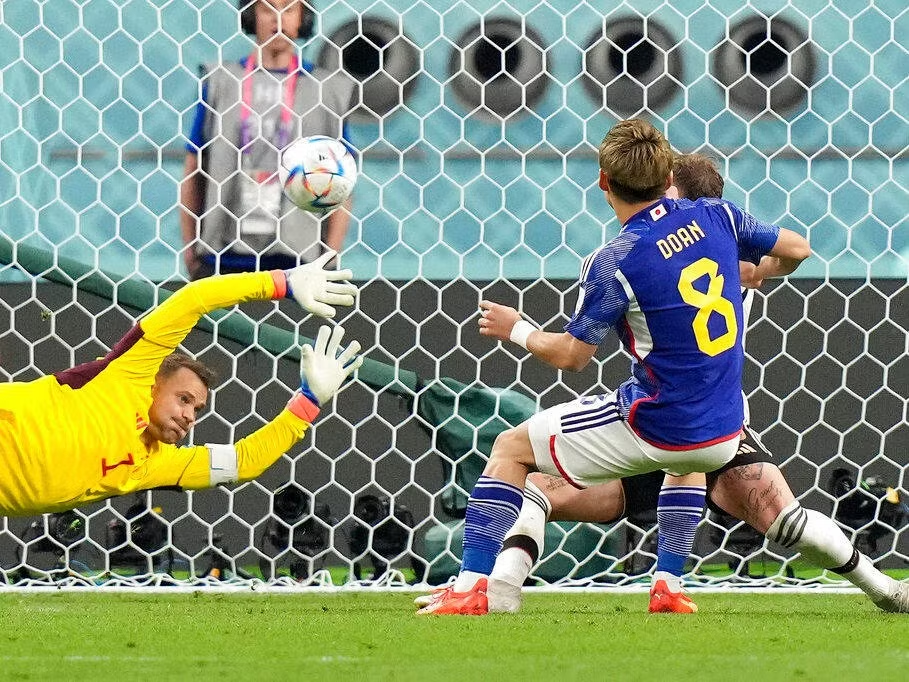
Japan's group stage schedule
- June 14, 2026: Japan vs Netherlands (Dallas Stadium)
- June 20, 2026: Tunisia vs Japan (Monterrey Stadium)
- June 25, 2026: Sweden vs Japan (Dallas Stadium)
Opportunities to advance and realistic goals
Given their current standing and well-balanced squad, advancing from the group stage is almost a mandatory task for coach Hajime Moriyasu's team. The group stage matches will be an opportunity for them to warm up and fine-tune their aim before entering the real battles.
The realistic goal and also the greatest aspiration of Japanese football at the 2026 World Cup is to reach the quarter-finals. With a squad currently at its peak, the Samurai Blue are fully capable of creating upsets and etching their names into the history of world football.
Quick prediction
Group stage performance: Finished second in the group (earned 5 points)
Final achievement at the tournament: Reached the quarterfinals.
Source: https://tienphong.vn/duong-den-world-cup-2026-cua-nhat-ban-samurai-xanh-but-pha-post1846953.tpo




![[Video] Sunset at Lap An Lagoon – Where the sun sets over the fishing nets](https://vphoto.vietnam.vn/thumb/1200x675/vietnam/resource/IMAGE/2026/05/31/1780192137701_beach-landscape-sea-water-nature-grass-745871-pxhere-com.jpeg)









![[Video] Sunset at Lap An Lagoon – Where the sun sets over the fishing nets](https://vphoto.vietnam.vn/thumb/800x450/vietnam/resource/IMAGE/2026/05/31/1780192137701_beach-landscape-sea-water-nature-grass-745871-pxhere-com.jpeg)









































![[Video] Sunset at Lap An Lagoon – Where the sun sets over the fishing nets](https://vphoto.vietnam.vn/thumb/402x226/vietnam/resource/IMAGE/2026/05/31/1780192137701_beach-landscape-sea-water-nature-grass-745871-pxhere-com.jpeg)
































Comment (0)