

It's about accepting short-term gains as a trade-off for investing in the future. Looking at it more broadly, this mindset, rooted in the "king of sports, " offers the core solution to the systemic challenges facing Vietnam's high-performance sports.
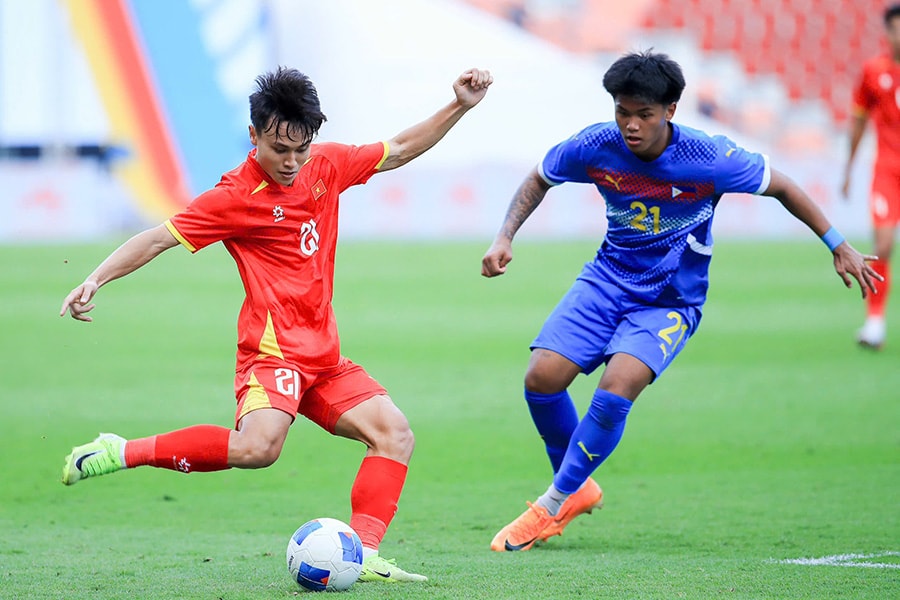
Shaping the young mind and mindset from an early age and beyond.
Instead of putting pressure on short-term results by allowing overage players to qualify, the Vietnam Football Federation (VFF) advocates against setting medal targets at the 2026 Asian Games to provide opportunities for future generations to gain experience. VFF Vice President Nguyen Xuan Vu affirmed that this is a long-term preparation aimed at two key goals: the 34th SEA Games in 2027, the 2028 U23 Asian Championship finals, and the 2028 Los Angeles Olympic qualifiers. This approach is similar to what Vietnamese football experimented with at the 19th Asian Games in Hangzhou (China), where many young talents broke through to become pillars of the national team.
In preparation for the tournament in Japan this September, the coaching staff plans to field a core group of young players such as Cao Van Binh, Le Van Thuan, Nguyen Cong Phuong, and Nguyen Le Phat, combined with the experienced U23 player Nguyen Dinh Bac. This addition is expected to provide both professional and psychological support, helping the young players quickly adapt to the tactical system being honed at the Vietnam Youth Football Training Center.
This move demonstrates a proactive approach in accepting a step back in the continent's biggest arena, where Vietnamese football still lags significantly behind in terms of skill level, in order to focus resources on building a foundation for players born from 2005 onwards. By 2028, when they enter the U23 Asian Championship finals to qualify for the Olympics, today's young team will have accumulated enough international playing hours to create a level playing field.
The decision not to prioritize performance targets at the 2026 Asian Games stems from a reality in the youth training system: the lack of "real-world" experience for players at the club level. According to data from the Vietnam Football Federation (VFF), if they don't qualify for the national finals, the journey of U17, U19, and U21 teams in the qualifying rounds is usually limited to 3 to 4 weeks with about 6 to 8 matches. With the frequency of domestic matches not high, continental tournaments become a necessary environment to compensate for the lack of real-world experience. This reality also changes the criteria for evaluating the capabilities of future talent. In the V.League, Dong A Thanh Hoa's decision to give opportunities to U20 and U21 players such as Le Van Thuan, Nguyen Ngoc My, Nguyen Van Tung, and Vo Nguyen Hoang... is evidence of the trend towards using young players.
From the football field to... a systems problem
The challenge of high competition intensity and the need to optimize the long-term competition system for the next generation of players is not unique to football, but a common problem for Vietnamese high-performance sports as they approach continental competition.
In athletics, a young athlete typically only has 2-3 official competition opportunities per year. Former Head of Athletics Department Duong Duc Thuy shared that primarily focusing on long periods of "training without competition" makes athletes prone to fatigue and losing their rhythm in the face of the fluctuating intensity of major competitions like the Asian Games. This model is in stark contrast to countries with strong athletics movements like Japan and South Korea, where a deeply structured network of competitions, from school to professional levels, operates year-round.
A similar situation exists in the swimming arena. The model of concentrating resources on a few outstanding swimmers for long-term overseas training, while yielding medal milestones, cannot guarantee the sustainability of the entire system. The process of selecting a successor generation with performance approaching Asian standards is inevitably interrupted when key athletes decline in form. Strong martial arts disciplines such as Taekwondo, Karate, Wushu, and Boxing also face similar pressure.
Meanwhile, the operational model of Vietnamese women's volleyball offers practical suggestions. The breakthrough in the national team's standing is linked to an increased frequency of international competitions through continuous tournaments from regional to world levels such as: AVC Challenge Cup, SEA V.League, FIVB Challenger Cup...
Accepting the participation of the U21 core team in the 2026 ASIAD or increasing the frequency of international competitions for volleyball are signals of a shift in the long-term planning mindset of Vietnamese sports. However, sending nineteen or twenty-year-old players to a demanding continental tournament also carries risks.
Therefore, the "nurturing" mindset will only be effective if the VFF has a comprehensive investment plan after the tournament, from nutrition and medical care to increasing the frequency of players' appearances in the domestic professional environment. And above all, patience from fans is needed in light of the initial experimental results at ASIAD 2026.
Source: https://hanoimoi.vn/dua-cau-thu-u21-du-asiad-2026-buoc-thu-nghiem-tu-duy-the-thao-dai-han-976400.html


![[Photo] Admire the coral "masterpiece" amidst the million-year-old heritage of Dak Lak province.](https://vphoto.vietnam.vn/thumb/1200x675/vietnam/resource/IMAGE/2026/05/31/1780221235105_anh-man-hinh-2026-05-31-luc-16-53-27.png)
![[Photo] Solemn bathing ceremony and Buddha procession in Hue](https://vphoto.vietnam.vn/thumb/1200x675/vietnam/resource/IMAGE/2026/05/31/1780228263543_1-jpg.webp)
![[Photo] The General Secretary, President and his wife begin their state visit to the Philippines.](https://vphoto.vietnam.vn/thumb/1200x675/vietnam/resource/IMAGE/2026/05/31/1780230559452_anh-man-hinh-2026-05-31-luc-19-28-11.png)











![[Video] Sunset at Lap An Lagoon – Where the sun sets over the fishing nets](https://vphoto.vietnam.vn/thumb/340x192/vietnam/resource/IMAGE/2026/05/31/1780192137701_beach-landscape-sea-water-nature-grass-745871-pxhere-com.jpeg)





































![[Photo] Admire the coral "masterpiece" amidst the million-year-old heritage of Dak Lak province.](https://vphoto.vietnam.vn/thumb/402x226/vietnam/resource/IMAGE/2026/05/31/1780221235105_anh-man-hinh-2026-05-31-luc-16-53-27.png)



































Comment (0)